

What if the "lazy" label you've carried for years isn't a character flaw, but a functional difference in how your brain processes the world? You know the weight of "ADHD paralysis." It's that heavy, frozen feeling when you have ten things to do but can't start even one. It's exhausting. It's real. Using an ADHD self-check tool online provides a way to stop guessing and start understanding. It's a bridge between your internal struggle and the clarity you've been seeking.
We believe your experience deserves validation, not judgment. This guide will show you how to use screening tools to move from confusion to a concrete plan of action. You'll learn how to document your symptoms so you can walk into a doctor's office with confidence. Beyond the data, we'll provide immediate, practical strategies to help you manage your executive function and daily tasks. We're here to help you find a map for your unique brain, turning a source of shame into a source of self-advocacy. Your journey toward clarity starts with a single, manageable step.
Key Takeaways
- Learn to distinguish between "laziness" and executive dysfunction by understanding the specific neurological patterns behind your daily challenges.
- Discover how an ADHD self-check tool online serves as a vital screening instrument to bridge the gap between confusion and a professional assessment.
- Gain clarity on your results by breaking down the two main symptom domains and seeing how they manifest in your personal and professional life.
- Prepare for a formal diagnosis with a concrete strategy for gathering childhood history and "collateral evidence" to share with your healthcare provider.
- Access immediate management tools, such as ADHD-specific timers and simulations, designed to help you navigate neurodivergent brain fog and task paralysis.
Why You Are Searching for an ADHD Self-Check Tool Online
You likely arrived here because the "try harder" method has stopped working. For years, you might have felt like you were running a race with your shoelaces tied together. People call it procrastination. You might even call it laziness. But deep down, you know it feels different. It's a physical wall between your intentions and your actions. Searching for an ADHD self-check tool online is often the first moment you allow yourself to ask: "What if there is a reason for this?" It is the beginning of moving from a place of constant, exhausting confusion toward a life built on functional understanding.
The Difference Between Screening and Diagnosis
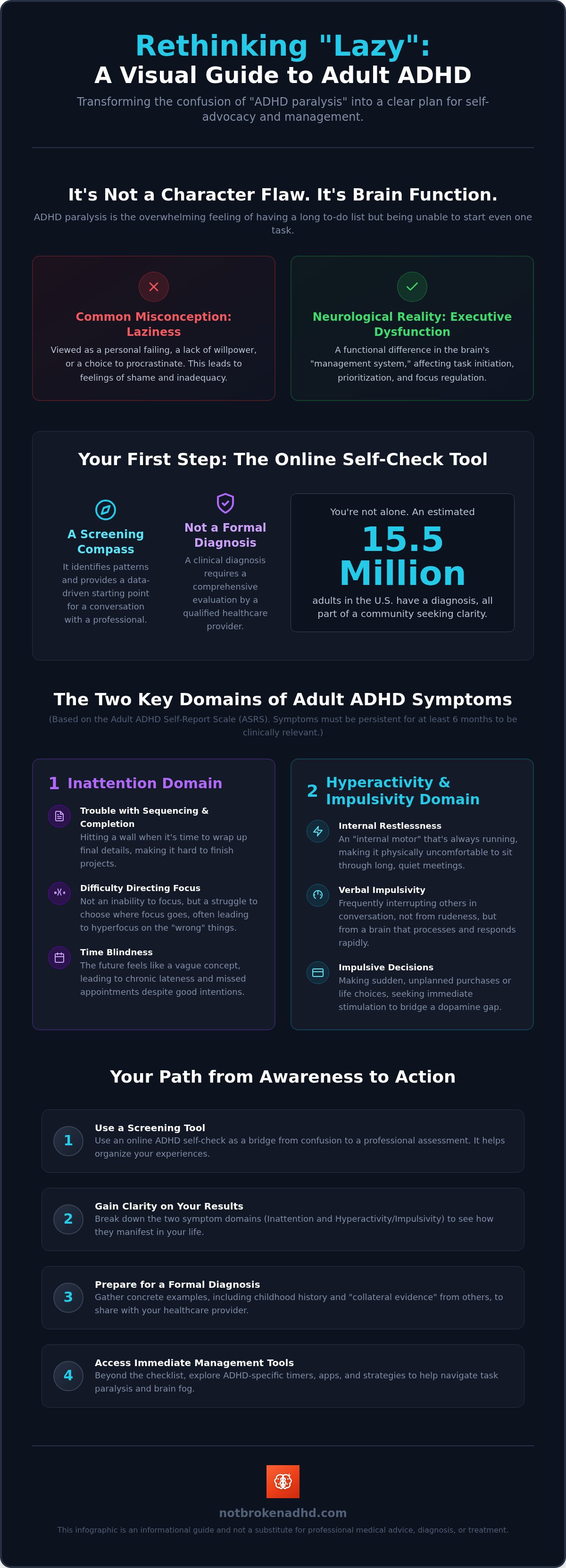
It's vital to understand that a self-check is a screening instrument, not a clinical diagnosis. Think of it as a compass rather than a final destination. These tools help you identify recurring patterns of Adult attention deficit hyperactivity disorder that might otherwise feel like isolated failures. While a professional assessment involves a deep dive into the DSM-5 criteria, a screener looks at your current functional challenges. It won't result in a prescription; however, it provides the data you need to speak with a professional. With roughly 15.5 million adults in the U.S. currently diagnosed, you are part of a massive community seeking this same clarity. You aren't looking for a shortcut. You're looking for an accurate map.
Dismantling the Stigma of the "ADHD Label"
Many people fear that seeking a label is just making excuses. We see it differently. Identifying ADHD is an act of radical self-advocacy. It's about reframing your history from a series of "should haves" into a logical map of functional differences. When you realize your brain is simply wired to process dopamine and focus differently, the chronic shame begins to lift. Validation is a powerful tool for your mental health. It transforms "I'm a failure" into "I have a brain that needs specific strategies." This shift doesn't lower the bar for your life; it finally gives you the right tools to reach it. Your search for an ADHD self-check tool online isn't about finding a limitation. It's about finding your manual.
Understanding the Adult ADHD Symptom Checklist
The most reliable foundation for an ADHD self-check tool online is the Adult ADHD Self-Report Scale (ASRS). Developed in conjunction with the World Health Organization, this scale is the gold standard for identifying adult symptoms. It shifts the focus away from the "disruptive child" stereotype and toward the lived, internal experience of being an adult. For these observations to be clinically relevant, the symptoms must have been persistent for at least the past 6 months. This timeframe helps distinguish between a permanent neurological trait and a temporary response to high stress or burnout. Understanding these specific criteria is a vital step in the professional ADHD diagnostic process.
The Inattention Domain: Beyond Just "Being Distracted"
Adult inattention often manifests as a specific struggle with sequencing and completion. It isn't that you can't focus; it's that you can't always choose where that focus goes. Many adults find they are highly effective during the creative or high-stakes parts of a project, but they hit a wall when it's time to wrap up the final details. This is executive dysfunction in action. It makes organizing your day feel like trying to solve a puzzle with missing pieces. You might also experience time blindness, where the future feels like a vague concept rather than a structured timeline. This leads to missed appointments or chronic lateness, despite your best intentions to be on time.
Hyperactivity and Impulsivity in Adults
Hyperactivity in adults is frequently misunderstood because it often moves from the body to the mind. Instead of physical running or climbing, you might experience an "internalized motor" that creates a constant sense of mental restlessness. This makes sitting through long, quiet meetings feel physically uncomfortable or even painful. Impulsivity also takes on new forms in adulthood. It might show up as interrupting others during conversations or making sudden, unplanned purchases. These aren't character flaws. They are reflections of a brain that seeks immediate stimulation to bridge a dopamine gap. If these descriptions resonate, using an ADHD self-check tool online can help you categorize these behaviors more clearly. To begin organizing your observations, you can find guided support through our ADHD Self-Check Tool.
How to Interpret Your Online ADHD Test Results
Seeing a "High Likelihood" result on an ADHD self-check tool online can trigger a complex mix of relief and anxiety. It validates that your internal struggle isn't a result of poor character, but a measurable neurological pattern. However, it's essential to look beyond the final score. ADHD is a spectrum, not a binary "yes or no" condition. You might find you score exceptionally high in the inattention domain while showing very few signs of hyperactivity. This doesn't make your experience less valid; it simply means your brain has a specific "flavor" of neurodivergence that requires a tailored approach to management.
Frequency vs. Impairment
You've likely heard people say, "Everyone does that," when you mention losing your phone or zoning out during a meeting. The critical difference lies in the frequency and the fallout of these events. When an online ADHD self-screening test uses terms like "Often" or "Very Often," it's looking for patterns that actively disrupt your ability to function. Everyone forgets their keys occasionally. A person with ADHD might lose them multiple times a week, leading to lost wages, late fees, or profound emotional distress. For a symptom to be clinically significant, it must create consistent friction in your work, home, or social life. Identifying where this friction is highest allows you to prioritize which areas of your life need immediate support.
Identifying Your Executive Function Profile
Your results are a window into your executive function. Executive function is the "CEO of the brain" that manages planning, focus, and emotional regulation. When this internal CEO is struggling, specific skills like working memory or task initiation falter. By looking at which questions you flagged most heavily, you can build a profile of your specific gaps. Do you struggle to start tasks even when you want to do them? That's a task initiation gap. Do you lose track of what you're doing mid-sentence? That's a working memory challenge. Understanding these nuances helps you move from generic advice to targeted strategies. Instead of trying to "just be more organized," you can look for tools that specifically support the executive function gaps identified by your ADHD self-check tool online.
Moving Forward: Preparing for a Professional ADHD Assessment
Once you have your results from an ADHD self-check tool online, the next hurdle is often the medical system. It's common to feel nervous about talking to a doctor. You might worry they'll dismiss your concerns as "just stress" or a lack of discipline. Bringing your screening results changes the dynamic. It shifts the conversation from a vague feeling of overwhelm to a documented pattern of behavior. This data acts as your opening statement, helping a GP or psychiatrist understand that your challenges are consistent, measurable, and impactful. You aren't asking for a favor; you're presenting evidence for a functional difference.
Advocacy is crucial during this process. If you encounter skepticism, stay focused on your functional impairment. A standard clinical evaluation for adults typically costs between $200 and $500, and it's a necessary step for accessing formal support. Remember that ADHD often travels with "roommates" like anxiety or depression. A professional assessment will look at these comorbid conditions to ensure you receive the right kind of care. You should also start gathering collateral evidence. Since ADHD is a developmental condition, evidence from your childhood, such as old report cards or stories from family members, provides the historical context doctors need for an accurate diagnosis.
Creating Your "Symptom Log"
A checklist is a snapshot, but a symptom log is a movie. Spend one week tracking real-world examples of the challenges you identified in your ADHD self-check tool online. If you flagged "difficulty finishing tasks," write down the specific project you abandoned and why it felt impossible to cross the finish line. This level of detail is invaluable during a clinical interview. It's also helpful to look ahead at your potential path. Reviewing our ADHD Medication Guide can help you understand the different types of support available so you feel informed when treatment options are eventually discussed. To help document your experience before your appointment, download our ADHD management tools and symptom logs.
Questions to Ask Your Doctor
Walking into an appointment with a script reduces "brain fog" and keeps you on track. Use clear, clinical language like: "I've noticed a persistent pattern of executive dysfunction that interferes with my ability to manage daily life." This tells the doctor you've done the work to understand your brain. Ask whether they perform a standard clinical interview or a more comprehensive neuropsychological evaluation. If you are using telehealth services, be aware that federal flexibilities allowing for online stimulant prescriptions are currently extended through December 31, 2026. Inquire about the timeline for the process and what specific diagnostic tools they use. Being proactive ensures you are a partner in your own care rather than just a passive observer.
Beyond the Checklist: Tools to Manage Your Neurodivergent Mind
Completing an ADHD self-check tool online is a significant milestone, but it is only the beginning of your journey. Knowing the name for your struggle provides relief; however, management is what provides freedom. Moving from a state of "knowing" to "managing" requires a shift in how you view your daily obstacles. Instead of fighting against your brain’s natural rhythm, you can start building a life that accommodates your functional differences. This transition involves moving past the data and into the practical application of support strategies.
When you hit the "wall" of ADHD paralysis, generic advice like "just start" often feels like an insult. Your brain needs a different kind of first-aid. This might look like lowering the sensory input in your room, changing your physical environment, or using external cues to trigger task initiation. The patterns you identified in your ADHD self-check tool online become the foundation for choosing which tools will actually work for your specific profile.
The Power of Interactive ADHD Simulations
One of the hardest parts of living with ADHD is explaining your internal experience to those who don't share it. You might struggle to describe why a loud office makes it impossible to think or why a simple decision feels like a mountain. Interactive simulations are a bridge for this communication gap. They allow friends and family to experience a version of the sensory overload and decision fatigue you face every day. At the ADHD Field Guide, we use these simulations to validate your reality and build empathy in your support system. When others can "see" the noise in your head, the burden of explanation begins to lift.
Building Your Executive Function Toolkit
Effective management requires a curated set of tools designed for a neurodivergent brain. This isn't about finding a perfect planner; it's about supporting specific executive functions. Our downloadable ADHD guides offer post-check education that helps you understand the "why" behind your symptoms. These resources provide a field manual for navigating everything from workplace accommodations to personal organization.
- Pomodoro Timers: Use a built-in pomodoro timer to break overwhelming tasks into 25 minute sprints. This reduces the fear of starting by making the finish line visible.
- Medication Guides: Use an ADHD Medication Guide to prepare for clinical discussions. Understanding your options helps you advocate for the treatment path that fits your goals.
- Executive Function Content: Dive into educational materials that reframe your "flaws" as functional gaps that can be supported with the right systems.
Your journey toward clarity doesn't have to be a solo trek. By combining data with practical, compassionate tools, you can move from a place of chronic overwhelm to a place of steady, grounded support. Explore the ADHD Field Guide and start your journey to clarity.
Turning Clarity Into Action
You've moved from a place of confusion toward a grounded understanding of your brain. Using an ADHD self-check tool online is more than a screening process; it's the first step in dismantling the shame of executive dysfunction. You now have the vocabulary to describe your internal state and the concrete evidence needed to partner with a medical professional. This transition from "why am I like this?" to "how do I navigate this?" marks the beginning of a more empowered life.
Your journey continues with the right systems in place. Whether you're using interactive simulations to help others understand your sensory world or relying on a built-in Pomodoro timer to break through task paralysis, these tools are your field manual. We provide comprehensive guides for medication and executive function to ensure you never have to walk this path alone. Download Your ADHD Field Guide and Start Managing Your Brain Today. You aren't flawed. You're simply learning the mechanics of a unique and capable mind.
Frequently Asked Questions
Can an online ADHD self-check tool give me a formal diagnosis?
No, an online screening tool cannot provide a formal clinical diagnosis. These instruments identify patterns of behavior that align with ADHD criteria, acting as a field manual for your symptoms. A formal diagnosis requires a comprehensive evaluation by a qualified healthcare professional, such as a psychiatrist or psychologist. Using an ADHD self-check tool online is a preparatory step that helps you organize your thoughts before a clinical appointment.
What is the most accurate ADHD test for adults available online?
The Adult ADHD Self-Report Scale (ASRS) is widely considered the gold standard for adult screening. While no online test is 100% diagnostic, the ASRS v1.1 and the updated ASRS-5 are calibrated to DSM criteria. This makes them highly reliable for identifying potential symptoms. These tools focus on how executive dysfunction impacts your life over the last six months. They provide a structured way to quantify internal restlessness and inattention before seeking professional help.
Is there a difference between the ASRS v1.1 and other ADHD checklists?
Yes, there is a significant difference in clinical validation. The ASRS v1.1 was developed by the World Health Organization and is used by medical professionals worldwide. Many other online checklists are informal and may not be grounded in the DSM-5 criteria. A validated ADHD self-check tool online ensures that the questions you answer are scientifically relevant to the way ADHD manifests in adults, rather than relying on outdated childhood stereotypes.
How should I feel if my ADHD self-check score is low but I still struggle?
It is common to feel frustrated if a score doesn't match your internal struggle. A low score doesn't mean your challenges aren't real. You might be masking symptoms or struggling with a specific executive function gap that a general checklist didn't emphasize. Other conditions, such as anxiety or chronic burnout, can also mirror ADHD symptoms. Your lived experience is valid. A low score is simply one data point in a larger journey of self-discovery.
What should I do immediately after getting a high-likelihood ADHD result?
Your first step should be to document specific, real-world examples of the symptoms you flagged. Start a symptom log for one week to track how executive dysfunction affects your work or relationships. This data is invaluable for your doctor. You can also download an ADHD Medication Guide or executive function resources to begin learning management strategies. Use this moment of clarity to schedule an initial consultation with your primary care physician to discuss a formal assessment.
Can I use my online test results to get ADHD medication?
Online test results alone cannot be used to obtain a prescription for ADHD medication. Legally, a licensed healthcare provider must conduct a formal evaluation before prescribing controlled substances. While federal telehealth flexibilities are currently extended through late 2026, a comprehensive clinical visit is still required. Your self-check results serve as a conversation starter. They help your doctor understand why you believe medication or other treatments might be a helpful path for your specific brain.
Are these online ADHD tests for adults confidential and safe to use?
Most reputable screening tools prioritize your privacy, but you should always check the platform's specific privacy policy. At The ADHD Field Guide, we treat your journey with the dignity it deserves. Our tools are designed for personal education and self-advocacy. Ensuring your data is handled securely allows you to explore your neurodivergent traits without fear of judgment. Always use resources from trusted, independent projects that focus on accessibility and user empowerment.
How do I explain my self-check results to my family or partner?
Start by reframing the results as a map of functional differences rather than a list of flaws. Explain that your brain processes dopamine and focus differently, which impacts task initiation and organization. Using interactive simulations can be especially helpful. They allow your loved ones to experience a version of your sensory overload. Focus the conversation on how this new understanding helps you implement better systems, like using a Pomodoro timer, to manage daily life more effectively.