

What if the "character flaw" you've been punishing yourself for isn't a choice at all? For many, the struggle to start a simple task feels like trying to drive a car with no spark plugs. It isn't a lack of fuel or a lack of will. It's a failure of the brain's ignition system. You know the feeling well. You're staring at a mounting pile of emails, and despite the intense guilt, you simply cannot move. It's easy to fall into a shame spiral and label it as laziness, but the reality is often far more complex.
This ADHD vs laziness explanation is designed to help you understand why your brain resists your best intentions. We recognize that the frustration of being "stuck" is real and exhausting. You'll learn to distinguish between the conscious choice of avoiding effort and the neurological reality of executive dysfunction. We will explore why approximately 6.0% of U.S. adults face this daily battle, provide you with the language to explain your experience to others, and offer actionable strategies to help you finally start. Your struggle isn't a sign of a broken character; it's a sign of a differently wired brain.
Key Takeaways
- Distinguish between the voluntary choice of laziness and the involuntary neurological hurdle of executive dysfunction.
- Identify why the prefrontal cortex struggles with "task initiation," making it feel like your brain's ignition system is failing.
- Recognize the physical and mental exhaustion of ADHD paralysis compared to the restorative nature of true rest.
- Use this ADHD vs laziness explanation to dismantle the shame spiral and adopt a more compassionate, evidence-based view of your daily struggles.
- Explore actionable tools like task-chunking and externalizing your schedule to help your mind bridge the gap between intention and action.
ADHD vs. Laziness: The Core Difference Explained
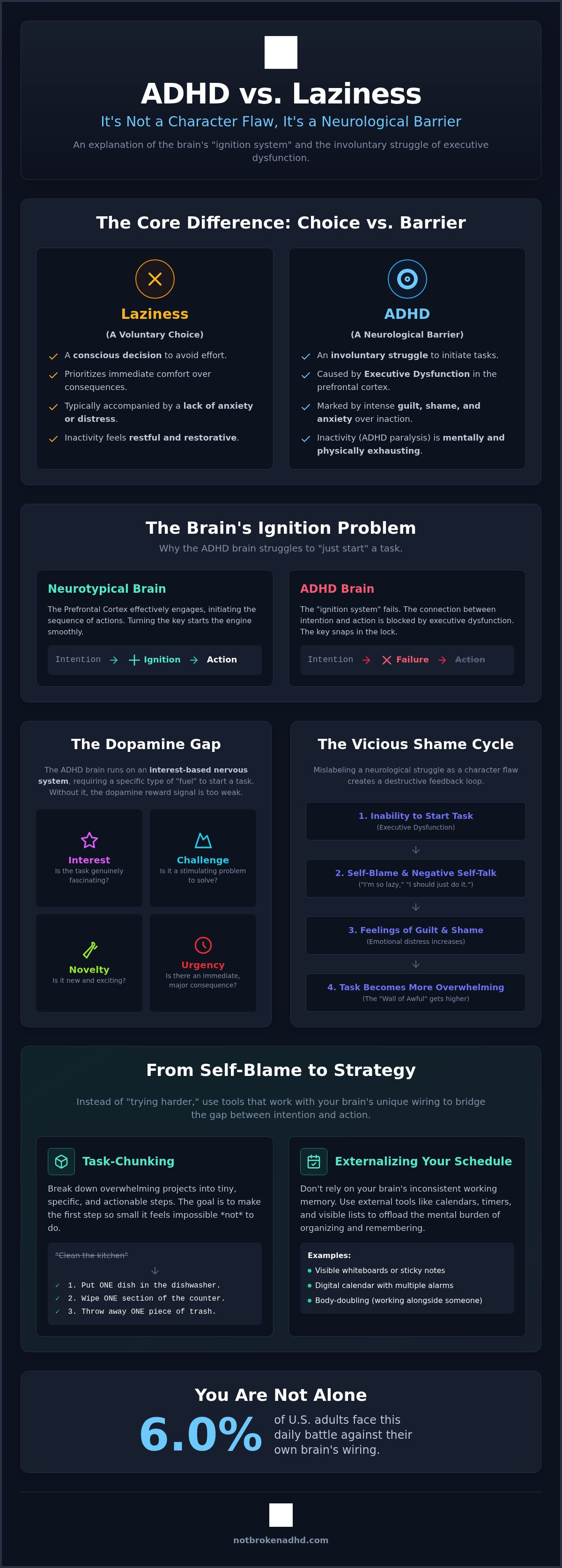
The distinction between ADHD and laziness isn't found in what you do. It's found in why you aren't doing it. Laziness is a choice. ADHD is a barrier. When you're stuck in a cycle of inactivity, the label you choose for your experience determines whether you'll find a way forward or remain trapped in a spiral of guilt. This ADHD vs laziness explanation is about more than just definitions; it's about identifying the biological mechanics behind your behavior.
The "shame cycle" is one of the most destructive parts of being neurodivergent. When you mislabel a neurological struggle as a character flaw, you tend to respond with self-punishment. You might tell yourself to "just do it" or "try harder," but these commands don't address the underlying issue. For someone with ADHD, willpower is rarely the problem. The problem is a lack of access to the brain's ignition system. Using the ADHD Self-Check Tool can be an essential first step in determining if your struggle is rooted in biology rather than a lack of desire.
Defining Laziness: A Choice of Will
Laziness is a voluntary decision to avoid effort despite having the capacity to act. It's a prioritization of immediate comfort over known consequences. Crucially, true laziness is usually accompanied by a lack of anxiety. If you're lazy, you've made peace with the fact that you aren't doing the work. You aren't pacing the room, feeling sick to your stomach, or screaming at yourself to start. People who are genuinely lazy aren't typically distressed by their inactivity. If you're reading this because you're worried you're failing, that's a strong sign your experience isn't about laziness.
Defining ADHD: A Neurological Barrier
ADHD is often described as a "performance disorder" rather than a knowledge disorder. You know what you need to do, and you likely know how to do it, but you cannot engage the internal gears to begin. This is driven by executive dysfunction, which impacts the brain's ability to self-regulate, organize, and initiate tasks.
In a neurotypical brain, dopamine provides a chemical reward for completing a task or even just thinking about the relief of being done. In an ADHD brain, that dopamine signal is often weak or inconsistent. Without that chemical "spark," the brain doesn't recognize a task as important or urgent. You're left staring at a "wall of awful," where the simple act of starting feels physically and mentally impossible. It's an involuntary struggle to engage the very parts of the brain responsible for "just doing it."
The Ignition Problem: Why the ADHD Brain Struggles to Start
Think of your brain as a high-performance vehicle. In a neurotypical brain, turning the key engages the starter motor and the engine hums to life. In an ADHD brain, the key often snaps off in the ignition. This is because the prefrontal cortex, the brain's executive manager, struggles to "clock in" and initiate the required sequence of actions. This breakdown in task initiation is a core component of any ADHD vs laziness explanation. It isn't a lack of fuel; it's a mechanical failure in the starting mechanism.
Repeated failures to start tasks often build what is known as the "Wall of Awful." This emotional barrier is constructed from bricks of past shame, disappointment, and the memory of being called "lazy." Every time you sit down to work and find yourself unable to move, you're staring at this wall. The task itself might be simple, like opening an email, but the emotional weight of the wall makes it feel like climbing a mountain. Understanding your specific barriers is the first step toward dismantling them, and using an ADHD Self-Check Tool can help you identify these patterns in your own life.
The Dopamine Gap
Dopamine acts as the brain's chemical currency for motivation and reward. While most brains can prioritize tasks based on their importance or future consequences, the ADHD brain operates on what Dr. William Dodson calls an interest-based nervous system. It filters the world through four specific lenses: interest, challenge, novelty, and urgency. If a task doesn't check one of those boxes, the dopamine "spark" doesn't fire. This explains why you might struggle to wash a single dish but can spend six hours researching a new hobby. When the brain can't find dopamine, it sometimes resorts to adrenaline. This is why many neurodivergent individuals only find "ignition" when a deadline becomes a genuine emergency.
Executive Dysfunction vs. Low Motivation
Executive dysfunction isn't just one problem; it's a cluster of challenges involving the brain's self-regulation. When working memory fails, you might walk into a room and forget why you're there. To a partner or employer, this can look like you don't care about the task. In reality, your brain simply dropped the information. Similarly, poor emotional regulation can turn the fear of doing a task poorly into a total "freeze" response. You aren't avoiding the work because you're unmotivated. You're avoiding the overwhelming emotional distress that the task now represents.
ADHD Paralysis vs. Genuine Rest: How to Tell
One of the most confusing parts of the ADHD vs laziness explanation is the physical experience of doing nothing. To an outsider, sitting on the couch looks the same whether you're relaxing or stuck. But internally, these states are opposites. Genuine rest is a conscious choice to recharge. You decide to sit down, your body softens, and you feel a sense of replenishment. ADHD paralysis, however, feels like being a prisoner in your own body. You want to get up. You might even be screaming at yourself to move. Yet, you remain frozen, and the longer you sit, the more exhausted you become.
Decision fatigue often acts as the catalyst for this paralysis. When your brain is overwhelmed by too many choices or steps, it simply shuts down. Choosing "nothing" isn't a preference for being idle. It's a survival mechanism for a brain that cannot find the next logical step. This often manifests as "Waiting Mode." If you have an appointment at 3:00 PM, you might find yourself unable to start any other task at 10:00 AM. Your brain perceives the upcoming event as a total block, making the hours leading up to it feel unusable. This isn't a lack of ambition; it's a glitch in how your brain sequences time and tasks.
The Rest vs. Paralysis Comparison
To help you distinguish between these two states, consider the following framework. True relaxation should leave you feeling better, not worse.
| Feature | Genuine Rest | ADHD Paralysis |
|---|---|---|
| Intent | A conscious choice to stop. | A desire to act, but unable to move. |
| Emotional State | Peaceful, content, or mindful. | Anxious, guilty, and frustrated. |
| Physical State | Soft muscles, steady breathing. | Tense, "heavy" limbs, or restlessness. |
| Outcome | Increased energy and clarity. | Deepening fatigue and shame. |
Try the "Internal Monologue" test next time you're stationary. Are you thinking, "I'm really enjoying this movie and I'm glad I took this break"? Or is your mind racing with thoughts like, "I'm so lazy, why can't I just get up and do the dishes"? If your internal voice is a drill sergeant hurling insults, you aren't resting. You're experiencing executive dysfunction.
Spotting the Signs of Executive Burnout
Sometimes, what looks like laziness is actually the brain entering a state of protective shutdown. Executive burnout occurs when the mental load of managing ADHD becomes too heavy to carry. In this state, your brain isn't just struggling to start; it's effectively offline. You might notice a total loss of interest in hobbies, increased sensory sensitivity, or a feeling of "brain fog" that won't lift. Recovering from this requires more than just a nap. It requires reducing your cognitive load, externalizing your tasks, and practicing radical self-compassion to break the cycle of shame.
From Self-Blame to Strategy: Tools for the ADHD Brain
Once you accept the ADHD vs laziness explanation, you can stop trying to "will" yourself into action. Willpower is a finite resource that often fails the neurodivergent brain. Instead, you need systems that act as external executive functions. These aren't crutches; they're ramps. They help you bridge the gap between knowing what to do and actually doing it.
One of the most effective ways to lower the "Wall of Awful" is task-chunking. If a task feels too big, your brain treats it as a threat and triggers avoidance. Breaking "clean the kitchen" into "put three forks in the dishwasher" makes the barrier small enough to step over. You might also try "body doubling." This is simply working in the presence of another person. Their presence acts as a social anchor. It keeps your brain focused on the task at hand without the need for constant, exhausting self-monitoring.
Task Initiation Hacks
The "Five-Minute Rule" is a powerful way to trick your brain's ignition system. Tell yourself you'll only work for 300 seconds. Usually, the hardest part is the start. Once the engine is running, it's easier to keep going. You can also build a "Dopamenu." This is a list of healthy dopamine hits, like a quick dance break or a favorite snack, that you can use to prime your brain before a difficult task.
For many, using a Pomodoro timer for ADHD focus is the ultimate hack. It creates an artificial sense of urgency. This mimics the adrenaline-fueled "emergency" focus we often rely on. By working in short, timed bursts, you bypass the overwhelming feeling of an endless task. It gives your brain a clear finish line, which makes starting feel much safer.
Managing the Environment
Your physical space should support your brain, not fight it. This means reducing friction. If you want to exercise, put your shoes by the bed. This is the "Path of Least Resistance." Because ADHD brains often struggle with object permanence, the "out of sight, out of mind" phenomenon, visual cues are vital. Use clear bins, sticky notes, or digital reminders to keep your priorities visible.
Interactive simulations can also be a game-changer. They allow you to "see" how different sensory triggers or environmental changes affect your focus. When you understand your specific triggers, you can design a space that feels safe and productive. To start building your personalized strategy, you can explore our Downloadable ADHD Guides to help you navigate your unique neurological landscape.
Finding Your Path: Next Steps for the Neurodivergent Mind
Shedding the "lazy" label isn't something that happens overnight. It's a deliberate process of unlearning years of internalized shame. When you finally accept the ADHD vs laziness explanation, you stop fighting against your brain and start working with it. This shift from self-blame to self-compassion is the most critical step in your journey. You're part of a massive community. As of late 2026, approximately 6.0% of U.S. adults, or roughly 15.5 million people, live with a current ADHD diagnosis. Globally, that figure is around 6.76%. You aren't alone, and you aren't failing.
Moving forward requires a balanced approach. This often includes a mix of professional support, environmental changes, and personal strategies. While our resources provide clarity and education, a formal evaluation is a powerful tool for many. In 2026, a diagnosis with insurance typically costs between $40 and $300 across two to four appointments. Without insurance, private evaluations can range from $300 to $800. Whether you choose a formal path or focus on self-management, the goal is the same: building a life that respects your neurological reality.
Using the ADHD Self-Check Tool
Data is the best antidote to shame. When you can see your struggles mapped out as functional gaps rather than character flaws, the "lazy" narrative begins to crumble. Our ADHD Self-Check Tool helps you identify exactly where your executive functions are stalling. It looks at task initiation, working memory, and emotional regulation to provide a clearer picture of your internal experience. These results are incredibly helpful if you decide to seek a clinical assessment, as they give you a structured way to describe your daily challenges to a provider.
Educational Resources and Medication Guides
Knowledge is your most effective management tool. Understanding how different treatments impact the brain's reward system can help you make informed decisions about your care. You can explore the ADHD Medication Guide to learn about current options and how they address the "ignition" problems we've discussed. Beyond medication, our downloadable guides offer deep dives into mastering specific executive functions like time blindness and organization.
Always remember that your brain isn't broken. It's simply a different operating system that requires a specific set of instructions. By replacing judgment with curiosity, you can start building a custom management plan that actually works. You have the capacity to achieve your goals; you just need the right tools to engage the engine.
Trading Internal Shame for Actionable Clarity
Understanding the biological mechanics behind your behavior is the first step toward a life with less guilt. This ADHD vs laziness explanation has shown that your struggle isn't a lack of will, but a challenge with your brain's ignition system. You've learned to distinguish between the exhaustion of paralysis and the restoration of true rest. Now, it's time to move from understanding into application. You don't have to navigate this journey without a map.
Our resources have helped thousands of neurodivergent individuals find their way. Through interactive ADHD simulations and empathy-driven The ADHD Field Guide, we provide the grounded perspective you need to build a custom management plan. Data-driven self-awareness is the ultimate tool for dismantling shame. When you see how your brain actually works, the "lazy" label loses its power. You aren't broken; you're just learning the manual for a unique operating system.
Ready to see your brain in a new light? Take the ADHD Self-Check Tool to find your clarity today. You deserve to move forward with confidence and compassion.
Frequently Asked Questions
Is ADHD just an excuse for being lazy?
No, ADHD is a neurodevelopmental disorder with a biological basis. It involves differences in brain structure and function, particularly in areas responsible for executive functions. Unlike laziness, which is a choice to avoid effort, ADHD involves an involuntary struggle to regulate attention and initiate tasks. This ADHD vs laziness explanation highlights that the struggle is neurological, not a character flaw. It's a matter of brain chemistry, not moral failing.
How can I tell if my child is lazy or has ADHD?
Look for the emotional response and consistency. A child who is "lazy" by choice usually feels fine about their inactivity. A child with ADHD often feels frustrated, anxious, or ashamed when they can't start a task. ADHD symptoms must also be present in two or more settings, like home and school. Since 11.4% of U.S. children have been diagnosed as of 2026, observing these patterns of distress is a vital first step.
Why can I focus on video games but not my taxes?
This is due to the ADHD brain's interest-based nervous system. Video games provide immediate, high-frequency dopamine rewards through novelty and challenge. Taxes are "boring" and offer no immediate reward, so the ADHD brain's ignition system doesn't fire. It's a problem of regulation, not a lack of focus. You can hyperfocus on what stimulates you, but you can't easily direct that focus toward mundane obligations without external tools or artificial urgency.
Can you have ADHD and still be successful?
Absolutely. Many highly successful people have ADHD and use their unique wiring to their advantage. Success often comes from building systems that bypass executive function gaps, such as using a Pomodoro timer or externalizing tasks. With approximately 15.5 million U.S. adults living with the condition in 2026, it's clear that neurodivergent individuals are thriving in every industry. They succeed by using tools that respect their brain's needs rather than fighting their nature.
Does medication help with the 'lazy' feeling of ADHD?
Medication can significantly reduce the internal friction that feels like laziness. It works by regulating neurotransmitters like dopamine and norepinephrine, which help the brain's "manager" clock in and initiate tasks. While medication isn't a cure-all, it often makes the "Wall of Awful" feel much smaller. You can learn more about how these treatments work by exploring our ADHD Medication Guide to see if it aligns with your specific management goals.
How do I explain ADHD paralysis to my boss or partner?
Describe it as a "technical glitch" in your brain's starting mechanism. Use the term "executive dysfunction" to explain that you have the desire and the fuel to work, but the ignition isn't catching. Explain that it's physically exhausting and causes significant distress. Providing them with a clear ADHD vs laziness explanation can help them understand that your inactivity is a functional barrier. It's a neurological reality, not a lack of respect or commitment.
What is the 'Wall of Awful' in ADHD?
The "Wall of Awful" is the emotional barrier built from past failures, shame, and the fear of being judged. Every time you struggle with a task, you add a "brick" of disappointment to this wall. Eventually, even simple tasks feel impossible because you're actually facing a mountain of negative emotions. Dismantling this wall requires self-compassion and strategies like task-chunking. You have to lower the height of the wall before you can climb over it.
Can you be both lazy and have ADHD?
It's possible, but they are distinct experiences. A person with ADHD might occasionally make a conscious choice to avoid a task they are capable of doing. However, for most neurodivergent individuals, what looks like laziness is actually executive dysfunction or burnout. If you feel intense guilt or anxiety about your inactivity, it's almost certainly your ADHD wiring at work. True laziness doesn't come with a side of self-loathing or the desperate wish to be productive.
