

What if the "laziness" you've been scolded for is actually a sophisticated brain trying to process too much data at once? You might spend your day fighting a mental fog that feels like wading through thick, waist-deep water. It's the frustration of knowing exactly what you need to do, yet finding yourself paralyzed by the sheer weight of starting. These common ADHD traits in adults are often misunderstood as personality defects. You aren't failing at being an adult. You're simply operating with a neurodivergent brain that wasn't built for a one-size-fits-all world.
If you've spent years feeling like an underachiever despite your obvious intelligence, you aren't alone. It's common to feel a deep sense of shame after being called "careless" for mistakes that felt unavoidable. This guide goes beyond the dry medical definitions to explore how neurodivergence actually feels in the real world. You'll discover how to distinguish functional brain differences from character flaws. We'll provide a clear framework to help you understand your unique cognitive profile and share practical tools to manage the daily mental clutter.
Key Takeaways
- Understand how common ADHD traits in adults differ from childhood symptoms, specifically how physical hyperactivity often transforms into internal restlessness or racing thoughts.
- Identify the "Big Three" executive function hurdles, task initiation, working memory, and time blindness, to see them as functional gaps rather than personality flaws.
- Discover why emotional regulation and hyperfocus are often more impactful on your daily life than simple inattention or lack of focus.
- Learn to distinguish between "laziness" and an interest-based nervous system, providing you with a new language to explain your brain to yourself and others.
- Transition from feelings of chronic underachievement to a strategy-focused mindset that prioritizes working with your neurodivergent brain instead of against it.
Beyond the Stereotype: What ADHD Actually Looks Like in Adulthood
ADHD doesn't disappear when you turn eighteen. For many, the symptoms don't even become obvious until the structure of school is replaced by the complex demands of independent living. Clinically recognized as Adult attention deficit hyperactivity disorder, the condition is defined by a persistent pattern of executive functioning differences that affect how you process information and manage your time. Essentially, ADHD is a "performance disorder" rather than a "knowledge disorder." It isn't that you don't know what to do; it's that your brain struggles to bridge the gap between knowing and doing.
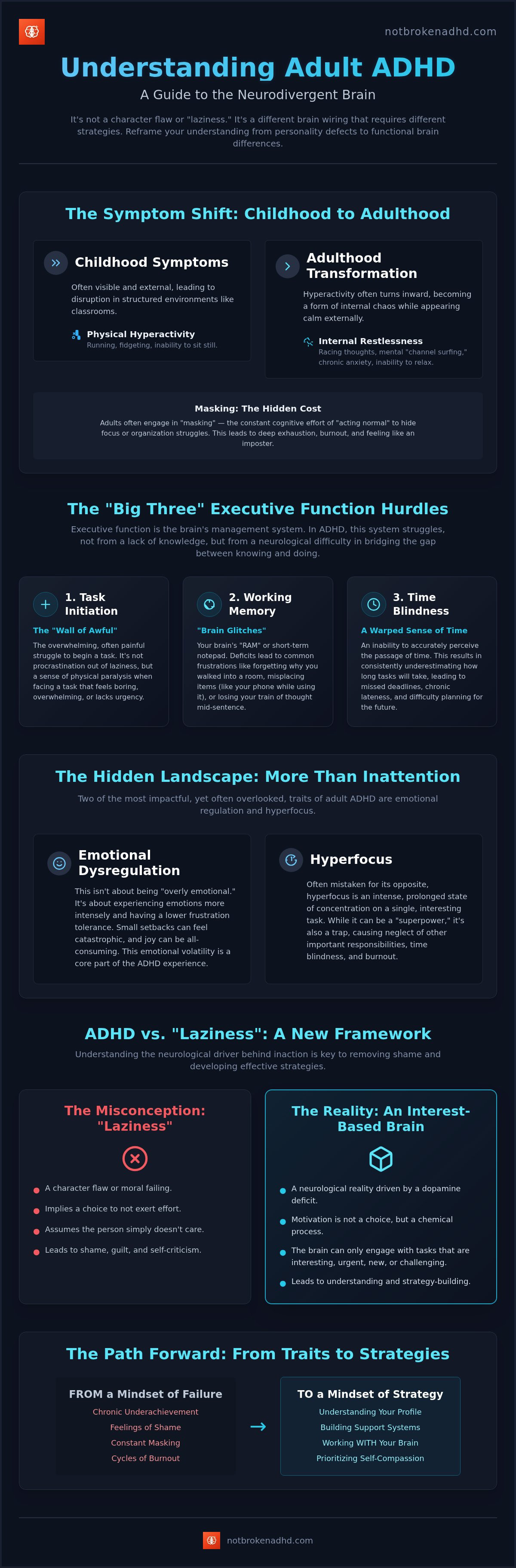
In many cases, common ADHD traits in adults often look less like physical disruption and more like internal chaos. You might look like you have it all together, but the internal cost of maintaining that facade is staggering; it's a process known as masking. Masking involves the constant cognitive labor of "acting normal" to hide struggles with focus or organization. This often leads to deep exhaustion and a sense of being an imposter in your own life. Understanding these common ADHD traits in adults helps strip away the shame by reframing these challenges as functional differences rather than character flaws.
The Shift from Childhood to Adulthood
In adults, hyperactivity often sheds its physical skin and moves inward. While a child might run across a classroom, an adult might sit perfectly still while their mind "channel surfs" through a dozen different topics at once. This internalized restlessness often manifests as racing thoughts, chronic anxiety, or an inability to relax even when the day is done. As responsibilities like bills, careers, and parenting pile up, the traits that were manageable in a structured school environment can become overwhelming. Many adults rely on high-pressure coping mechanisms, like using panic to fuel a deadline, which eventually leads to chronic burnout, a state of total mental and physical depletion.
Why Many Adults are "Late-Diagnosed"
High intelligence or a supportive childhood environment can act as a shield, hiding ADHD traits for decades. You might have been able to "wing it" through college, but then you hit a wall when life's complexity finally exceeds your brain's ability to compensate. This "hitting the wall" moment is often what leads adults to seek answers for the first time. Women and marginalized groups are particularly prone to late diagnosis, as their symptoms are frequently mislabeled as depression, anxiety, or bipolar disorder. For these individuals, discovering their neurodivergence isn't a burden. It is the first step toward finding clarity and finally understanding why their brain works the way it does.
The Core Executive Functioning Traits: The "Brain’s CEO" at Work
Think of executive function as your brain’s management system. It's the "CEO" that handles everything from planning your day to remembering where you parked. For many, common ADHD traits in adults stem from this system struggling to stay online. It isn't a lack of intelligence or a failure of character. It's a neurological reality driven by a dopamine deficit. Dopamine is the brain’s currency for motivation. Without enough of it, tasks that feel "boring" or routine don't just feel dull; they feel physically impossible to start. These functional gaps usually center around the "Big Three" challenges: Task Initiation, Working Memory, and Time Blindness. These common ADHD symptoms represent functional gaps in the brain's ability to regulate attention and effort.
Daily life with executive dysfunction often feels like fighting a series of small, frustrating "glitches." These moments can erode your confidence over time, but they're actually predictable results of how your brain is wired. Here are five common glitches adults face:
- Losing your phone while you're actively using it to talk or listen to music.
- Walking into a room and completely forgetting your purpose for being there.
- Missing a project deadline because you underestimated how long a "five-minute" task takes.
- Feeling a sense of physical paralysis when looking at a messy kitchen or a full inbox.
- Abandoning a task halfway through because a new, more interesting idea popped into your head.
Task Initiation and the "Wall of Awful"
The struggle to begin is often the most painful part of the ADHD experience. It's frequently described as the "Wall of Awful," a mental barrier constructed from anxiety, shame, and past frustrations. When you face a task that feels too big or poorly defined, your brain’s "start" button fails to engage. You might sit for hours, knowing you need to work, yet unable to move. This isn't laziness. It's a breakdown in the brain's initiation circuits. To lower the barrier, you need a "low-friction" entry point. Using a Pomodoro timer for ADHD focus allows you to commit to just 25 minutes, making the task feel less like a mountain and more like a molehill.
Working Memory and the "Out of Sight, Out of Mind" Rule
Working memory is the mental scratchpad we use to hold information temporarily. In an ADHD brain, this scratchpad is often too small or easily erased. If something isn't in your immediate field of vision, it effectively ceases to exist. This "out of sight, out of mind" rule is why you might leave a half-finished cup of coffee in every room of the house. It's also why organization feels impossible; if you put things away in a drawer, you'll forget they're there. To cope, you must externalize your brain's functions. Use transparent bins for storage, set recurring digital alarms, and place physical reminders in your path. If you're struggling to manage these common ADHD traits in adults, gaining insight through our self-check tool can provide the validation you need to start making changes.
The Hidden Landscape: Emotional Regulation and Sensory Traits
While disorganization and forgetfulness are the most visible common ADHD traits in adults, the internal emotional landscape is often where the real struggle lies. For many, emotional regulation is the most debilitating part of their daily experience. It feels like having an internal thermostat that is permanently broken. You might experience joy, frustration, or sadness with an intensity that feels overwhelming to you and confusing to others. It is helpful to remember that ADHD is a state of having "too much" or "too little" focus, rather than "no" focus at all.
This regulation struggle extends to your physical senses. Sensory processing differences mean that a hum from a refrigerator or a specific fabric texture can become an impossible distraction. These aren't just minor preferences; they are neurological interruptions. When your brain cannot filter out background noise, your cognitive energy drains just trying to stay present. A ticking clock in a quiet room or a "scratchy" clothing tag can derail an entire day's progress because your brain treats these small stimuli as urgent threats to your focus.
Rejection Sensitive Dysphoria (RSD)
One of the most intense emotional common ADHD traits in adults is Rejection Sensitive Dysphoria, or RSD. This is an extreme emotional pain triggered by the perception, not necessarily the reality, of being rejected, teased, or criticized. It feels like a physical wound. Because this pain is so sharp, many adults develop defensive behaviors. You might find yourself trapped in a cycle of extreme people-pleasing to avoid any hint of conflict. Others might stop trying new things altogether, preferring the safety of isolation over the risk of perceived failure. RSD is an involuntary neurological response, distinct from standard social anxiety or typical sensitivity.
The High Cost of Masking
Masking is the process of hiding your neurodivergent traits to blend into social or professional settings. You might force yourself to sit perfectly still in meetings or spend hours proofreading a simple email to ensure you don't look "careless." While this helps you navigate a neurotypical world, it is incredibly exhausting. Chronic masking is one of the primary causes of ADHD burnout. This is a state where your brain simply shuts down after months or years of over-exertion. Embracing the perspective offered by The ADHD Field Guide is the essential first step to unmasking safely. When you stop viewing yourself as a flawed version of a neurotypical person, you can begin to build a life that actually fits your brain's unique rhythm.
ADHD vs. Laziness: Distinguishing Traits from Character
"Am I just lazy?" This is the question that haunts almost every adult living with undiagnosed or newly discovered neurodivergence. Laziness is a choice. It is a conscious decision to avoid effort because you simply don't care about the outcome. ADHD is the exact opposite. Most people with common ADHD traits in adults care deeply, often to the point of agonizing over their perceived failures. The struggle isn't a lack of character; it is a mismatch between your brain’s wiring and the world’s expectations. You aren't failing at being an adult. You're simply navigating a world designed for a different operating system.
Neurotypical brains generally operate on an "Importance-Based Nervous System." They can prioritize a task because it is important, carries a reward, or has a deadline. An ADHD brain works on an "Interest-Based Nervous System." It prioritizes based on interest, novelty, challenge, or urgency. When a task lacks these qualities, the brain’s executive function, its actual capacity to act, simply doesn't engage. It's like trying to drive a car with a broken ignition. It doesn't matter how much gas is in the tank if the spark won't catch. This is why you can spend ten hours researching a niche hobby but struggle to spend ten minutes on a simple spreadsheet.
The Willpower Myth
Society often tells us that "trying harder" is the solution to every productivity problem. For someone with ADHD, this advice is not just unhelpful; it's scientifically inaccurate. Willpower is a measure of intent, but executive function is a measure of neurological capacity. When your brain lacks the dopamine signal required to bridge the gap between "I want to do this" and "I am doing this," the result is paralysis. This is the difference between "won’t" and "can’t." When you mistake a neurological barrier for a choice, you trigger a shame response. This shame creates an avoidance loop. The task becomes so associated with negative feelings that you physically cannot bring yourself to look at it. Shame is a terrible fuel for the neurodivergent brain.
Situational Inattention vs. Chronic ADHD
It's true that modern life can make anyone feel scattered. Constant digital notifications, chronic stress, and burnout can mimic common ADHD traits in adults. However, there is a fundamental difference in how these traits manifest. To be considered ADHD, these patterns must be persistent and pervasive across multiple areas of your life, such as work, home, and relationships. Most importantly, these traits must have been present since childhood, even if they were masked at the time. If your struggles are new, they might be situational. If they feel like a lifelong story of "not living up to your potential," it is likely neurodivergence. You can use an ADHD self-check tool online to help you identify these long-term patterns and find the clarity you deserve.
Navigating Your Journey: From Traits to Strategies
Identifying common ADHD traits in adults is the first step toward a more compassionate life. It isn't about fixing a broken brain. It's about learning the rules of your own unique architecture. Education is roughly 50% of the struggle. When you understand why your brain seeks dopamine or struggles with transitions, you can stop fighting your nature. Our Downloadable ADHD Guides serve as a bridge between this realization and meaningful action. They provide the practical framework needed to translate "knowing" into "doing" without the heavy weight of shame.
While self-understanding is life-changing, seeking a professional diagnosis can open doors to specific medical and therapeutic support. Preparing for this conversation is vital. Doctors often look for clinical markers, but they need to hear about your lived experience. Use a detailed symptom checklist to document how your traits impact your work, relationships, and mental health over time. Ask your provider about the differences between stimulant and non-stimulant options. You might also ask how they distinguish ADHD from co-occurring conditions like anxiety or depression. If you're considering this path, The ADHD Field Guide offers clear insights into medication options, helping you make an informed choice alongside your healthcare provider.
Building an ADHD-Friendly Toolbox
Beyond clinical support, you need a daily toolbox designed for your specific needs. This includes "low-demand days" where you consciously reduce the number of executive function hurdles you face. Manage your sensory environment by using noise-canceling headphones or adjusting lighting to prevent cognitive fatigue. You can also use interactive simulations to identify your specific triggers in a safe, controlled environment. These simulations allow you to test strategies for task initiation or focus without the real-world consequences of failure. These tools help you build a life that accommodates your brain rather than one that punishes it.
You are not a collection of flaws. You are a person with a specific set of functional differences that require a specific operating manual. Finding the right field guide changes everything. With the right strategies, you can move from a state of chronic overwhelm to a life of clarity and quiet confidence. Common ADHD traits in adults don't have to be barriers to success. They are simply the starting point for a new way of living that honors your neurodivergent brain.
Embracing Your Brain's Unique Manual
Understanding the common ADHD traits in adults is the first step toward a life that actually works for you. You've seen how these functional differences impact everything from your working memory to your emotional regulation. Most importantly, you now have a framework to distinguish these neurological hurdles from character flaws. You aren't lazy. You're operating with an interest-based nervous system that requires a different set of tools to thrive.
Clarity is the foundation of change. If you're ready to stop guessing and start building a supportive environment, we're here to help. Our resources are developed for the ADHD brain by people who live with it every day. Join the thousands of neurodivergent adults who use our practical, shame-free educational resources to navigate their daily lives with more ease.
Take the ADHD Self-Check Tool to find your clarity.
It's time to stop fighting your brain and start working with it. You have incredible strengths. You just need the right field guide to unlock them.
Frequently Asked Questions
Can you have ADHD if you were never hyperactive as a child?
Yes, you can. ADHD has three distinct presentations, and many people fall into the "Predominantly Inattentive" category. As a child, you might have been a quiet daydreamer rather than someone who couldn't sit still. This is why many common ADHD traits in adults go unnoticed for decades. In adulthood, hyperactivity often moves inward, manifesting as a restless mind or racing thoughts rather than physical movement.
Is ADHD in adults just a result of too much screen time?
No, ADHD is a neurodevelopmental condition with strong genetic roots. While constant digital notifications can shorten anyone's attention span, they don't cause the fundamental brain differences associated with ADHD. These differences are typically present from birth. However, the fast-paced nature of modern technology can make it much harder for a neurodivergent brain to regulate focus, often making existing traits feel more intense and harder to manage.
What is the difference between ADHD and "burnout"?
Burnout is a temporary state of mental and physical exhaustion caused by prolonged stress. ADHD is a lifelong neurological profile. While they look similar, burnout usually improves with rest and lifestyle changes. Common ADHD traits in adults remain consistent regardless of your stress levels. It's also true that people with ADHD reach burnout faster because they spend so much cognitive energy trying to "act normal" in a neurotypical world.
Can I have ADHD if I was an A-student in school?
Absolutely. High intelligence or a deep interest in specific subjects can often mask executive function gaps during your school years. You might have relied on last-minute adrenaline to finish assignments or had a highly structured home life that kept you on track. The struggle often only becomes visible in adulthood when that external structure is removed and the complexity of managing a career and household exceeds your brain's ability to compensate.
What exactly is "Executive Dysfunction"?
Executive dysfunction refers to a breakdown in the brain's management system. It impacts the skills you need to plan, organize, and execute tasks. Think of it as a "CEO" who struggles to prioritize or keep track of the schedule. This dysfunction is the underlying cause of most common ADHD traits in adults. It explains why you might know exactly what you need to do but find yourself physically unable to start the task.
Does ADHD in adults ever go away?
ADHD doesn't go away, but the way you experience it can change. You don't "outgrow" neurodivergence; instead, you learn to build a life that accommodates your brain's unique needs. Many adults find that their symptoms become more manageable as they gain self-awareness and implement better strategies. Choosing a career that aligns with your natural strengths and using the right management tools can significantly reduce the daily friction you feel.
Is it worth getting a diagnosis later in life?
Seeking clarity in adulthood is incredibly valuable because it provides a bridge from shame to self-compassion. A formal diagnosis helps you reframe years of struggle as a functional difference rather than a character flaw. It also allows you to access specific medical treatments and workplace accommodations. While we provide educational resources like symptom checklists to help you prepare, a professional evaluation is the final step in confirming your neurological profile.
How do I explain my ADHD traits to my partner or boss?
The best approach is to describe your "operating manual" rather than just listing symptoms. Instead of saying you're "disorganized," explain that your brain processes information best when it's visual or written down. Use neutral language to explain how your environment affects your productivity. When you frame your needs as functional requirements rather than excuses, it helps others understand how to support your strengths while respecting your specific cognitive boundaries.

