

What if making everyday choices easier starts with making fewer of them? ADHD decision fatigue solutions don’t have to mean building a perfect routine. Choosing what to eat, what to wear, or which task to start can seem minor, but those decisions add up. By the time a bigger choice comes along, you may feel drained, stuck, or unsure how to move forward.
If too many options leave you frozen, or a rigid system feels like one more thing to maintain, you’re not failing at decision-making. ADHD can make it harder to organize choices and keep details in mind, so everyday decisions may take more effort. Feeling depleted after choices and feeling unable to choose can overlap, but they aren’t quite the same.
This guide shares practical ways to reduce unnecessary choices without aiming for perfection. You’ll learn how to narrow options, prioritize what matters, and use simple defaults that save effort while leaving room for flexibility. You’ll also find ways to restart your approach when plans get disrupted. The aim isn’t to control every decision. It’s to make the next one feel more manageable.
Key Takeaways
- Recognize the difference between feeling mentally depleted after choices and getting stuck before making one; each may call for a different kind of support.
- Explore ADHD decision fatigue solutions such as option limits, default choices, written prompts, and decision windows, and see when each approach may help.
- Try simplifying one recurring choice first, then use a small default to make the next step easier to start.
- Check whether a strategy genuinely reduces mental effort or adds more steps, and adjust it when your needs or circumstances change.
- Build a decision approach you can return to after disruptions, without treating a missed routine as a reason to start over perfectly.
What ADHD Decision Fatigue Can Feel Like, and What It Does Not Mean
Choosing what to eat, replying to a message, or deciding what to do first can take more energy than the choice seems to deserve. After a day of small and larger decisions, you might feel mentally worn down, keep weighing the same options, or put off choosing altogether. Decision fatigue is a common term for feeling depleted after repeated or demanding choices. It describes an experience, not a diagnosis.
That distinction matters. Struggling to decide doesn’t mean you’re lazy, careless, or indifferent to the outcome. ADHD decision fatigue solutions are about reducing unnecessary effort, not judging yourself for needing more support. ADHD experiences vary: some people find choices especially tiring, while others notice this pattern only in particular situations or not at all.
How decision overload can show up in everyday life
Decision overload can look like delaying a choice, moving back and forth between options, or picking whatever feels easiest just to be done. At home, you might open the fridge several times without settling on a meal. At work, you may reread a message because you can’t decide how to respond, or struggle to pick a first task from a long list. While running errands, comparing similar products may feel harder than expected. A personal routine, such as choosing when to exercise or what to wear, can also become one more decision to carry.
These moments don’t necessarily mean you don’t care. You may care a lot about making the right choice while feeling short on attention or energy to compare possibilities. “Good enough” can be hard to spot when every option brings another detail to consider.
Why choice-making may take extra effort for some people with ADHD
Executive function is a group of mental skills that helps with tasks such as planning, shifting attention, and getting started. Working memory is the ability to hold information in mind briefly while using it. Picture choosing lunch: you might need to remember what food you have, compare what sounds appealing, consider how much time you have, and then begin preparing something. Each step can compete for attention.
For some people with ADHD, keeping those details active or moving from comparison to action may take extra effort. Other factors, such as stress, fatigue, or the decision’s importance, can also shape how difficult it feels. There isn’t one explanation that fits everyone, and decision fatigue by itself doesn’t confirm ADHD. Noticing when choices become harder can still help you identify where fewer options or a clear prompt might make daily life easier.
Why ADHD Decision Fatigue Builds, and Which Choices Use the Most Energy
A choice can look like one quick question: What should I eat for lunch? But answering it may involve several small steps. You notice you’re hungry, remember what you like and what’s available, check how much time you have, compare possibilities, and decide what to do first. If any detail is hard to keep in mind, the whole choice may feel more involved. That sequence is different for everyone, but it shows how small decisions can ask for more effort than they seem to.
The hidden steps inside an apparently small decision
Each piece of information you hold and compare adds to cognitive load, the mental effort involved in processing information. For lunch, you might weigh whether a meal needs cooking, whether you have the ingredients, and whether you’ll have time to eat before your next commitment. Then comes the step of starting: getting food out, preparing it, or placing an order. The decision isn’t complete just because you’ve named an option.
Uncertainty can add another layer. If you’re not sure what you want or what the day allows, you may keep reconsidering. Too many options can make comparison harder, while an interruption may mean you have to rebuild your train of thought. These factors don’t affect everyone in the same way. Choice overload is a descriptive experience, not a standalone ADHD diagnostic criterion. For further context, see Overcoming Decision Fatigue in ADHD.
When context makes choosing feel more demanding
The same decision may feel manageable one day and taxing the next. Fatigue, unclear priorities, competing demands, or sensory distractions can all make it harder to focus on relevant details. A busy room, background conversation, or bright screen may pull attention away from comparing options. If environmental input is a major part of the difficulty, these ADHD sensory overload strategies may offer useful ways to think about reducing distractions.
Time pressure can narrow the space available to consider options, but it doesn’t automatically make a decision impossible. A clear deadline may help some people choose; for others, it can add stress or make it harder to weigh what matters. Notice the conditions around a tiring choice, not just the choice itself. That can help you decide whether fewer options, clearer priorities, or a calmer setting might help. The ADHD Field Guide’s executive-function educational content offers practical ideas for planning and everyday tasks. You can also explore ADHD-focused educational resources.
ADHD Decision Fatigue Solutions Compared: Narrow, Standardize, or Externalize
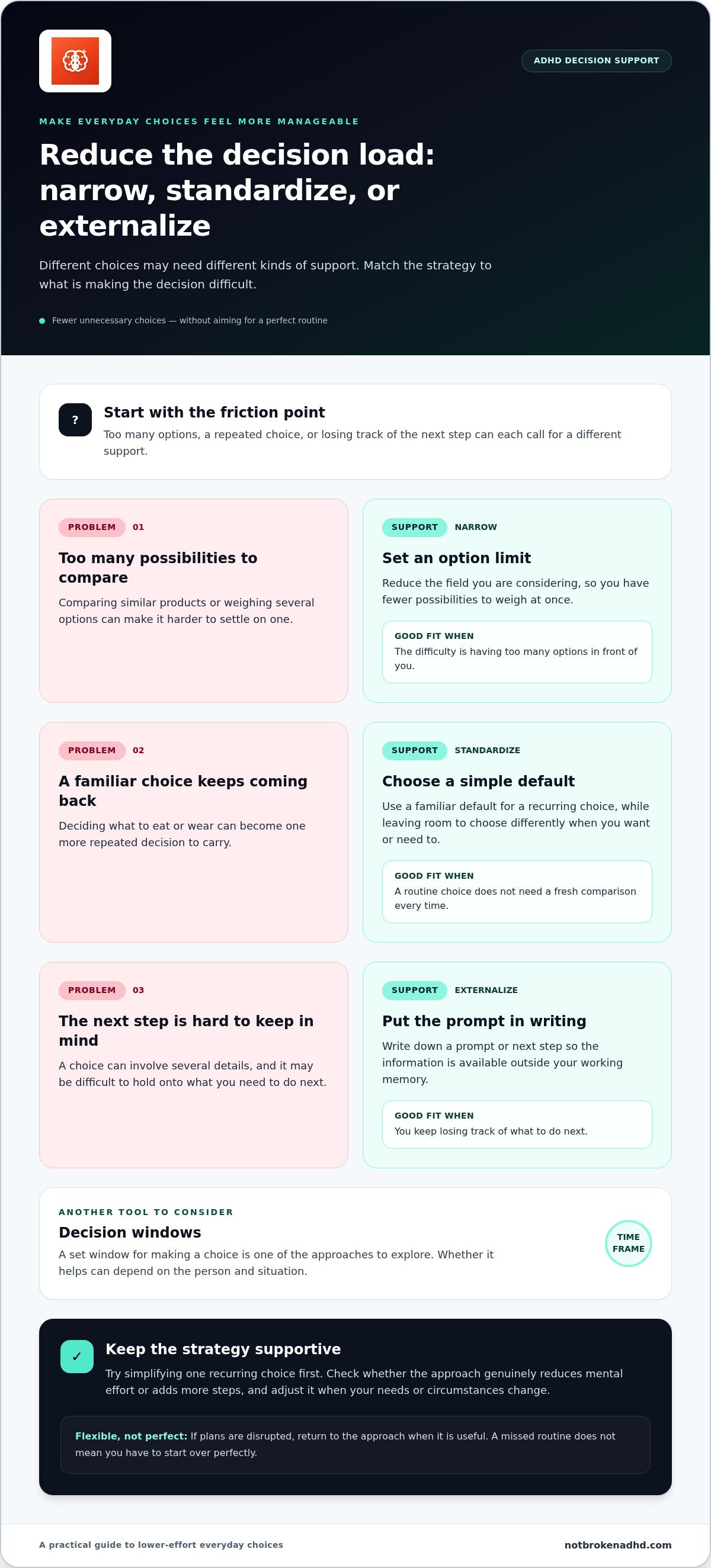
Different choices call for different kinds of support. You might need fewer options for a purchase, a default for a familiar meal, or a written prompt when you keep losing track of the next step. Treat these ADHD decision fatigue solutions as experiments, not rules to follow perfectly. Try one small adjustment and keep it only if it makes choosing easier.
| Method | When it may help | Possible drawback | Low-effort starting version |
|---|---|---|---|
| Option limits | Comparing lots of similar choices is slowing you down. | A shortlist can leave out an option you care about. | Choose two or three workable options, then decide among them. |
| Default choices | A recurring decision takes attention every time. | A default may not fit a changed need or situation. | Pick a usual option, with permission to change it. |
| Written prompts | You’re trying to remember options, priorities, or steps. | A complicated list can become another task to manage. | Write one reminder or a short shortlist where you’ll see it. |
| Decision windows | You keep revisiting a choice without getting closer to action. | A time limit may feel pressuring for an important decision. | Set a gentle stopping point for a low-stakes choice. |
Reduce the number of options before you decide
For a recurring choice, decide what matters most before comparing options. A short list of must-haves can help: for lunch, that might mean food you already have and enough time to prepare it. Then consider two or three possibilities that fit. Preset categories, such as “quick,” “make ahead,” or “eat out,” can also make a broad choice easier to sort.
Narrowing isn’t about banning alternatives or forcing yourself into one answer. It makes useful choices easier to see while keeping room for preferences and changing circumstances.
Externalize choices with defaults and visible prompts
A written shortlist or prompt puts useful information somewhere you can see it, instead of asking you to keep every option in mind. A default works similarly: it gives you a ready starting point for a familiar decision. It’s reversible, not a promise to choose the same thing every time. If it no longer fits, choose something else.
For broader ideas about reducing the load of planning and organizing, explore The ADHD Field Guide’s executive-function educational content. The best strategy depends on the decision and context. A useful approach lowers effort without taking away the flexibility to choose differently.
How to Build a Low-Decision Routine That Survives Real Life
A useful routine doesn’t need to cover your whole day. Start with one repeated choice that often slows you down, then make that choice easier to approach. These ADHD decision fatigue solutions should fit your actual needs, including days when energy, time, or plans change.
Set up one decision at a time
Try this small process:
- Choose one recurring decision. Pick a moment that creates noticeable friction, such as deciding what to bring for lunch or which work task to begin.
- Simplify the options. Make a short list of workable choices, or decide on a usual starting point. Keep the options that matter to you.
- Put the prompt where the choice happens. A note by the door, a shortlist on your desk, or a reminder near the place you prepare food can make the next step easier to see.
- Test it in real situations. Use the prompt for several occasions, then ask whether it reduced effort. Keep it, adjust it, or let it go.
Keep the system small. If the prompt takes more effort to maintain than the decision itself, simplify it. A short review can focus on one question: where did I get stuck? Change that friction point rather than rebuilding your whole routine.
Make a reset plan for disrupted days
Before you need it, choose a low-energy alternative. If your usual lunch plan falls through, it might be the easiest acceptable meal you have. If your planned first task feels too big, it could be opening the document or choosing one small next step. This is a minimum viable choice, not a standard you have to meet every day.
At the start of a day, it may help to separate choices into three groups: what matters today, what can wait, and what can be removed. Not every open question needs an answer right now. If timing or transitions make it harder to choose what comes next, these ADHD time blindness solutions may offer relevant ideas.
Plans will get interrupted. You don’t need to catch up perfectly or restart the whole routine. Begin again with the next decision, and adjust the system when your circumstances change. For more practical support, explore ADHD-focused educational resources and choose ideas that feel workable for you.
Keep ADHD Decision Fatigue Solutions Supportive, Flexible, and Sustainable
A strategy is useful when it makes a choice clearer or takes some effort off your plate. It may need adjusting if you have to remember extra steps, maintain a complicated system, or feel guilty when you don’t use it. Your needs can change from day to day, too. Keep what helps, adapt what almost works, and let go of approaches that add pressure without making decisions easier.
Use tools as supports, not another system to maintain
Tools can offer a prompt or structure, but they don’t need to become a new routine to manage. The ADHD Field Guide’s built-in Pomodoro timer can provide a contained work period when getting started feels difficult. If using it creates another decision or distraction, skip it. The tool is there to support your needs, not the other way around.
Interactive simulations offer an educational way to explore neurodivergent experiences and reflect on how different situations may affect attention or daily tasks. They’re optional learning resources, not treatment or a promised result. The ADHD Field Guide also offers simulations and an ADHD Self-Check Tool as educational resources. You can also read about an interactive ADHD experience for related perspective.
Choose one small experiment and learn from it
Start with one recurring choice and one strategy from the comparison above. For example, use a written prompt for a decision that often slips your mind, or try a default for a familiar choice. After a few real occasions, ask: Did the option make the choice clearer? Did it take less effort, or did keeping the system going become another task?
There’s no need to track every detail or make the strategy permanent. A quick mental check is enough. If it helps, keep it. If it partly helps, change one piece. If it adds friction, set it aside and try something else later. That’s useful information, not a failure.
One small next step is enough: choose a recurring decision and test a support that feels easy to begin. ADHD decision fatigue solutions work best when they’re flexible enough to fit real life. For optional reading and tools, explore ADHD educational tools and guides.
Make Your Next Choice a Little Easier
Everyday decisions can take real effort, and needing support with them isn’t a personal failing. The most useful ADHD decision fatigue solutions are often simple: narrow the options, make a helpful default visible, or use a prompt to hold information outside your head. Start with one recurring choice, then keep or adjust the strategy based on whether it actually reduces effort.
There’s no need to build a perfect system or maintain every tool. The ADHD Field Guide offers downloadable guides, executive-function educational content, along with an interactive self-check tool, simulations, and a built-in Pomodoro timer. These resources provide options for learning and exploring strategies at your own pace.
Explore practical ADHD guides and tools from The ADHD Field Guide to find ideas you can adapt at your own pace. One easier choice is a worthwhile place to begin, and you can always restart with the next one.
Frequently Asked Questions
Is decision fatigue a symptom of ADHD?
No. Decision fatigue is a way to describe feeling mentally worn down after making repeated or demanding choices, not a formal ADHD symptom or diagnostic criterion. Some people with ADHD may find certain decisions take extra effort, but experiences vary. Stress, fatigue, uncertainty, and the situation itself can also affect how choosing feels. Experiencing decision fatigue alone doesn’t mean someone has ADHD.
Can ADHD make everyday decisions feel harder?
It can. For some people with ADHD, tasks like holding options in mind, comparing details, prioritizing, and beginning an action may take extra effort. A simple choice can involve several of these steps. This doesn’t mean every person with ADHD struggles with decisions, or that every difficult choice is caused by ADHD. Sleep, stress, distractions, and competing demands may also shape the experience.
How can I stop overthinking simple decisions with ADHD?
Give a low-stakes decision a clear stopping point. For example, identify what matters most, choose from two or three workable options, and pick one that meets your needs well enough. A written shortlist or familiar default can help you avoid restarting the comparison. If the choice still feels stuck, take a brief pause or choose the easiest acceptable next step. You can revise a decision when circumstances change.
What are the best ADHD decision fatigue solutions for daily routines?
The most useful ADHD decision fatigue solutions are the ones that reduce effort in your actual routine. Try a default for a repeated choice, a short list for options you often compare, or a visible note that reminds you what to do next. Test one adjustment at a time. If it creates extra steps or pressure, simplify it or try another approach. There’s no single method that works for everyone.
Can reducing choices help with ADHD decision fatigue?
It can help when comparing many possibilities is making it harder to choose. Narrow the field to a few options that meet your needs, such as two available meals or a short list of errands to prioritize. The goal isn’t to remove meaningful choices or lock yourself into a rigid rule. Keep room to change your mind when your preferences, energy, or circumstances shift.
What should I do when decision fatigue makes me avoid a choice?
First, make the next step smaller. Decide whether the choice needs an answer now, can wait, or can be removed. If it’s time-sensitive, identify the easiest acceptable option rather than searching for a perfect one. A note, shortlist, or trusted default may help you get moving. If you’re too depleted to choose, pause if you can, then return to just that decision.
Does decision fatigue mean I am lazy or unmotivated?
No. Feeling drained or stuck while weighing options isn’t proof that you’re lazy or don’t care. You may want to make a thoughtful choice and still find it hard to organize the options or start acting on one. Try noticing what makes the choice demanding, such as unclear priorities, too many possibilities, or interruptions. That information can guide a practical adjustment without turning the difficulty into a judgment about yourself.


