

What if the answer to running late isn’t trying harder to watch the clock, but finding a way to make time easier to see? You may start a task expecting it to take a few minutes, look up, and realize your next appointment is close. Reminders can fade into the background, and transitions can feel rushed. If this sounds familiar, ADHD time blindness solutions can offer practical support without turning time struggles into a character flaw.
Time can be difficult to track when it stays abstract. Making it visible with simple cues gives you more information to work with, even if no tool is perfect every day. This article explores why time may feel slippery with ADHD and how to notice your own patterns without blame. You’ll find low-friction ways to externalize time, estimate tasks, and plan more realistic transitions. Think of it as a flexible toolkit, not another routine you have to get exactly right.
Key Takeaways
- Notice when tasks tend to expand or transitions catch you off guard, without treating these patterns as personal failings.
- Match an external cue, such as a visual timer or written transition list, to the moment you find hardest.
- Build a toolkit gradually: spot one recurring snag, test one support, and adjust based on what actually helps.
- If time difficulties keep affecting daily responsibilities, safety, work, or relationships, consider discussing your concerns with a qualified healthcare professional.
What ADHD Time Blindness Can Feel Like in Everyday Life
You plan to answer one message before leaving. It should take a minute. Then you notice another task, get pulled into it, and look up to find your departure time has arrived. You may still need to get dressed, gather your things, and head out. The rush can feel confusing, especially when you thought you had plenty of time.
Time blindness is a common, informal phrase for difficulty sensing how much time has passed or estimating how long an activity might take. It describes an experience, not a standalone medical diagnosis. ADHD can involve challenges with self-regulation, a broad area that includes managing actions and attention over time. For an overview of the condition, see Attention deficit hyperactivity disorder.
How time blindness can show up in a typical day
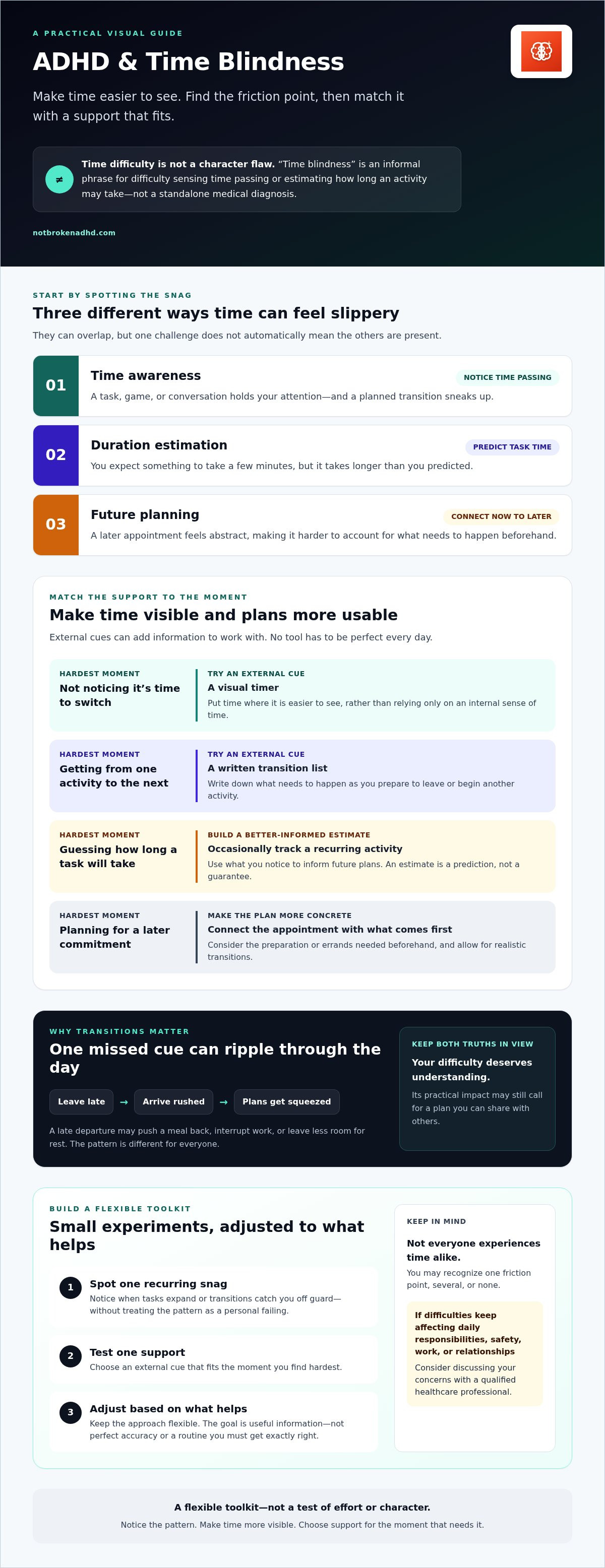
Time-related friction can take different forms. You might lose track of the clock while absorbed in a game, work task, or conversation. Or you may know it’s 7:30 but underestimate how long getting ready, finding your keys, and leaving will take. These experiences are related, but they aren’t identical:
- Time awareness: Not noticing that time is passing or that a planned transition is near.
- Duration estimation: Expecting a task to take less time than it actually does.
- Future planning: Finding it hard to connect a later appointment with what needs to happen beforehand.
A missed transition can ripple through the day. Leaving late may mean arriving rushed to an appointment, pushing a meal back, interrupting work, or squeezing rest into a smaller window. The pattern isn’t the same for everyone with ADHD. You might recognize one of these friction points, several, or none at all.
Why it is not a measure of care or effort
Missing a time cue doesn’t automatically mean you don’t care, aren’t trying, or are being disrespectful. Your internal sense of time may not give you a useful warning, or an activity may hold your attention past the point you meant to stop. Understanding the pattern helps you identify useful support instead of adding blame.
At the same time, lateness and disrupted plans can affect other people. Both things can be true: your difficulty deserves understanding, and its practical impact may call for a plan you can share with others. For a wider perspective on different ADHD experiences, explore the interactive ADHD experience guide.
As you consider ADHD time blindness solutions, first identify which part feels hardest: catching the moment to switch, estimating a task, or planning backward from a commitment. That distinction makes it easier to choose a strategy for the specific situation.
Why ADHD Can Make Time Harder to Notice and Estimate
Time isn’t only what a clock displays. It’s also how you sense its passage, judge how long an activity might take, and use that sense to plan what comes next. These abilities are connected, but they can be difficult in different ways. ADHD is associated with challenges in self-regulation and executive functioning, the mental skills used to manage attention, actions, and plans. Not everyone with ADHD experiences time alike.
Attention can narrow around whatever has captured it. If you’re deeply engaged in a task, a clock across the room or a reminder on your phone may not register strongly enough to prompt a change. This is one possible reason an external cue can be easy to miss, not a definitive explanation of any one person’s experience.
The difference between feeling time and estimating it
Feeling time means noticing time as it passes in the moment. Estimating time means predicting how long something will take before you begin. For example, you might notice that your shower is still going, yet have trouble predicting beforehand how much time getting ready will need. One challenge doesn’t automatically mean the other is present, too.
A time estimate is a prediction, not a guarantee of how long a task will take. A task may involve extra steps, interruptions, or a slower start than you expected. Occasionally tracking how long a recurring activity actually takes can give you more useful information for future plans. The aim is a better-informed estimate, not perfect accuracy.
Why transitions and future plans can feel slippery
Changing activities involves several steps: noticing that it’s time, pausing what you’re doing, and beginning something else. If your attention is absorbed or the next task feels distant, the transition may not feel urgent until the deadline is close.
A time horizon is the span of future time someone can comfortably keep in mind while planning. An appointment later in the week, for instance, may feel abstract until it’s close. That can make it harder to connect the appointment with the errands or preparation needed beforehand. This varies by person and situation. It isn’t a fixed limit or a measure of motivation.
Breaking a distant commitment into visible steps can make planning feel more manageable. For broader context, see these executive functioning strategies. If you’d like more educational material to explore ADHD and self-management, visit The ADHD Field Guide resource hub. Naming the friction point can help you choose ADHD time blindness solutions for the moment instead of expecting one explanation or tool to work for everyone.
Which ADHD Time Blindness Solutions Fit Your Most Frustrating Moment?
The most useful support is usually aimed at the moment that trips you up. A reminder may not help much if the harder part is guessing how long getting ready takes. Start with one recurring snag, then test a cue where it’s needed.
| Frustrating moment | External supports to try |
|---|---|
| You lose track while focused | Put a visible clock near your activity, or set a gentle alarm or planned check-in. |
| A task regularly takes longer than expected | Make an initial estimate, time the task occasionally, and use what you observe to inform future plans. |
| Leaving feels rushed | Use separate cues to stop your current activity, begin getting ready, and leave. Keep a short written departure list nearby. |
These aren’t tests of willpower. They’re environmental cues that put reminders outside your memory, so you don’t have to keep checking the time internally. Put each cue where you’re likely to encounter it. A timer across the house may be easy to miss; a clock in your work area or a note by the door is more directly connected to the task.
If you lose track while absorbed in an activity
Choose a cue you can notice without startling you. A quiet chime, a visual timer in your line of sight, or a planned check-in can mark a moment to pause and ask, “Is it time to switch?” If sound disrupts your focus or raises stress, try a visual prompt instead. The goal is a useful nudge, not an alarm you dread.
If tasks take longer than expected or leaving feels rushed
For a recurring task, write down your estimate before starting, then occasionally check the actual elapsed time. One observation doesn’t determine how long the task will take next time, but patterns can give you more context for planning. For leaving, separate the transition into steps: stop, get ready, then go. Add a realistic buffer based on your own routine and circumstances. There’s no single number that fits everyone.
Test one change at a time, then notice whether it made the transition easier. If a cue is annoying, hard to see, or creates another task to manage, adjust its location or format, or drop it. ADHD time blindness solutions should reduce friction, not become another standard you have to meet. The right support may be simple, though it can take a few tries to find a useful fit.
How to Build a Simple ADHD Time-Management Toolkit
A useful toolkit doesn’t need to be complicated. Start small enough to tell whether a support helps, without adding a whole new routine to manage. The goal is to make one part of your day easier to see or act on.
Notice one recurring snag, choose one cue, test it in the moment, and review what changed.
Choose one recurring time problem to work on first
Pick a situation that repeats, such as losing track during a work block or forgetting to start getting ready until it’s nearly time to leave. Avoid trying to repair your whole schedule at once. For a few days, make a brief, neutral note about what happened: “Didn’t notice the time until the meeting reminder” or “Getting ready took longer than I expected.” This is information, not a score for your productivity or worth.
Then ask what kind of support was missing:
- Elapsed-time awareness: Would a visible clock or timer help you notice time passing?
- Task-duration estimates: Would occasionally checking how long a recurring task takes help with future planning?
- Transition cues: Would a prompt to stop, get ready, or move to the next activity help?
Test cues and adjust them around real routines
Choose one cue and put it where you need it. A calendar alert may help you remember an upcoming commitment; a written transition list by the door may help you follow departure steps. A visual timer or app may make an interval easier to notice. Try the support during the actual routine, then check whether it was visible, understandable, and easy to respond to.
A Pomodoro-style timer can be one optional way to mark a work interval, but it won’t suit every task or person. If sound is distracting or stressful, choose a quiet visual cue instead. These ADHD sensory overload strategies may offer useful context for choosing gentler prompts.
After testing a cue, ask: Did I notice it? Did it help me take the next step? Did it create extra friction? Keep it if it supports your routine, adjust it if it nearly works, or drop it if it adds more effort than value. You don’t need to adopt several new habits at once. One well-placed support can be a more practical starting point than a perfect-looking system you can’t maintain.
For more educational resources to support your self-management, explore the ADHD Field Guide. The Field Guide offers downloadable ADHD guides, executive function educational content, simulations, and a Pomodoro timer. Treat time-management ideas as flexible experiments: the aim is to find cues that fit your real day, not to follow a system flawlessly.
When Self-Help Is Not Enough: Support and Next Steps for ADHD Time Blindness
External cues and routines can make time easier to work with, but they aren’t expected to solve every difficulty. If time-related problems keep affecting your safety, relationships, work, or daily responsibilities, it’s reasonable to seek additional support. You don’t need to wait until everything feels unmanageable.
How to tell when additional support may help
Look for recurring effects, not a single difficult day. Perhaps you repeatedly miss important commitments, struggle to complete essential tasks, or find that lateness is creating ongoing conflict. Before speaking with a qualified healthcare professional, you might jot down a few concrete examples: what was happening, what you expected to happen, and what impact followed. These notes can help you describe your concerns without needing to explain everything perfectly.
A conversation with a professional can help you explore what may be contributing to the difficulty and what kinds of support could be appropriate. This doesn’t mean time-management tools have failed or that you should stop using strategies that help. Seeking support and adjusting your everyday setup can go hand in hand. No single approach works for everyone, and this article can’t determine what’s behind your experience.
ADHD time blindness solutions can be useful supports, but persistent challenges deserve attention in their own right. You’re allowed to ask for help before you have a complete explanation.
Explore learning tools at your own pace
Learning about ADHD experiences may help you find language for patterns you’ve noticed and consider what supports could fit your routines. The ADHD Field Guide offers educational guides and simulations as optional learning tools. They’re for education and self-management, not clinical assessment. The Field Guide doesn’t provide diagnosis, prescriptions, or individual coaching.
You can choose one small next step: keep a brief note about a recurring difficulty, try a manageable cue, or bring your observations to a qualified professional. You can also explore educational materials at your own pace. There’s no need to do everything at once.
Explore ADHD learning resources for another low-pressure way to learn and consider what might support you.
Make Time More Visible, One Support at a Time
Time feeling hard to track isn’t a measure of how much you care or how hard you’re trying. Start by noticing where the friction shows up: sensing time pass, estimating a task, or switching to what comes next. Then choose one external cue, try it in your real routine, and adjust it if it adds more effort than help.
The most practical ADHD time blindness solutions are flexible. A calendar, visual timer, or written transition list may help make time easier to notice, but no single support needs to work for every person or every day. If these difficulties keep affecting important parts of your life, it’s okay to seek help from a qualified healthcare professional, too.
If learning more feels like a helpful next step, The ADHD Field Guide offers educational resources and interactive simulations to explore at your own pace. These tools support learning, not diagnosis. Explore ADHD learning resources at your own pace, and choose one small idea to try. Progress can begin with a cue that makes the next moment a little clearer.
Frequently Asked Questions
What is time blindness in ADHD?
Time blindness is a common phrase for difficulty noticing time passing, estimating how long tasks may take, or anticipating when to switch activities. Someone might become absorbed in a task and miss a transition cue, or expect a short task to take less time than it does. The experience differs from person to person. The phrase describes a practical challenge, not a personal failing or a standalone diagnosis.
Is time blindness an official ADHD diagnosis?
No. Time blindness is a descriptive term for difficulties with time awareness or estimation, not a formal diagnosis on its own. If these difficulties are persistent or disruptive, a qualified healthcare professional can discuss your concerns in the broader context of your wellbeing and daily life. Educational articles and self-check resources may help you reflect on patterns, but they can’t determine whether you have ADHD or replace an individual assessment.
Can timers help with ADHD time blindness?
Timers can make elapsed time more visible, particularly during an absorbing task, but they aren’t a guaranteed fix. Try one cue, such as a visual countdown, gentle alarm, or planned check-in, and notice whether it helps you shift activities. Placement matters: keep it where you’re likely to see or hear it. If the cue feels stressful, distracting, or easy to ignore, change its format or location.
How can I stop losing track of time with ADHD?
Start by identifying one situation where time regularly slips away, then add a cue at that point, such as a visible clock, calendar alert, or planned check-in. If a recurring task runs long, occasionally note its actual duration to inform future estimates. These ADHD time blindness solutions work best as flexible supports, not rigid rules. Keep the setup small, and adjust or drop anything that adds more effort than help.
Why do people with ADHD underestimate how long tasks take?
Task duration can be hard to predict, especially when an activity has several steps or gets interrupted. Attention may also stay focused on the current task while a later commitment feels distant, making it harder to plan the time needed beforehand. This experience isn’t the same for everyone with ADHD. Briefly tracking how long a recurring task takes can offer useful personal information without turning it into a judgment.
What is the best timer for ADHD time blindness?
There isn’t one best timer for everyone. Some people prefer a visual countdown; others find a gentle sound, calendar reminder, or scheduled check-in easier to use. Choose a cue you can notice in the place where you need it. Test one option at a time, then assess whether it helps you act or creates pressure and distraction. A different format or placement may be a better fit.
When should I seek professional help for ADHD-related time problems?
Consider speaking with a qualified healthcare professional if time difficulties repeatedly interfere with responsibilities, relationships, safety, or wellbeing, or if you have broader concerns about ADHD. Bring specific examples, such as a recurring impact on work or daily tasks, and note what supports you’ve tried. Asking for help doesn’t invalidate your efforts. Educational resources can support reflection, but they don’t replace individual assessment or professional advice.


