

What if the same argument keeps returning not because either of you doesn’t care, but because you’re caught in a pattern that’s hard to see from inside it? In the adhd relationship conflict cycle, a missed task or forgotten plan can lead to reminders, hurt, defensiveness, and distance. Then the distance feels like another sign that something is wrong. A familiar issue becomes a bigger argument, with no lasting change.
If you’ve promised to do things differently but can’t seem to build routines that stick, or you feel criticized, dismissed, overwhelmed, or misunderstood, you’re not alone in finding this painful. ADHD-related challenges can affect attention, follow-through, and emotional regulation, but they don’t make one partner the sole cause of conflict. The pattern between you matters.
This article explains how that cycle can take hold and how both partners can begin to interrupt it. You’ll find practical ways to pause escalation, make needs clearer, create shared systems that support follow-through, and repair after a disagreement. We’ll also explore when self-help may not be enough and outside support could be useful.
Key Takeaways
- The adhd relationship conflict cycle is a repeating interaction pattern, not proof that either partner is the problem.
- Executive-function challenges can affect everyday tasks and shared plans, while each partner may interpret the same event differently.
- Learn a flexible way to notice escalation, pause, name the issue, make one clear request, and agree on follow-up.
- Discuss shared routines and responsibilities when you’re both calm, rather than trying to solve everything mid-argument.
- If distress continues or repair feels stuck, a qualified professional may help you explore support options, including couples therapy.
What Is the ADHD Relationship Conflict Cycle?
You agree to take care of a household task, but it slips your mind. Your partner brings it up again, and you hear disappointment in their voice. They may feel alone carrying the responsibility, while you feel judged before you can explain. Suddenly, the argument is about more than the task. If this feels familiar, it may help to look at the pattern between you instead of deciding one person is the problem.
The ADHD relationship conflict cycle is a repeated interaction pattern in which a practical difficulty, the meaning each partner gives it, and their reactions can reinforce one another, regardless of either person’s character or intentions. It isn’t a formal diagnosis or a universal experience for people with ADHD. ADHD can contribute to friction, but it doesn’t determine a relationship’s future or excuse hurtful behavior. A clinical overview of adult ADHD notes that relationship difficulties can be associated with the condition. That context can inform understanding without defining any particular couple.
How a Small Disagreement Can Become a Familiar Pattern
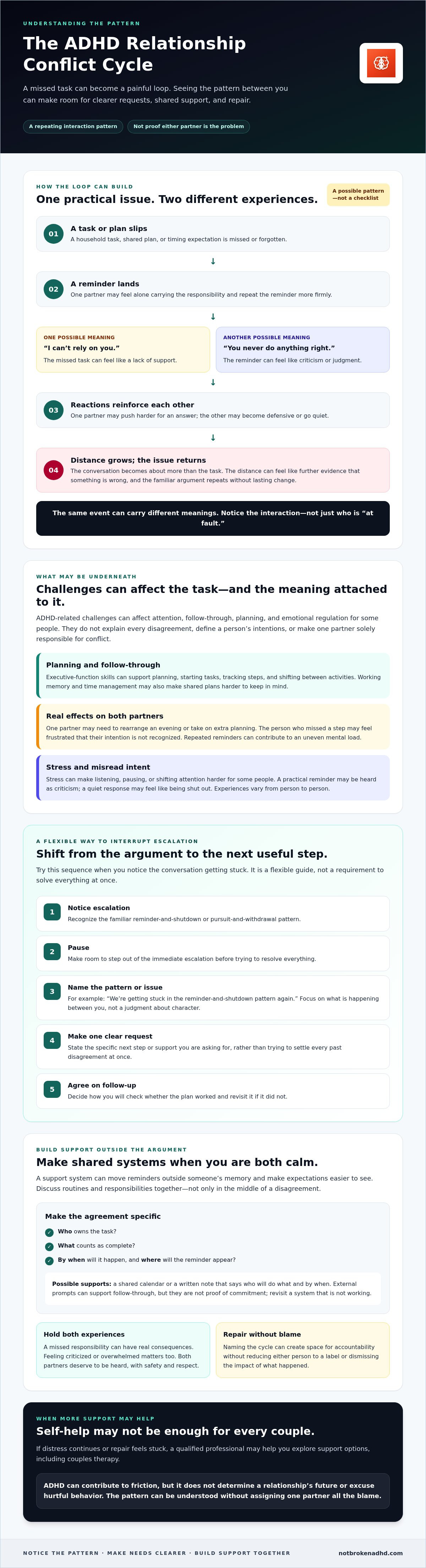
Imagine one partner expects the recycling to go out before pickup, while the other doesn’t realize the timing matters. The first might interpret the missed task as, “I can’t rely on you,” and repeat the reminder more firmly. The second might hear, “You never do anything right,” and respond defensively or go quiet. Feeling shut out, the first partner may push harder for an answer. A practical concern has become a loop of pursuit and withdrawal.
That’s one possible sequence, not a checklist for identifying ADHD or diagnosing a partner. The same event can have different explanations, and similar arguments can arise for reasons unrelated to ADHD.
Why Naming the Pattern Is Different From Assigning Blame
Giving the interaction a name can create a pause: “We’re getting stuck in the reminder-and-shutdown pattern again.” This shifts attention from judging someone’s character to noticing what happens between you and asking what each person needs next. It doesn’t require either partner to agree on every detail of the past argument.
Understanding context is not the same as dismissing impact. A missed responsibility may have real consequences, and feeling criticized or overwhelmed matters, too. Both experiences deserve to be heard, and both partners deserve safety and respect. Naming the cycle makes room for accountability without reducing either person to a label.
How ADHD-Related Challenges Can Feed the Conflict Cycle
Some recurring disagreements grow from the gap between intending to do something and being able to organize, start, and finish it at the expected time. ADHD can affect these processes for some people, but it doesn’t explain every missed plan or argument. Understanding possible challenges can help couples look for useful supports instead of treating a difficulty as proof of someone’s character.
Executive Function, Follow-Through, and Uneven Mental Load
Executive function is the group of mental skills used to plan, begin tasks, keep track of steps, and shift between activities. Working memory, which helps hold information in mind while using it, and time management may also make shared plans harder to track for some people with ADHD. A person might intend to pick up a prescription after work, then lose track of the plan amid competing demands.
The practical impact can be real. A partner may have to rearrange their evening or take on extra planning, while the person who missed the step may feel frustrated that their intention isn’t being recognized. Neither impact reveals, by itself, whether someone cares or is trying. Repeatedly carrying the reminders can also create an uneven mental load, even when neither partner wants that arrangement.
When a task keeps slipping, move the reminder outside someone’s memory: put the next step in a shared calendar or write down who will do what and by when. Make the agreement specific enough to use: identify who owns the task, what counts as complete, and where the reminder will appear. External prompts support follow-through, but they aren’t proof of commitment and don’t remove the need to revisit a system that isn’t working.
Emotional Reactions, Stress, and Misread Intent
Stress can make it harder for some people to listen, pause before responding, or switch attention from one task to a serious conversation. Emotional reactions may feel intense, too, but people with ADHD don’t all experience or express emotion in the same way. Concepts such as rejection sensitivity shouldn’t be treated as a universal ADHD symptom or assumed to explain every disagreement.
A reminder meant as practical help might land as criticism. The other partner may then defend themselves, go quiet, or leave the conversation, which can feel dismissive and prompt more questions or sharper reminders. This pattern can reinforce itself, but it isn’t inevitable. Both partners can describe what happened and its effect without claiming certainty about the other person’s intent.
Learning about executive function may help you identify where a routine needs more support. ADHD-focused executive-function educational resources can offer background for reflection, though they aren’t relationship treatment.
ADHD Relationship Conflict: Different Experiences, Shared Responsibility
The same event can carry different meanings for each partner. One person may be trying to explain a real difficulty; the other may be managing its real effects. Neither interpretation automatically captures the whole story. In the ADHD relationship conflict cycle, curiosity about those different experiences can help replace assumptions with questions, without asking either partner to ignore what happened.
What Each Partner May Be Experiencing
Consider a shared plan that gets missed. A partner with ADHD might feel overwhelmed, ashamed, or frustrated that an intention didn’t become action. Their partner might feel disappointed, left to handle the consequences, or tired of tracking details alone. These are possible responses, not roles every couple fits. Try separating what you observed from what you inferred:
| Observable event | Possible interpretation and question to clarify |
|---|---|
| A planned call or appointment wasn’t remembered. | One partner may think, “I’m not a priority.” The other may feel embarrassed or overloaded. Ask: “What got in the way, and what would help us keep track next time?” |
| One partner asks about a responsibility more than once. | The reminder may feel like criticism; the repeated follow-up may reflect worry or an unequal workload. Ask: “What are you concerned about, and how should we divide or track this?” |
Use the questions to learn, not cross-examine. “What happened?” and “What support would help?” can reveal more than deciding that a missed step proves carelessness or that a reminder proves hostility.
Where Understanding Ends and Accountability Begins
ADHD may help explain why a task, transition, or plan was difficult. It doesn’t erase the effect on a partner or make repair optional. Likewise, acknowledging impact doesn’t mean assuming bad intent. Both can be true: a person didn’t mean to let their partner down, and their partner was still left handling the result.
Move from apology to a specific agreement. Clarify who owns the responsibility, what “done” means, and what reminder or backup system you’ll use. Then check whether the plan worked. A sincere apology matters, but repeated apologies without a workable change may leave the same burden in place.
Everyday conflict is different from intimidation, coercion, threats, or abuse. Fear, control, or recurring harm isn’t simply a communication mismatch, and a conversation technique may not be safe or sufficient. Prioritize safety and seek appropriate help from a qualified professional or local support service. If there’s immediate danger, contact emergency services.
How to Interrupt an ADHD Relationship Conflict Cycle
You don’t have to solve every underlying issue in the middle of an argument. The first goal is to slow the interaction enough for both partners to understand what’s happening and choose a next step. Try this flexible sequence: notice the pattern, pause, name the issue, make one clear request, and agree on when you’ll follow up.
Pause Escalation Without Avoiding the Conversation
Agree on a pause signal when you’re both calm, such as, “I’m getting overwhelmed and want to come back to this.” Name a specific time to resume so the conversation doesn’t disappear into indefinite withdrawal. Each partner can say what would help them feel ready to continue, such as a few quiet minutes, a written note, or focusing on one topic at a time.
A pause isn’t a way to silence a concern or avoid accountability. It’s a chance to return with more capacity to listen. If the agreed time needs to change, communicate that and set another time together.
Turn Repeated Reminders Into Shared Systems
Discuss recurring responsibilities when you’re calm, not while either of you is already feeling criticized or overloaded. Choose one visible tool, such as a shared calendar or written task list, and make the details explicit: who owns the task, what completion means, and how you’ll check in. For example, a task list can show the owner and due date, while the calendar can hold the reminder. Treat the system as something to test and adjust, not a measure of love or effort.
For a conversation about a late bill, a script might be: “The payment was still pending this morning. I felt anxious because I wasn’t sure whether we’d avoid a late fee. Could we add the due date to our shared calendar and agree who checks it?” The structure is simple: describe the observable event, explain its impact, then make one specific request. The other partner can share their perspective and say what support would make the agreement workable.
If the ADHD relationship conflict cycle starts again, try naming the process without accusing: “We’re getting stuck on reminders and defensiveness. Can we pause, then decide on one next step?” That keeps the focus on a practical repair rather than replaying every past disagreement. Afterward, check whether the plan worked for both of you. If not, revise it together. A first attempt that falls short is information, not proof that change is impossible.
For more background on planning, organizing, and follow-through, explore these executive-function educational resources. They can support learning and reflection, though they aren’t a substitute for relationship care or professional support.
When to Seek Support and Build a More Sustainable Pattern
Self-guided strategies can be useful, but they aren’t the right tool for every situation. Consider reaching out to a qualified professional if the same painful arguments keep returning despite sincere efforts, if distress is affecting daily life, or if apologies and agreements aren’t leading to meaningful repair. You don’t have to wait until a relationship is in crisis to ask for help.
Signs Your Current Repair Attempts Need More Support
Individual support or couples therapy may be options to discuss with a qualified professional. The right fit depends on what each person wants, the concerns involved, and whether both partners can participate safely. Couples therapy can offer a space to examine recurring interactions, but outcomes aren’t guaranteed, and one approach won’t suit every couple.
Pay attention to safety. If a partner feels afraid, controlled, threatened, or intimidated, prioritize confidential, local safety support instead of relying on routine communication strategies or assuming joint sessions are appropriate. If there’s immediate danger, contact emergency services. Fear and coercion call for support that takes safety seriously.
Use ADHD Education as a Starting Point, Not a Diagnosis
Learning more about ADHD may help you reflect on how attention, planning, or follow-through affect everyday life. The ADHD Field Guide offers educational materials and interactive ADHD simulations for learning. These tools can prompt questions and support reflection, but they can’t establish a diagnosis, provide therapy or coaching, or treat relationship problems. For concerns about ADHD or relationship distress, seek guidance from a qualified professional.
The adhd relationship conflict cycle can take time and shared effort to change. If you’d like to keep learning, The ADHD Field Guide’s downloadable guides, executive-function resources, and interactive simulations can serve as optional educational supports. They can add context to what you’ve noticed, while professional care remains the appropriate next step when you need assessment or relationship support.
Take One Step Toward a Different Pattern
Recurring arguments can leave both partners feeling misunderstood, but the pattern isn’t the whole relationship. The adhd relationship conflict cycle may become easier to recognize when you focus on what happens between you, rather than treating a missed task or tense reaction as proof of someone’s intentions.
Start small. Pause when the conversation escalates, return to it at an agreed time, and make one clear request. When you’re both calm, decide on a shared reminder or written agreement, then check whether it works for each of you. Understanding possible ADHD-related challenges can add context, while accountability and the impact on both partners still matter.
If conflict continues to cause distress or repair feels stuck, consider speaking with a qualified professional. For additional learning, The ADHD Field Guide offers ADHD-focused guides, executive-function resources, interactive simulations, and an online ADHD Self-Check Tool. These are educational resources for reflection, not diagnosis or relationship treatment.
Explore practical ADHD education and tools as you keep learning. Change doesn’t require getting everything right at once. A more workable next step is still progress.
Frequently Asked Questions
Can ADHD cause relationship conflict?
ADHD-related challenges can contribute to relationship conflict, but they don’t automatically cause it or determine how a relationship will go. Difficulties with remembering plans, organizing tasks, or managing time may create strain, especially if one partner takes on more of the planning. Stress and communication habits can also play a role. Looking at the specific situation, its impact, and what support might help is more useful than assuming ADHD explains every disagreement.
Why do couples with ADHD keep having the same arguments?
Couples may revisit an argument when the underlying problem and the way they respond to it haven’t changed. A missed responsibility can prompt repeated reminders; those reminders may feel critical, leading to defensiveness or withdrawal. The other partner may then pursue the conversation more urgently. If the couple relies only on apologies but doesn’t clarify ownership, reminders, or follow-up, the same practical problem can restart the pattern.
How can couples stop an ADHD conflict from escalating?
Agree on a pause signal and a clear time to return to the conversation. Once calmer, focus on one observable event, describe its impact, and make one specific request. For example: “The appointment wasn’t added to our calendar, and I felt unsure how to plan. Can we decide who records appointments?” Discuss shared tools and responsibilities outside the argument, when both partners have more room to listen and problem-solve.
Does ADHD excuse hurtful behavior in a relationship?
No. ADHD may offer context for some difficulties, but it doesn’t erase their impact or remove the need for accountability and repair. A partner can acknowledge that a behavior caused hurt, listen to the other person’s experience, and work on a practical change without assuming bad intent. Repeated harm, intimidation, coercion, or fear is not simply an ADHD-related conflict pattern. Prioritize safety and seek appropriate local support if these concerns are present.
Can couples therapy help when one partner has ADHD?
Couples therapy may help partners explore recurring conflict and consider ways to communicate or share responsibilities, but it can’t guarantee a particular outcome. A qualified professional can help you assess whether couples support, individual support, or another option fits your circumstances. Safety matters: if one partner feels controlled or afraid, confidential local safety support may be a better first step than routine communication advice or joint sessions.
How do you talk to your partner about ADHD and recurring conflict?
Choose a calm moment and describe a specific pattern without making a diagnosis or assigning motives. You might say, “We’ve had a few missed plans, and we both seem upset afterward. Can we talk about what gets in the way and what would help?” Listen to your partner’s view, share your own needs, and agree on one practical next step. ADHD educational resources can support reflection, but they can’t diagnose or treat relationship problems.


