

In an intense moment, the goal may not be to calm down instantly. It may be to notice what’s happening soon enough to choose your next step. With ADHD, emotions can rise quickly and take over a conversation or make a change of plans hard to manage. You may react before you’ve had time to think, then replay the moment afterward. ADHD emotional regulation strategies aren’t about blaming yourself or forcing feelings away. They’re ways to spot the signals and create more room to respond.
If generic advice like “just take a breath” feels dismissive or impossible to use when you’re overwhelmed, that makes sense. A strategy needs to fit the moment, not add another expectation. Emotional intensity isn’t a character flaw, and a difficult reaction doesn’t define you.
This guide explains why emotions may feel especially strong with ADHD and offers practical options for pausing, responding, and recovering. You’ll learn to recognize early cues, try realistic strategies during intense moments, and move forward after a reaction with less self-blame. Start by noticing the signal, then choose one workable next step.
Key Takeaways
- ADHD emotional regulation strategies can begin with noticing emotional cues, not trying to make feelings disappear.
- A brief pattern log can help you connect situations, feelings, intensity, needs, and what offered support.
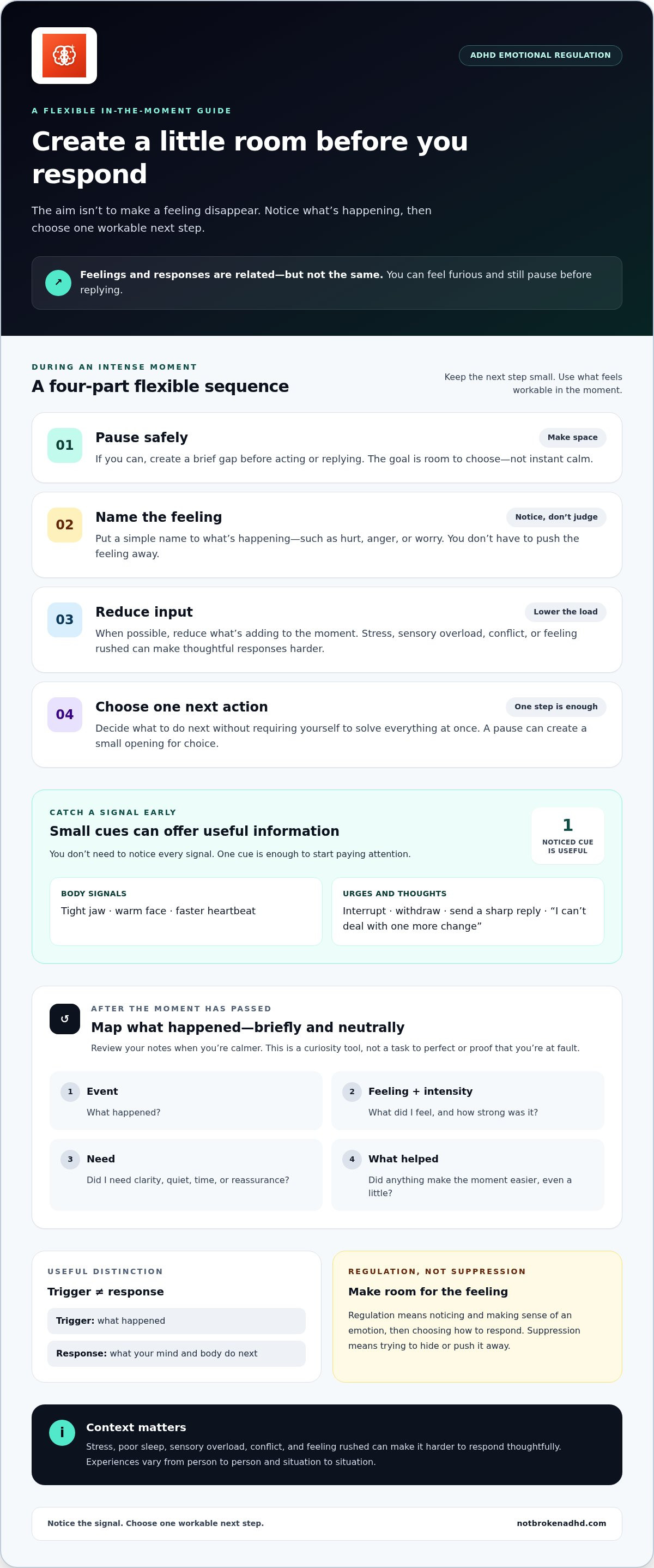
- During an intense moment, try a flexible sequence: pause safely, name the feeling, reduce input, and choose one next action.
- Build a plan by practising one strategy in a recurring situation, then reflecting on what helped and what conditions mattered.
- The ADHD Field Guide’s self-guided resources, including downloadable guides, interactive simulations, the ADHD Self-Check Tool, and Pomodoro timer, can support learning and reflection.
ADHD emotional regulation strategies start with understanding the emotional surge
Emotional regulation is the ability to notice what you’re feeling, make sense of it, and choose how to respond. The feeling doesn’t have to vanish first. Regulation means making room for an emotion without letting it dictate your next action; suppression means trying to hide or push the emotion away.
For some people with ADHD, feelings can arrive quickly, feel especially strong, or linger after the moment has passed. A conversation, a change of plans, or a small delay may feel surprisingly hard to manage. That isn’t evidence of a character flaw. Emotional dysregulation is a broad term for difficulty managing emotional responses. It can describe an experience without defining a person.
What emotional dysregulation can feel like in everyday life
A critical comment might bring a rush of hurt or anger. A delayed reply could spark worry; an unexpected schedule change might leave you feeling thrown off. Sometimes the emotion builds quickly. Sometimes it sticks around after the original moment and takes time to settle.
The feeling and the response are related, but they aren’t the same thing. You might feel furious and still pause before replying. Or you may snap, leave the conversation, or agree to something just to end the tension. Noticing that distinction can create a small opening for choice. There’s no single pattern: intensity, escalation, and recovery time differ from person to person and from situation to situation.
Why ADHD and strong emotions may interact
ADHD can affect executive functions, the mental skills that help with tasks such as directing attention and pausing before acting. For some people, that may make it harder to shift attention away from a distressing thought or create a gap between an emotional impulse and a response. This doesn’t mean ADHD causes every intense emotion or that everyone with ADHD experiences emotions in the same way.
Context matters, too. Stress, poor sleep, sensory overload, conflict, or feeling rushed can make it harder to respond thoughtfully. Strong emotions also occur in people without ADHD and can have many causes. Emotional regulation difficulties alone don’t establish an ADHD diagnosis; ADHD is assessed through a broader pattern of symptoms and their effects across life. Understanding your emotional signals is useful, but it’s not a test you need to pass.
That understanding is where practical ADHD emotional regulation strategies can begin: with curiosity about what happened and what might help next time, rather than self-criticism.
How to spot an emotional trigger before it takes over
A trigger is the event or condition that sets an emotional response in motion. The trigger is what happened; the response is what your mind and body do next. Separating the two can help you notice a moment of choice without judging whether your reaction was “too much.”
Early signals can be subtle: a tight jaw, warm face, faster heartbeat, or a sudden urge to interrupt, withdraw, or send a sharp reply. You might notice a thought such as “They’re ignoring me” or “I can’t deal with one more change.” Changes in the situation can matter, too, such as being interrupted mid-task or receiving unclear instructions. You don’t need to catch every signal. One noticed cue is useful information.
Map the moment with a simple trigger-and-response check-in
After the moment has passed, jot down a few neutral details. Keep it brief. This is a curiosity tool, not another task to perfect. Try these prompts:
- Event: What happened?
- Feeling and intensity: What did I feel, and how strong was it?
- Need: What did I need then, such as clarity, quiet, time, or reassurance?
- What helped: Did anything make the moment easier, even a little?
Review your notes when you’re calmer, not at the peak of distress. A pattern may emerge: perhaps rushed transitions are harder, or a short pause helps you respond more deliberately. A note isn’t evidence that you’re at fault or proof of a diagnosis. It’s simply a record of what you experienced. Some research on emotional dysregulation discusses its relationship with ADHD while highlighting the value of understanding emotional experiences in context.
Notice rejection-related distress without overpathologizing it
A brief message, missed invitation, or piece of feedback may bring a sharp wave of hurt or worry for some people. “Rejection sensitive dysphoria” (RSD) is a popular term for intense rejection-related distress, but it isn’t a formal standalone diagnosis. The experience can feel real and painful without serving as proof of ADHD. It also isn’t universal among people with ADHD.
When you notice rejection-related distress, record the specific event, the story your mind attached to it, and what you needed in that moment. This can help distinguish what you know from what you fear, without dismissing the feeling. For self-guided reflection, explore the ADHD learning resources from The ADHD Field Guide.
These observations can make ADHD emotional regulation strategies more personal. Instead of trying every suggestion, look for the cues and situations that matter most to you.
Which ADHD emotional regulation strategies help during an intense moment?
In a heated conversation or sudden wave of frustration, a complicated plan may be hard to remember. Keep the next step small. These ADHD emotional regulation strategies are options to test, not guaranteed fixes or rules you have to follow perfectly.
Pause safely, name the feeling, lower the noise, then choose one next step. That might mean waiting before replying, stepping away briefly if it’s safe and practical, or asking for a moment to think. If you can’t leave, turning your attention away from a screen or placing both feet on the floor may offer a small pause.
Use a pause, label, and next-step sequence
Start by making a little space between the feeling and your response. If it feels comfortable, try one slower exhale. You don’t need to breathe in a particular way or make the emotion disappear. Then name what’s happening in everyday words: “I’m embarrassed,” “I’m getting frustrated,” or “I feel overwhelmed.” You can add a simple intensity check, such as “strong” or “building.” The aim is to notice, not judge.
Choose one manageable action. You might say, “I want to respond thoughtfully. Can I come back to this in a few minutes?” Or ask, “Can you clarify what you meant?” If a reply can wait, save a draft rather than sending it while the feeling is at its peak. The American Psychological Association’s discussion of managing emotion dysregulation also highlights practical approaches to emotional challenges associated with ADHD.
Reduce overload before deciding what to say or do
Sometimes the environment is adding to the strain. If it’s safe and practical, lower the input: move somewhere quieter, dim a bright screen, pause background audio, or ask to continue the conversation later. You’re not avoiding the issue; you’re making it easier to think before choosing how to respond.
Grounding can be simple and personal. Notice the chair beneath you, the feel of your sleeves, or a familiar sound nearby. If focusing on bodily sensations makes things worse, choose something external instead, such as naming objects in the room. Preferences differ, so keep what feels supportive and skip what doesn’t.
For more ideas about sensory input and overwhelm, explore ADHD Sensory Overload Strategies: Practical Ways to Find Calm. Afterward, note which step helped, if any. A strategy that works in one setting may not fit another, and that’s useful information for adapting your approach.
Build an ADHD emotional regulation plan that works beyond the crisis
A plan doesn’t need to cover every possible situation. Start with one recurring moment, such as feeling rushed during a transition or getting overwhelmed by a difficult conversation. Choose one strategy to practise there, then review what happened afterward: What helped? What didn’t? Were you tired, under pressure, or dealing with extra noise? The goal is to adjust the plan, not grade yourself.
Consistency may be harder on some days than others, so practical supports matter. You might build in transition time, keep a prepared phrase on your phone, or reduce optional demands after a stressful interaction. A strategy that fits your access, energy, and surroundings is more useful than a perfect routine you can’t maintain.
Create a personal coping menu for different emotional states
A short menu can make choices easier when thinking feels effortful. Keep it flexible and include options that suit your circumstances:
- Early warning: Notice a body cue, pause, or use a phrase such as, “I need a moment to think.”
- Peak intensity: If safe and practical, step away, reduce stimulation, or postpone a reply.
- Recovery: Take time to rest, meet a basic need, or write down what you want to do differently next time.
You don’t have to use every option or move through the menu in order. Pick one low-effort step that feels possible in the moment. The Executive Functioning: Neurodivergent Guide (2026) may also offer related planning ideas as you shape supports that work for you.
Practise reflection and repair after a difficult interaction
Having an emotion isn’t a wrongdoing. If an action hurt someone, though, you can take responsibility for its impact without turning that responsibility into shame about who you are. When you’re ready, try a simple repair: “I’m sorry I interrupted you. I was overwhelmed, but I know that affected you. Next time, I’ll ask for a pause before continuing.” Keep it honest and choose a next step you can realistically try.
If emotional distress keeps disrupting relationships, work, or daily responsibilities, self-help education may not be enough on its own. Consider discussing what you’re experiencing with a qualified health professional. Educational tools can support reflection and learning, but they don’t replace individualized care.
To explore self-guided ADHD learning and practical resources, visit The ADHD Field Guide. Use what feels relevant, adapt it to your needs, and let your plan change as you learn more about what supports you.
Use The ADHD Field Guide resources for self-understanding
Learning what ADHD can look like in everyday life may help you reflect on your own patterns and consider which supports feel practical. The ADHD Field Guide is an educational companion for that process. Its tools are optional starting points for learning, not measures of your worth or requirements to follow a particular approach.
Choose an educational tool that fits the moment
Different resources can serve different purposes. Pick one that matches what you’re trying to understand or organize:
- The ADHD Self-Check Tool can support reflection on ADHD-related experiences. It does not diagnose ADHD.
- Downloadable ADHD and executive-function guides offer self-paced information you can revisit. They’re educational references, not personalized treatment plans.
- Interactive simulations offer educational experiences to explore.
- The Pomodoro timer can support focus and task structure. It’s a focus aid, not a treatment for emotional regulation.
You might use a guide to learn more about attention and daily challenges, or explore a simulation as one way to consider how different experiences can affect someone’s day. These resources can complement ADHD emotional regulation strategies by helping you build understanding and reflect on what may be useful. Educational materials and self-checks can’t confirm a diagnosis or replace individualized clinical care.
Know when self-guided strategies may not be enough
Self-guided learning can be useful, but you don’t have to manage everything alone. If distress persists or significantly disrupts relationships, work, school, or daily life, consider seeking support from a qualified clinical professional. They can help you explore your concerns and discuss options suited to your needs.
If you’re in immediate danger or thinking about harming yourself, contact local emergency services or crisis support now. You deserve timely help and support through the moment.
Explore The ADHD Field Guide’s educational resources at your own pace. Choose what feels relevant, leave aside what doesn’t, and use each tool as one possible aid to learning and reflection.
Take one small step toward a steadier response
Emotional regulation isn’t about never feeling overwhelmed. It’s about noticing what’s happening, finding a pause when you can, and choosing a next step that fits the moment. A few ADHD emotional regulation strategies may be enough to begin: track a recurring trigger, try one response during an intense moment, and adjust your plan based on what you learn.
Progress can include repairing a difficult interaction or giving yourself time to recover. It doesn’t require getting every moment right. Self-understanding grows through small, repeated observations, not self-blame.
The ADHD Field Guide offers self-guided educational resources, including an ADHD Self-Check Tool, downloadable guides, interactive simulations, and a Pomodoro timer for focus support. These tools can help with learning and reflection, but they don’t diagnose ADHD or replace clinical care. Explore practical ADHD guides and learning tools at your own pace.
Start with what feels manageable today. You can build from there, one small step at a time.
Frequently Asked Questions
Can ADHD cause difficulty regulating emotions?
ADHD can be associated with difficulty managing emotions for some people, though experiences vary. It may feel hard to shift attention away from an upsetting thought or pause before reacting, especially under stress. Emotional regulation difficulties alone don’t establish an ADHD diagnosis. If intense feelings are affecting daily life, it may help to track when they arise and discuss the pattern with a qualified health professional.
What are the best ADHD emotional regulation strategies for adults?
There isn’t one best approach for everyone. ADHD emotional regulation strategies may include noticing early body cues, naming the feeling, reducing stimulation, and choosing one small next step. For example, you might say, “I need a moment before I reply,” or step somewhere quieter if it’s safe and practical. Try one strategy in a recurring situation, then reflect on what helped and adapt it to your needs.
How can I calm down quickly during an ADHD emotional reaction?
You may not be able to switch off a strong feeling instantly, but you can try creating a little space before acting. If comfortable, pause and take a slower exhale, then name the emotion in plain words, such as “I’m frustrated.” Reduce input if possible, and choose one next step: ask for time, clarify what happened, or wait before sending a reply. These are options, not guaranteed fixes.
Is rejection sensitive dysphoria an official ADHD diagnosis?
No. Rejection sensitive dysphoria, often shortened to RSD, is a popular term for intense distress related to perceived rejection or criticism. It isn’t a formal standalone diagnosis, and experiencing rejection-related sensitivity doesn’t prove someone has ADHD. The feelings can still be painful and worth understanding. Notice the event, your interpretation of it, and what support you need, without treating the label as a clinical conclusion.
Can emotional dysregulation happen without ADHD?
Yes. Difficulty managing strong feelings can happen with or without ADHD and may be influenced by stress, sleep, relationships, sensory demands, or other circumstances. Emotional intensity by itself can’t confirm or rule out ADHD. If you’re concerned about a persistent pattern, consider discussing it with a qualified health professional, who can look at your broader experiences and how they affect daily functioning.
What happens if ADHD emotional regulation strategies do not help?
A strategy that doesn’t help in one moment isn’t proof you’ve failed. It may not fit that situation, or you may need more support than a self-guided technique can offer. Notice what was happening and consider trying a different adjustment. If distress continues or substantially disrupts work, relationships, or daily responsibilities, speak with a qualified clinical professional. If you’re in immediate danger or thinking about self-harm, contact local emergency or crisis support.
How can I explain my emotional reactions to someone I care about?
Choose a calm moment and describe what you experience without using it to excuse hurtful behavior. You might say, “Sometimes my feelings rise quickly, and I need a pause to respond thoughtfully. If I ask for a few minutes, I’ll come back to the conversation.” If your reaction affected them, acknowledge that impact and name a practical next step. A clear request can help you work together without assigning blame.


