

A routine that works with ADHD may need fewer fixed times, not more. If rigid schedules feel impossible to sustain, a missed task or disrupted morning can make the whole day seem lost. An ADHD friendly daily routine doesn’t have to run like clockwork. A few flexible anchors can offer structure while leaving room for changing energy, attention, and responsibilities.
A routine can also reduce the effort of remembering every transition and deciding what to do next. Simple cues and repeatable steps make everyday tasks easier to start without turning your day into a pass-or-fail test. When plans get interrupted, return to the next useful anchor instead of scrapping the whole routine.
This guide will help you build a practical daily checklist around essentials such as getting ready, meals, work or study, and winding down. You’ll find ways to make tasks visible, use short focus periods when starting feels hard, and adjust your plan for low-energy or unpredictable days. The goal isn’t a perfect timetable. It’s a flexible structure you can come back to.
Key Takeaways
- Build an ADHD friendly daily routine from a few reliable anchors, then add small steps and visible cues to make transitions easier.
- Compare anchor-based routines, time blocks, and minimum-viable routines to find a format that suits your day and energy.
- Use a short checklist to support daily essentials, transitions, breaks, and an evening reset without relying on memory alone.
- When plans change, return to the next helpful step rather than treating an interruption as a reason to abandon the routine.
- Review what’s working, simplify friction points, and remove steps you’re not using so the routine can adapt with you.
What Makes a Daily Routine ADHD-Friendly?
An ADHD-friendly routine is a small set of repeatable cues and steps that helps you move through daily tasks without requiring every action to happen at an exact time. It’s flexible structure, not a strict timetable. A morning cue might be putting your medication beside breakfast, or placing your keys by the door so they’re easier to spot when it’s time to leave.
An ADHD friendly daily routine can reduce the number of decisions you need to make from scratch. It won’t guarantee symptom relief or make every task easy. Instead, it gives you a familiar next step to return to while leaving room for changing energy, responsibilities, and circumstances.
Why can everyday routines feel difficult with ADHD?
Executive function is the group of mental skills we use to start tasks, plan steps, remember what we intended to do, and switch from one activity to another. With ADHD, using these skills can feel less consistent. You might lose track of time while getting dressed, remember an errand only after you’ve left home, or finish breakfast and forget that packing lunch was next.
That gap between intending to do something and getting started isn’t proof that you’re lazy or don’t care. A transition may be easy to miss when it exists only in your head. If a plan gets interrupted, it can also take effort to work out where to pick it back up. Visible reminders and repeatable cues help bring the next action into view.
What should a useful routine do?
A useful routine supports what matters in your actual day. It doesn’t need to fill every hour. Start with essential tasks and a few reliable anchors, such as waking up, arriving home, or getting ready for bed. Then connect each anchor to a simple action. After arriving home, for example, you might put your bag in one spot and check a short list for what’s next.
Good cues are easy to notice where you need them: a note near the door, a calendar alert, or breakfast items set out the night before. These supports make transitions more visible and reduce reliance on memory alone. Broader approaches to the management of ADHD symptoms include behavioral and psychosocial strategies. A daily routine can help organize everyday actions, but it isn’t a promise of treatment or symptom relief.
Most of all, the routine should fit your responsibilities, energy, and environment. A plan for someone working from home may look different from one built around school drop-offs or shift work. If a step repeatedly creates friction, use that as information. The structure should serve your day, not become another standard you have to meet perfectly.
Build an ADHD-Friendly Daily Routine Around a Few Reliable Anchors
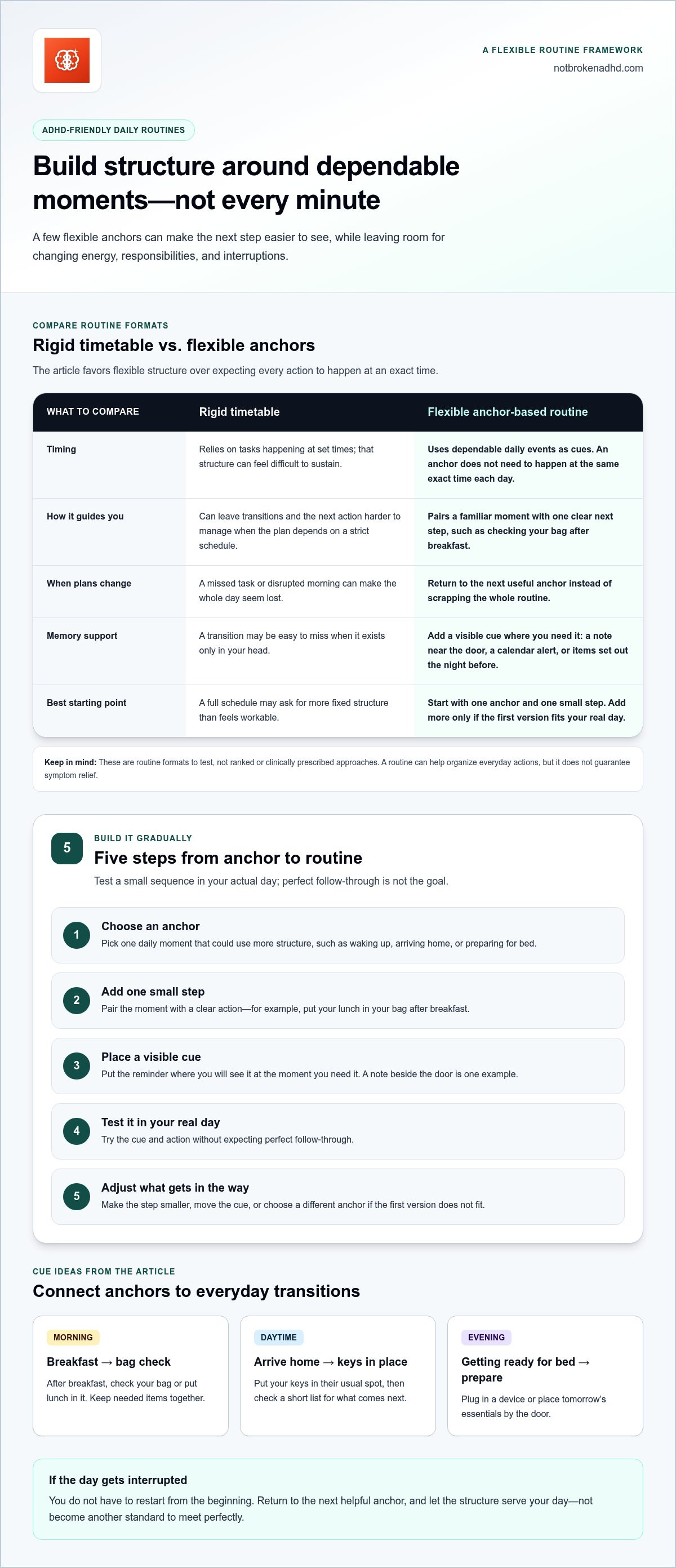
Start with one transition, not a complete schedule. Choose a moment that already happens most days, such as waking up, arriving home, or preparing for bed. An anchor is a dependable event that reminds you what action comes next. It doesn’t need to happen at the same exact time every day. The goal is to make the next step easier to notice.
Build from there with this simple sequence:
- Choose an anchor. Pick one daily moment that could use a little more structure.
- Add one small step. Pair the anchor with a clear action, such as putting your lunch in your bag after breakfast.
- Place a cue. Put a reminder where you’ll see it at the moment you need it.
- Test the routine. Try the cue and step in your real day, without expecting perfect follow-through.
- Adjust what gets in the way. Make the step smaller, move the cue, or choose a different anchor if the first version doesn’t fit.
This gradual approach gives you a starting point for an ADHD friendly daily routine without asking you to plan every hour. External supports, including reminders and organizational strategies, are also discussed in the CDC’s overview of behavior therapy and organizational skills training.
How do you choose morning, daytime, and evening anchors?
Look for events that already mark a shift in your day. In the morning, an anchor might be your first drink or breakfast. During the day, it could be lunch or leaving home. In the evening, try plugging in a device or placing tomorrow’s essentials by the door. Keep fixed commitments, such as a work start time or appointment, separate from flexible tasks that can move to another time window. For more focused morning planning, see this ADHD morning routine checklist.
How can you make each routine step easier to remember?
Attach a new action to a cue you already encounter. After breakfast, check your bag. When you arrive home, put your keys in their usual spot. Keep the items you need together, and place reminders at the point of action rather than somewhere you might not look. A note beside the door may be more useful than a long list saved on your phone.
Keep the first version short. Try one anchor and one step before adding more. The ADHD Field Guide’s executive function educational content can help you explore task organization and related skills through self-guided learning. Browse the ADHD executive-function resources.
Choose a Routine Format That Fits Your ADHD and Your Day
Once you’ve picked a few daily anchors, choose a format for linking tasks together. The best routine format is the one that matches the shape of your day, giving you enough structure to get oriented without adding more friction. These are options to test, not ranked or clinically prescribed approaches. You can also combine them.
| Format | Predictability | Flexibility | Setup effort | On disrupted days |
|---|---|---|---|---|
| Anchor-based | Steady cues link actions to familiar events. | Tasks can happen at different times. | Low to moderate. | Easy to resume at the next anchor. |
| Time blocks | Clear planned periods show when tasks fit. | Less flexible if the day shifts. | Moderate; blocks need planning. | May need reshuffling after interruptions. |
| Minimum-viable | A short list keeps essentials visible. | High; designed to scale down. | Low once essentials are chosen. | Useful when energy or time is limited. |
Is an anchor-based routine or a time-blocked schedule better?
Anchors organize actions around events, such as breakfast or arriving home. Time blocks reserve planned periods for tasks, such as setting aside part of the morning for email. If exact timing feels restrictive or your day changes often, anchors may feel easier to follow. If open-ended time makes it hard to begin or stop, blocks may offer helpful boundaries. Neither format works best for everyone. You can use anchors for transitions while time-blocking one task that needs a clearer start and finish. An optional focus timer can make a work period’s beginning and end more visible. If movement is part of your routine, CHADD shares ideas for how to incorporate physical activity into a daily schedule.
What is a minimum-viable routine for a difficult day?
A minimum-viable routine is a shorter fallback plan with only the actions that matter most in a particular situation. Before a busy morning, that might mean eating something, getting ready for a commitment, and setting out the essentials you need to leave. It isn’t the full routine done badly. It’s an intentional adjustment that keeps key needs in view when the usual plan feels like too much.
Try one format for a few days and notice what helps you start, switch tasks, or recover when plans change. Keep what fits and simplify what doesn’t. The ADHD Field Guide’s self-guided ADHD educational resources can support your learning as you explore what works for your routines.
Use This ADHD Daily Routine Checklist, and Reset When Plans Change
A checklist works best as a prompt, not a record of everything you’re expected to complete. Choose a few actions that support your day, group them by time of day, and leave space for priorities to shift. This flexible approach can make an ADHD friendly daily routine easier to use without needing to follow every step perfectly.
What belongs on an ADHD daily routine checklist?
Use the examples below as a menu. Pick only the actions that fit your responsibilities and environment. For more context on planning and task-switching skills, explore this executive functioning guide.
- Morning: ☐ Check the day’s first commitment. ☐ Gather one or two items you need before leaving or starting work.
- Daytime: ☐ Pause for food, water, or a needed break. ☐ Choose the next priority. ☐ Use a visible cue for an important transition.
- Evening: ☐ Put essentials in their usual place. ☐ Check what’s needed for tomorrow. ☐ Choose one simple first step for the morning.
Keep the list short enough to scan. If focusing on one task feels difficult, a Pomodoro-style timer can make a bounded work period more visible. The ADHD Field Guide’s built-in Pomodoro timer is an optional prompt, not a rule about how long you should work or rest.
What should you do when your routine falls apart?
Don’t try to reconstruct every missed step. Pause, check your next commitment, and name one useful action you can take now. That might be eating something, packing one needed item, or opening the document for your next task. A small reset is still a reset. For ideas on breaking a larger task into manageable steps, see these ADHD task management strategies.
At the end of the week, take a brief look at your checklist. Keep steps that helped, simplify the ones that repeatedly caused friction, and remove items you didn’t use. A routine is a working tool, not a promise to follow a fixed plan every day.
The ADHD Field Guide’s Pomodoro timer and ADHD learning resources offer self-guided support for focus and task management.
Keep Your ADHD-Friendly Routine Useful, Flexible, and Yours
A routine isn’t a test you pass by following every step. It’s a tool you can refine as your responsibilities, energy, and environment change. Try a step, notice what happens, and adjust. That cycle helps you build an ADHD friendly daily routine around what’s workable in real life, not what looks perfect on paper.
How can you tell whether a routine needs adjusting?
Look at the step itself before judging your follow-through. Was the cue easy to notice? Did the action feel manageable in that moment? Did the timing fit what else was happening? If the answer is often no, the setup may need a change. Move a reminder closer, make the action smaller, or connect it to a more dependable event.
Change one element at a time when you can. If you move a reminder and simplify the task all at once, it’s harder to tell which change helped. A disrupted day doesn’t automatically mean the routine is wrong. An unexpected appointment or a poor night’s sleep may be temporary; a step that repeatedly feels confusing or hard to access may be worth redesigning.
Measure usefulness, not perfect completion. Did the cue help you remember what came next, even once? Could you return to the plan after an interruption? Those small observations offer more useful information than expecting uninterrupted consistency.
Which The ADHD Field Guide tools may support routine experiments?
Self-guided learning tools can help you explore what makes planning and follow-through easier for you. Executive function educational content offers context for skills like organizing steps and starting tasks. The ADHD Field Guide’s Pomodoro timer can add a visible boundary to a focus session when beginning or staying with a task feels difficult. Use it if that structure suits the task, and adjust your approach if it doesn’t.
Interactive simulations offer educational experiences related to ADHD. They’re a way to explore and learn, not a diagnosis or treatment, and you don’t need any tool to begin adjusting a routine. The most useful support is the one that fits your needs and feels practical to return to.
Explore self-guided ADHD learning and task-support tools at The ADHD Field Guide. Take what’s useful, leave what isn’t, and keep shaping a routine that can flex with you.
Start Small and Let Your Routine Grow With You
An ADHD friendly daily routine doesn’t need to map out every hour. Start with a few dependable anchors, choose a format that fits your day, and keep a short fallback plan for moments when energy or plans shift. If a step isn’t helping, treat that as information: adjust the cue, simplify the action, or try a different approach.
Progress can mean noticing what helps you begin or making it easier to return after an interruption. It doesn’t have to mean completing every item without a break. Small, thoughtful changes can make your routine feel more supportive over time.
If you’d like extra ideas, explore ADHD-focused executive-function educational content, interactive simulations, and the built-in Pomodoro timer as optional supports for learning and focus. Explore practical ADHD guides and tools and choose what feels useful for your next routine experiment.
Start with one small change using the ADHD Field Guide’s practical guides and tools, then adapt your routine as life changes.
Frequently Asked Questions
How do you create an ADHD-friendly daily routine?
Start an ADHD friendly daily routine with one or two dependable anchors, such as waking up, eating a meal, or leaving home. Attach one small action to each, then place a visible reminder where you’ll do it. Try this simple version and notice what gets in the way. Adjust one step at a time. Your routine can support the day without accounting for every minute or requiring perfect follow-through.
What is a good morning routine for someone with ADHD?
A helpful morning routine is short, visible, and built around your actual commitments. Choose a few essentials, such as getting ready, gathering what you need, and checking your first appointment or task. If it reduces morning decisions, set out clothes, keys, or work items the night before. There’s no single ideal sequence. Use a checklist as a starting point, then keep the steps that make your morning more manageable.
Can a daily routine help with ADHD?
A daily routine can make some tasks and transitions easier to notice by connecting them to familiar cues. It may also reduce how often you need to decide what to do next. Results vary, and a routine isn’t a treatment or a guarantee that tasks will feel easy. Keep the structure practical and adjust it as needs change. For questions about diagnosis or treatment, seek guidance from a qualified clinical professional.
How many habits should you add to an ADHD routine at once?
There’s no fixed number of habits that works for everyone. For a first experiment, choose one anchor and attach one small action to it. A short routine gives you room to notice whether the cue, location, and timing work before adding more. If you keep missing a step, consider changing how or where it’s prompted rather than automatically adding more reminders. Build gradually, based on what feels manageable.
What should you do if you miss part of your ADHD routine?
Treat a missed step as a chance to reset, not proof that the whole day is lost. Check your next commitment or essential need, then choose one useful action, such as preparing an item you’ll need. You can return to the routine at its next anchor instead of trying to catch up on every skipped task. Later, consider whether the missed step needs a clearer cue or a smaller version.
Is a strict schedule or a flexible routine better for ADHD?
The better fit depends on your needs, the task, and how predictable your day is. Time blocks reserve planned periods for work or other activities, while an anchor-based routine links actions to familiar events and can leave more room for changes. You can also combine them. Try one format and notice whether it helps you start and switch tasks without adding pressure. Adjust it if the structure doesn’t suit your day.
How can I remember the steps in my daily routine?
Place reminders where the action happens, such as a checklist by the door, an alert before an appointment, or needed items together in one spot. You can also pair an action with an existing event, like checking your bag after breakfast. Choose only a few prompts you’re likely to notice. If a reminder blends into the background, move it or change its format so it stands out at the right moment.


