

What if your inability to stick to a conventional routine isn't a character flaw, but a design flaw in the systems you were handed? Standard advice tells you to sit down, write a linear checklist, and force yourself into disciplined focus through pure willpower. But when you are living with a dopamine-seeking nervous system, forcing neurotypical consistency usually leads to task initiation paralysis, severe time blindness, and the familiar sting of shame when another planner gets abandoned. That friction is not your fault. To get things done without burning out, you need genuine ADHD productivity hacks that work with your neurological wiring rather than waging war against it.
You already know the exhausting cycle of hyperfocusing on unimportant details for hours while crucial deadlines trigger quiet panic. In this guide, you will discover practical, neurodivergent-friendly strategies designed to bypass executive dysfunction, reduce friction, and rebuild momentum naturally. We will explore how to externalize your working memory, manage dopamine fluctuations sustainably, and build supportive scaffolds that help you start and finish tasks on your own terms.
Key Takeaways
- Understand why typical discipline fails an interest-based nervous system, reframing executive dysfunction as a brain wiring difference rather than a personal flaw.
- Use actionable ADHD productivity hacks like micro-steps and the very next physical action rule to overcome task initiation paralysis with minimal resistance.
- Externalize the passage of time with visual tools, transforming the abstract gap between "now" and "not-now" into something tangible and manageable.
- Optimize your work environment with body doubling and open storage systems that protect limited working memory.
- Adopt cyclical, shame-free workflows that permit seasonal resets and separate your daily biological energy from your moral self-worth.
Why Traditional Productivity Advice Fails the ADHD Brain
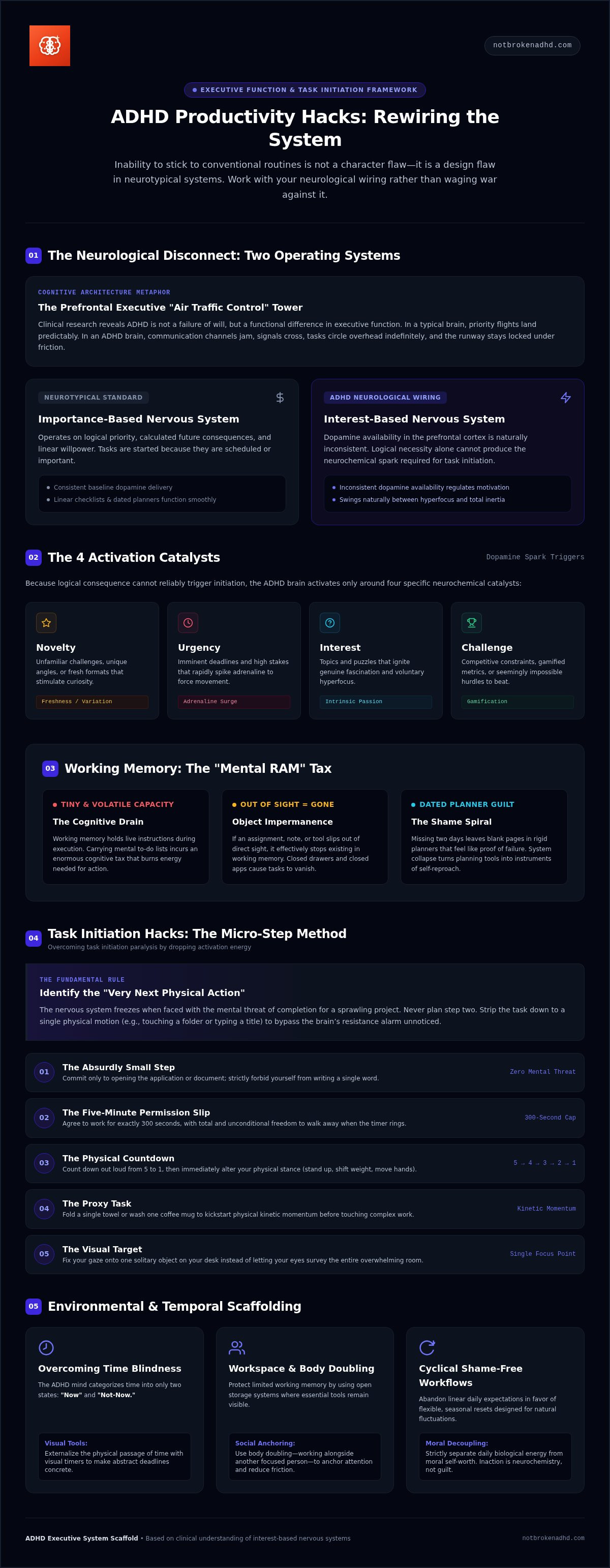
Most standard efficiency advice relies on a single premise: if a task is important, you will find the discipline to do it. For a neurodivergent mind, that logic falls apart immediately. Clinical research into attention deficit hyperactivity disorder reveals that the condition is not a failure of will. It stems from a functional difference in executive function. Think of your executive system as an air traffic control tower. In a typical brain, flights land smoothly based on scheduling priorities. In an ADHD brain, the control tower lacks reliable communication channels. Signals jam. Tasks circle overhead indefinitely. The runway stays locked.
When you attempt to force standard habit stacking or rigid daily schedules onto this neurological reality, the system collapses under friction. Surviving this disconnect requires intentional ADHD productivity hacks that address your actual cognitive architecture, not the neurotypical standard.
The Dopamine Deficit: Understanding Interest-Based Motivation
Neurotypical people operate primarily on an importance-based nervous system. They weigh consequences, assign priority, and start working. ADHD brains, by contrast, run on an interest-based nervous system. Dopamine availability in the prefrontal cortex is naturally inconsistent. Because dopamine regulates motivation, logical necessity alone cannot generate the spark needed for task initiation.
Instead, your brain activates reliably around four specific catalysts:
- Novelty: Unfamiliar challenges or fresh formats.
- Urgency: Imminent deadlines that spike adrenaline.
- Interest: Topics that trigger genuine curiosity.
- Challenge: Competitive or gamified constraints.
Fluctuating between intense hyperfocus and total inertia is not a personal defect. It is biological regulation at work.
Executive Functioning and Working Memory Breakdowns
Working memory acts like mental RAM. It holds instructions while you execute them. With ADHD, that scratchpad is tiny and volatile. If an assignment or tool slips out of direct sight, it effectively stops existing. Carrying mental to-do lists incurs an enormous cognitive tax, draining the mental energy you need for actual execution.
Rigid, dated planners often turn into instruments of self-reproach. Missing two days leaves blank pages that feel like proof of failure. Effective ADHD productivity hacks replace invisible mental tracking with externalized physical or visual scaffolds, keeping prompts observable without demanding impossible cognitive stamina.
Task Initiation Hacks: How to Break Through ADHD Paralysis
You sit frozen on your couch or stare blankly at your monitor. You desperately want to begin, yet your limbs feel glued in place. This is not defiance. It is task initiation paralysis, an acute neurological roadblock where the brain treats an open task as an insurmountable wall. Breaking through requires tactical, body-centered ADHD productivity hacks that lower the physical activation energy needed to spark movement.
The primary barrier is the mental threat of completion. If a project feels sprawling, the nervous system retreats into freeze mode. Instead of telling yourself to "clean the garage" or "file the report," strip the assignment down to its very next physical action. Do not plan the second step. Find a single concrete motion, like touching a folder or typing the document title, to slip past internal resistance unnoticed.
The Micro-Step Method: Lowering Activation Energy
Shrinking tasks into microscopic gestures bypasses cognitive alarms. You do not commit to finishing the project. You merely agree to set up the workspace. Use these five micro-initiation tactics when paralysis strikes:
- The absurdly small step: Tell yourself you will only open the application, not write a single word.
- The five-minute permission slip: Commit to working for exactly 300 seconds, with total freedom to stop when the timer ends.
- The physical countdown: Count down out loud from five to one, then immediately shift your physical stance.
- The proxy task: Fold a single laundry towel or clear one coffee mug to generate physical kinetic momentum.
- The visual target: Focus your gaze on one solitary object on your desk instead of surveying the entire room.
If you want structural frameworks to build these scaffolds systematically, exploring evidence-based executive function educational content can help normalize these patterns and offer practical blueprints.
Temptation Bundling and Sensory Priming
Dopamine drives initiation. When a task provides zero neurochemical reward, supply it externally through sensation. Pair dry, administrative chores with intense sensory inputs, such as gripping audiobooks, high-energy instrumentals, or textured desk items. Clinical observations documented via vertexaisearch.cloud.google.com indicate that novel sensory cues help dislodge persistent executive inertia.
Adjust your physical space to signal focus. Turn on a distinct amber desk lamp that is used exclusively during work sessions. When paralysis takes hold, change your physical altitude: sit on the floor, stand by a counter, or walk to another room. The nervous system resets with altered sensory scenery, opening a fresh window for these ADHD productivity hacks to kick in.
Time Management Hacks to Overcome ADHD Time Blindness
Time blindness is not poor discipline or carelessness. It is a genuine sensory gap. For someone with ADHD, time rarely moves as a predictable stream of minutes and hours. Instead, the brain perceives duration in only two operational modes: "now" and "not-now." If an upcoming deadline sits in the "not-now" bucket, it creates zero neurochemical response. The moment it tips into "now," it sparks panic. Standard calendar blocking fails because invisible digital grid lines provide no physical cues for passage. Bridging this perceptual gap requires practical ADHD productivity hacks that take time out of your head and make it visible.
Adapting the Pomodoro Technique for ADHD Flow States
The standard Pomodoro method insists on a rigid rhythm: 25 minutes of work followed by a 5-minute break. For an ADHD nervous system, this design can backfire. It often takes 20 minutes just to slip past task paralysis. A sharp digital buzzer ringing right as you reach genuine hyperfocus breaks momentum entirely, making re-entry nearly impossible.
Modify the technique so it protects your flow state rather than fracturing it:
- Use variable focus blocks: Adjust focus sessions between 15 and 45 minutes based on current dopamine levels.
- Select neurodivergent-friendly tools: Rely on a specialized digital pomodoro timer built to accommodate neurodivergent focus intervals without rigid interruptions.
- Adopt gentle auditory cues: Replace jarring, blaring alarms with soft chimes or fading acoustic sounds to avoid startle responses that spike anxiety.
Externalizing Time: Making the Invisible Visible
Digital clocks showing plain numbers fail to convey duration. Looking at "1:42 PM" demands mental math to deduce how many minutes remain before a 2:00 PM meeting. Analog clocks or visual countdown timers that physically shrink an illuminated disc display passage at a glance, instantly translating an abstract concept into observable reality.
To eliminate perpetual lateness and the chronic anxiety of shifting tasks, apply intentional buffer rules:
- The 2x Estimation Rule: Calculate how long you think a task will take, then double that estimate to account for unseen friction.
- Landing Zones: Never book back-to-back commitments. Build a mandatory 15-minute landing zone between meetings to decompress sensory input.
- Transition Alarms: Set one alarm 10 minutes prior to a departure time, signaling that it is time to wrap up, not run out the door.
By externalizing hours through visual tools and realistic padding, you turn time management into an observable, supportive ally.
Environmental and Focus Hacks: Designing Low-Friction Workspaces
Minimalist workspaces are often championed as the ultimate solution for focus. Put everything behind closed cupboard doors. File all papers into opaque drawers. Clear every surface. Yet for someone navigating executive functioning challenges, out of sight means completely out of mind. Hiding your critical tools triggers immediate forgetting, while sterile desks offer zero sensory stimulation to keep dopamine levels buoyant. Practical ADHD productivity hacks focus on visibility, tactile feedback, and external social anchors to maintain workflow continuity.
Instead of locking essentials away, set up open storage systems. Use clear acrylic bins, pegboards, and tier carts positioned directly in your eye line. Keep project folders open and visible on vertical book stands. When physical prompts remain in your field of vision, they function as effortless visual triggers, saving your working memory from running continuous background checks.
The Power of Body Doubling and Social Presence
Working in total isolation often amplifies executive freeze. Body doubling uses the quiet, non-judgmental presence of another person to anchor your attention. This strategy does not require paying for expensive community memberships or subjecting yourself to micromanagement. A friend sitting across the kitchen table reading a book, a quiet colleague working silently on a video call, or a recorded study-with-me stream provides enough social resonance to keep you grounded.
Before launching a body doubling session, state your exact target: "I am writing two project paragraphs right now." Announcing a singular micro-goal out loud establishes a calm external boundary that helps prevent aimless wandering.
Managing Digital Distractions and the Browser Vortex
Digital environments are full of friction traps. A quick search for an invoice template can easily morph into twenty open browser tabs and two lost hours. To prevent your digital workstation from derailing your focus, implement structural boundaries:
- Single-tab focus modes: Use full-screen settings on a single window to hide the dock, system clock, and taskbar entirely.
- The analog side-pad: Keep a blank notepad directly beside your keyboard. When an impulsive, unrelated thought strikes, write it down immediately to process later, keeping your browser locked on the task at hand.
- Curated dopamine menus: Write down pre-selected five-minute reset activities, like stretching or stepping outside, so you do not default to doomscrolling between tasks.
If you want to tailor your daily space with concrete, self-guided tools, you can explore practical, neurodivergent-friendly digital resources and downloadable ADHD guides to support your everyday workflow.
Building a Shame-Free Workflow: Sustainable Systems for the Long Haul
Most productivity systems break down because they assume human capacity is static. When a neurotypical routine stumbles, standard advice tells you to try harder. For a neurodivergent brain, trying harder against a depleted nervous system only deepens burnout. Your energy and focus will naturally rise and fall. Separating your biological capacity from your moral self-worth is the most foundational shift you can make. Having a low-energy day does not make you undisciplined; it simply means your cognitive battery requires recharging.
Sustainable ADHD productivity hacks are not about rigid consistency. They are about creating flexible scaffolds that you can step away from and return to without guilt, adapting your expectations to your daily reality.
Recovering From System Burnout Without Shame
When a new planner or organizational app stops working after three weeks, it is easy to spiral into self-blame. The reality is simple: novelty naturally wears off. The initial dopamine boost that made the tool exciting has simply leveled out. Instead of declaring yourself a failure, normalize seasonal workflow resets.
Keep a small rotation of two or three trusted systems, such as a physical whiteboard, digital sticky notes, or index cards. When one method begins to create friction, switch to another without apology. Above all, celebrate partial completion. Writing three sentences out of an intended page is real, measurable executive progress.
Curating Your Personal ADHD Tool Stack
A functional toolkit should soothe friction rather than generate new maintenance chores. Rather than adopting massive, complex organizational software, prioritize lightweight supports that require minimal administrative effort. Simple visual timers, open trays, and focused prompts give you just enough structure to build momentum without cognitive overload.
Gaining clarity on your unique processing patterns is the first step toward lasting change. If you want baseline insight into your daily challenges, completing an ADHD self-check tool online can help you identify specific friction points across focus, organization, and initiation. From there, pairing structured reflection with evidence-based executive function educational resources allows you to curate personalized ADHD productivity hacks that honor your cognitive rhythm for the long haul.
Moving Forward With Tools That Fit Your Brain
Living with ADHD means accepting that traditional, rigid productivity rules were never designed for your neurological wiring. You don't need more willpower or harsher self-discipline. By externalizing your working memory, lowering activation energy for stubborn tasks, and honoring your natural dopamine cycles, you can turn daily friction into steady momentum. Sustainable progress begins the moment you replace self-reproach with supportive, flexible scaffolding.
Creating an intuitive daily rhythm is much easier when you have the right resources at your fingertips. When you are ready to design a setup that genuinely honors how you think, explore downloadable ADHD guides and practical focus tools. From plain-language executive functioning educational guides and custom-tailored digital pomodoro timers to self-check tools and interactive simulations, having access to accessible resources makes all the difference.
Your brain isn't broken. With reliable ADHD productivity hacks built for your actual cognitive rhythm, getting things done can finally feel like a calm, sustainable partnership with your mind.
Frequently Asked Questions
Why do standard productivity planners rarely work for people with ADHD?
Traditional planners assume linear thinking, consistent motivation, and intact working memory. They demand daily maintenance that an interest-based nervous system cannot sustain once the initial novelty fades. Missing several days leaves blank entries that trigger guilt. Effective ADHD productivity hacks replace rigid date grids with undated, visual checklists that allow you to pause and resume tracking without emotional penalty.
How does body doubling help overcome task initiation paralysis?
Body doubling works by leveraging low-demand social accountability to ground your attention. When another person is working silently alongside you, their focused presence acts as an external anchor for your nervous system. This quiet companionship lowers internal anxiety and helps bypass the initial paralysis of opening a task, even if you never speak to one another during the session.
What is the best way to modify the Pomodoro technique for ADHD focus?
Ditch the rigid 25-minute intervals in favor of adjustable work blocks that honor your immediate focus levels. Use intervals anywhere from 15 to 45 minutes, paired with soft, non-startling auditory tones. If you enter deep hyperfocus, allow yourself to bypass the break timer entirely so you do not derail productive momentum mid-thought.
How can I stop hyperfocusing on the wrong tasks during the workday?
Hyperfocus is non-directional, meaning your brain latches onto whatever offers immediate dopamine. To redirect this tendency, place visible physical barriers between yourself and rabbit holes. Keep a single physical index card on your keyboard stating your primary objective. If an unrelated thought pulls at your attention, write it on an external notepad to investigate after completing your core goal.
Can an online self-check replace a clinical assessment for adult ADHD?
No, an online screening tool cannot provide a formal medical diagnosis or replace a professional clinical evaluation. The ADHD Field Guide provides tools like the ADHD Self-Check Tool strictly for educational insight and structured self-reflection. These digital resources help you identify daily executive function friction points so you can better understand your cognitive patterns and seek professional medical guidance if desired.
What should I do when my favorite ADHD productivity hack stops working?
Recognize that system breakdown is a normal biological event, not a failure of character. When a method stops working, the novelty has simply worn off. Rotate to an alternative tool, such as shifting from digital notes to a physical dry-erase board. Keeping a small pool of reliable ADHD productivity hacks lets you switch strategies without shame whenever your brain craves a fresh spark.


