

What if the recurring arguments in your home aren't a sign of fading love, but a collision between two fundamentally different neurological operating systems? Dealing with ADHD in a relationship often feels like an exhausting loop. Couples frequently slip into a painful parent-child dynamic. One partner ends up carrying the invisible mental load of managing the household, while the other feels perpetually criticized, defensive, and misunderstood.
It's completely normal to feel burnt out when routine forgetfulness is mistaken for a lack of caring, or when emotional sensitivity derails simple conversations. You don't need more nagging or self-blame; you need supportive systems that work with the brain, not against it. In this guide, you will discover practical strategies to break destructive communication cycles and build an equal, empathetic partnership when ADHD is in the mix. We will explore how executive functioning shapes your daily dynamic and outline structured tools to restore emotional intimacy and shared trust.
Key Takeaways
- Reframe recurring conflicts by recognizing that working memory lapses and task paralysis stem from dopamine regulation, not indifference.
- Dismantle the exhausting parent-child dynamic by replacing personal reminders with external, automated household systems.
- Master actionable communication frameworks to successfully manage emotional spikes caused by Rejection Sensitive Dysphoria during routine disagreements.
- Follow a step-by-step collaborative blueprint designed for successfully dealing with ADHD in a relationship without resorting to blame or shame.
- Rebuild mutual trust and emotional intimacy through shared executive function education and objective self-awareness tools.
How ADHD Patterns Silently Shape Relationship Dynamics
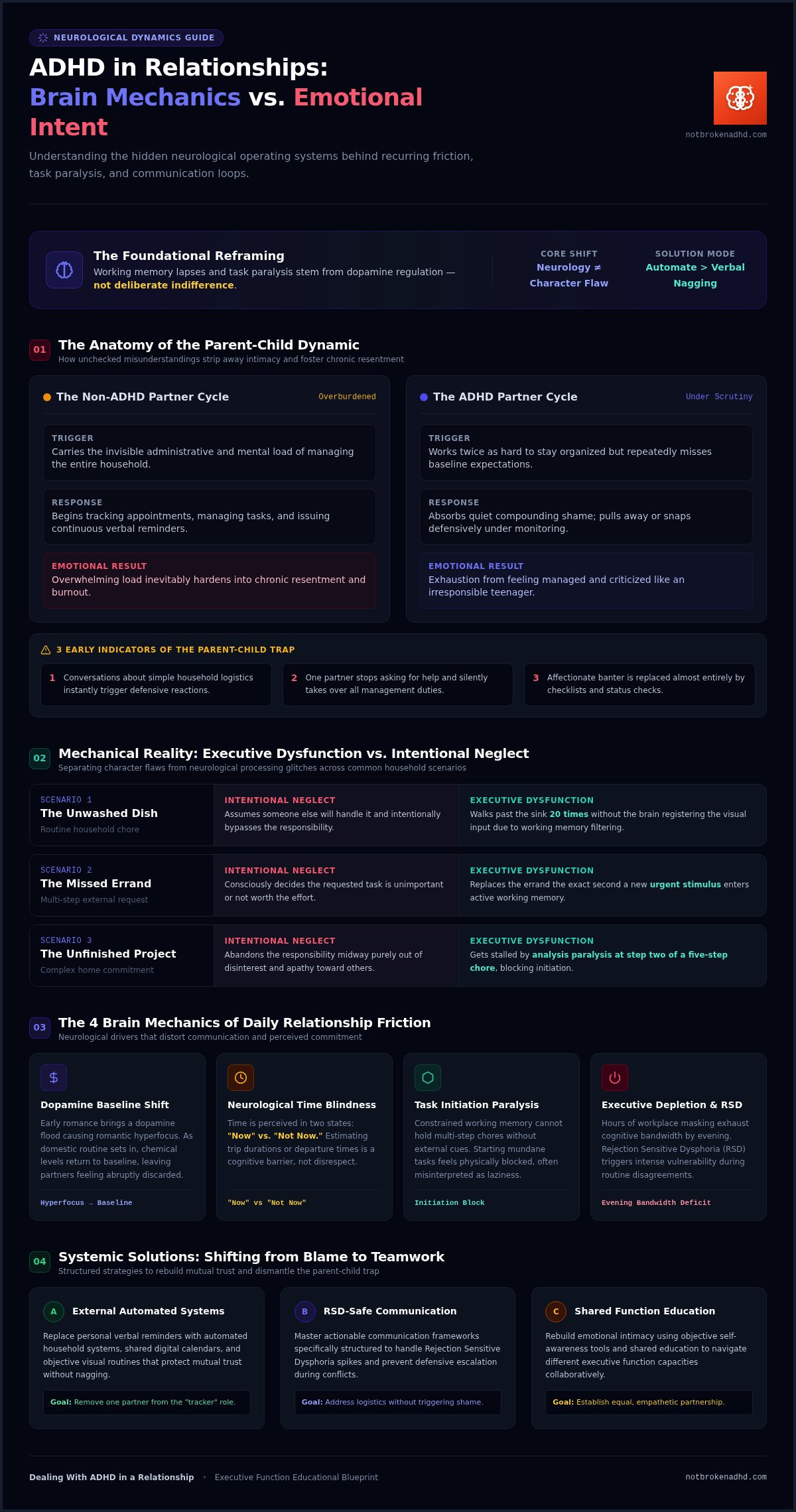
Couples rarely struggle because affection has vanished. They struggle because invisible executive function differences distort daily interactions. When adult attention deficit hyperactivity disorder is present, working memory lapses can mimic emotional disregard. A forgotten grocery item, an unreturned text, or a dropped chore feels deliberate to an uninformed partner. On the other side, the partner with ADHD absorbs quiet, compounding shame. They often work twice as hard to stay organized, yet constantly fall short of baseline expectations. Successfully dealing with ADHD in a relationship requires separating character from neurology. A dropped commitment is an executive processing glitch, not an absence of love.
The Parent-Child Trap and Chronic Resentment
Unchecked misunderstandings quickly push couples into an uneven dynamic. One partner begins tracking tasks, managing appointments, and offering verbal reminders. Within months, an equal partnership shifts into an exhausting parent-child dynamic.
This dynamic strips intimacy out of the connection. The non-ADHD partner carries an overwhelming administrative load, which inevitably hardens into resentment. Sensing the scrutiny, the ADHD partner pulls away or snaps defensively, exhausted from feeling monitored like an irresponsible teenager. Watch for these early indicators:
- Conversations about simple household logistics instantly trigger defensive reactions.
- One partner stops asking for help and silently takes over all household management.
- Affectionate banter is replaced almost entirely by logistical checklists and status checks.
Time Blindness and Broken Daily Agreements
Time blindness is not a sign of poor character. It is a genuine neurological tendency to perceive time only in two distinct states: "now" and "not now." Estimating how long a drive takes or when to get ready becomes an ongoing cognitive hurdle.
To a waiting partner, however, chronic delays feel like abandonment. Sitting alone at a restaurant or waiting by the front door sends an unintended emotional message: my time does not matter to you. While the ADHD partner rarely means to cause harm, the emotional hurt experienced by the other partner remains genuine. Constructive progress in dealing with ADHD in a relationship means moving away from arguments about good intentions and focusing on external structures, shared calendars, and objective routines that protect mutual trust.
The Brain Mechanics Behind Routine Relationship Friction
Early in a romance, an ADHD brain experiences a massive surge of dopamine. This chemical flood fuels intense romantic hyperfocus. Texts get answered instantly. Dates are planned with exquisite care. Attention feels absolute. As the novelty fades into domestic routine, dopamine levels return to baseline. The shift is rarely deliberate, yet it leaves the non-ADHD partner feeling abruptly discarded.
Everyday friction begins right at the neurological level. Task initiation paralysis makes starting mundane chores feel physically impossible, which a partner easily misinterprets as plain laziness. Meanwhile, constrained working memory cannot hold multi-step requests without external cues. By evening, hours spent masking and concentrating at work completely deplete remaining executive reserves, leaving little cognitive bandwidth for complex relationship talks.
Executive Dysfunction Versus Emotional Neglect
Distinguishing brain wiring from character flaws is central to dealing with ADHD in a relationship. Intentional neglect involves apathy toward a partner's feelings. Executive dysfunction involves desperate effort paired with unreliable neurological retrieval. Consider the mechanical differences:
- The Unwashed Dish: Neglect assumes someone else will handle it. Executive dysfunction walks past the sink twenty times without the brain registering the visual input.
- The Missed Errand: Neglect consciously decides the task is unimportant. Executive dysfunction replaces the errand the second a new urgent stimulus enters working memory.
- The Unfinished Project: Neglect abandons responsibility out of disinterest. Executive dysfunction gets stalled by analysis paralysis at step two of a five-step chore.
When you need clear language to map these daily patterns together, exploring structured executive function educational content helps bridge the gap between intention and real-world execution.
Rejection Sensitive Dysphoria and Volatile Disagreements
Routine conversations often derail because of Rejection Sensitive Dysphoria (RSD). This intense neurological vulnerability turns benign comments into perceived catastrophes. A gentle remark like "Could you rinse your plate?" triggers a physical response resembling acute grief or betrayal.
The nervous system registers corrective feedback as an existential threat to the relationship. The ADHD partner suddenly lashes out or shuts down entirely, baffled by their own surge of distress. Successfully navigating these moments requires physical de-escalation before addressing the actual chore:
- Hit pause immediately: Agree on a neutral word that signals a fifteen-minute sensory timeout.
- Ground the body: Step away to drink cold water, wash hands, or focus on slow breathing to settle sympathetic arousal.
- Affirm the bond first: Start the resumed conversation by validating affection before reopening the original logistical concern.
Treating emotional volatility as a temporary nervous system flare helps both partners stay focused on constructive solutions instead of personal attacks.
Shifting From Blame to Teamwork: Operational Comparisons
Most domestic conflicts follow an exhausting, reactive script. One partner points out an unwashed pan; the other feels criticized and shuts down. Over time, accountability mutates into harsh ultimatums. An ultimatum demands flawless executive functioning through sheer willpower, which invariably sets both partners up for failure. A collaborative framework treats dropped tasks as operational bugs rather than character defects. The focus shifts from "Why didn't you do this?" to "Why did our system fail here?"
Objective tracking transforms this dynamic. When daily responsibilities live on an external board rather than inside one person's memory, the emotional urge to micromanage disappears. Successfully dealing with ADHD in a relationship means turning vague personal expectations into clear, neutral operating agreements.
Reorganizing Domestic Roles Around Cognitive Strengths
Splitting household duties down the middle rarely works when neurodivergent wiring is involved. Forcing an arbitrary 50/50 split on every chore causes friction. Instead, divide work based on how each brain processes effort:
- Match momentum to the task: ADHD partners often thrive with high-energy, visually engaging chores like lawn care, deep-cleaning a bathroom, or running active errands. Structured administrative duties like filing taxes or tracking utility bills often fit the non-ADHD partner's cognitive rhythm far better.
- Define clear end-states: Vague requests like "clean the kitchen" trigger immediate initiation paralysis. Replace ambiguity with explicit definitions: dishes placed in the dishwasher, counters wiped with spray, and trash taken out.
Replacing Critical Nagging With Objective Automation
Telling an ADHD partner to "just use a calendar" usually fails because phone chimes quickly blend into background noise. Effective external systems completely remove interpersonal enforcement, protecting romantic affection from administrative drag:
- Externalize alerts: Use shared digital Kanban boards, visual whiteboards in high-traffic hallways, or automated subscription deliveries. When an alert pops up, the app is the prompter, not the partner.
- Hold a weekly sync: Spend fifteen calm minutes together every Sunday. Review the coming week, check calendar overlaps, and troubleshoot broken household workflows together as equal teammates.
How to Deal With ADHD in a Relationship: A 5-Step Action Plan
Reversing chronic relationship patterns requires a sequenced approach. Attempting an aggressive lifestyle overhaul overnight almost always triggers overwhelm and backslides. Real stability comes from small, reliable adjustments executed together. Successfully dealing with ADHD in a relationship means removing character judgments first, setting up clear psychological safety nets second, and then automating daily household operations.
Step 1 & 2: Clarifying Symptoms and Establishing Safety Phrases
Start by identifying personal executive hurdles. Map out whether your primary daily friction comes from transitions, sensory overload, or conversational distraction. If you want a neutral baseline to pinpoint these specific functional roadblocks together, explore our structured ADHD Self-Check Tool.
Next, establish an explicit pause protocol. Agree on a non-judgmental phrase, such as "circuit breaker" or "yellow flag." When either partner speaks that phrase, the conversation halts instantly without debate. Take a strict twenty-minute physical pause. This gives the nervous system adequate time to clear elevated adrenaline and cortisol before reopening dialogue.
Step 3 & 4: Externalizing Memory and Redesigning Routines
Never rely on mental promises alone. When an agreement is made, enter it directly into a shared calendar or task app before moving on to another topic. Keep commitments visible in real time.
Design small anchor routines around the most turbulent moments of your day. Morning departures and post-work arrivals tend to carry the highest stress. Smooth these periods with low-friction visual tools:
- Use a dedicated launchpad: Place keys, wallets, badges, and bags on a single table right beside the front door every evening.
- Run silent focus bursts: Set a visual pomodoro timer for fifteen minutes after dinner. Clear clutter or sort mail together in companionable silence, eliminating task initiation friction through parallel momentum.
Step 5: Implementing Weekly Strategic Connection Meetings
Quarantine your logistics away from your romance. Constant running commentary about unpaid bills and chores destroys emotional intimacy. Instead, channel domestic business into a dedicated twenty-minute Sunday meeting.
Review appointments, synchronize weekly schedules, and assign specific meals. Once the timer rings, close your laptops and end the administrative discussion. Acknowledge what went smoothly over the preceding week. Genuine positive recognition provides the brain with an immediate boost of dopamine, which naturally reinforces positive follow-through.
Long-Term Strategies: Strengthening Connection and Self-Awareness
Sustainable partnership requires ongoing resilience, not perpetual firefighting. Executive function burnout happens when couples treat operational tools as short-term fixes rather than lifelong support rails. Independent self-care is vital here. Neither partner can be the other's sole emotional regulator or administrative manager. Cultivating private hobbies, quiet downtime, and external friendships prevents emotional depletion. Dealing with ADHD in a relationship is an evolving, collaborative practice. Asking for clarity directly is not a critique; it is a commitment to keeping the connection secure.
Building Empathy Through Self-Assessment and Education
Much of the initial struggle comes from navigating invisible barriers. When an adult suspects neurodivergent traits but lacks clarity, completing an ADHD self-check tool online offers an objective, non-judgmental starting point. Gaining a shared vocabulary transforms the emotional climate. Instead of accusing a partner of being thoughtless, you both learn to recognize working memory limits, transition friction, and sensory overload. Education replaces moral guilt with targeted, compassionate problem-solving.
Sustaining Emotional Intimacy Beyond Practical Logistics
Systems keep the household running, but affection keeps the bond alive. Couples often become so consumed by managing daily friction that romance gets sidelined. Protect your intimacy by establishing clear, protective habits:
- Enforce a zero-logistics zone on dates: Declare dates an administrative-free haven. Household chores, calendar appointments, and budget spreadsheets remain strictly off-limits.
- Practice intentional appreciation: Past friction often leaves behind a residue of criticism. Actively voice sincere appreciation for small moments of effort to rebuild emotional trust.
- Use self-directed resources: Deepening your mutual understanding through downloadable ADHD guides and executive function resources empowers both partners to solve problems independently.
Successfully dealing with ADHD in a relationship means giving each other permission to be imperfect, while continuously leaning on shared frameworks that keep frustration low and emotional connection high.
Moving Forward: Turning Shared Friction Into Lasting Teamwork
A thriving partnership doesn't require neurological uniformity. It requires shared curiosity, objective operating systems, and a steady commitment to separating brain wiring from personal character. Successfully dealing with ADHD in a relationship is about replacing exhaustion with collaborative empathy. When you stop taking executive dysfunction personally and start treating dropped tasks as operational glitches, domestic tension drops dramatically.
Real transformation happens through small, steady adjustments. By externalizing daily routines, holding brief logistical syncs, and honoring pause cues during emotional spikes, you protect the warmth that brought you together in the first place. You don't have to navigate this learning curve through trial and error alone. To reduce domestic paralysis and establish balanced household systems, explore our downloadable executive function resources and tools. With the right scaffolding in place, your relationship can move beyond survival mode into genuine, lasting connection.
Frequently Asked Questions
Can a relationship survive and thrive when one partner has ADHD?
Yes, absolutely. Relationships thrive when couples replace character blame with structured, supportive operating systems. Research shows that relationship distress is closely tied to unmanaged executive dysfunction rather than the traits themselves. When both partners understand how the ADHD brain regulates dopamine, attention, and memory, dealing with ADHD in a relationship becomes a collaborative project rather than a source of continuous conflict.
How do I stop feeling like a parent to my partner with ADHD?
Step out of the managerial role immediately by outsourcing reminders to external tools. Stop issuing verbal tracking prompts or cleaning up unfinished tasks. Replace your personal oversight with shared digital boards, visual timers, and automated notifications. When an app or checklist handles accountability, you can return to being an equal romantic partner instead of a domestic supervisor.
Why does my partner with ADHD get so defensive whenever I offer feedback?
This defensiveness is often driven by Rejection Sensitive Dysphoria (RSD), an intense neurological vulnerability to perceived criticism. Feedback about a misplaced item can trigger a genuine fight-or-flight panic response. Counter this by pairing practical observations with explicit verbal reassurance, or use a neutral cue to pause difficult conversations until your partner's nervous system settles.
What is the best way to divide household chores fairly with an ADHD partner?
Fairness does not mean splitting every single domestic task right down the middle. Assign responsibilities based on neurological strengths and dopamine patterns. The ADHD partner often excels at active, hands-on tasks like yard work, trash runs, or rapid decluttering. Clear, unambiguous definitions of what "done" looks like help prevent overwhelm and incomplete follow-through.
How can I tell if my partner is being selfish or struggling with executive dysfunction?
Look at their baseline intent and overall pattern of remorse. Selfishness involves conscious indifference to your comfort or feelings. Executive dysfunction involves genuine guilt, self-frustration, and inconsistent follow-through despite trying hard to remember. If your partner feels deep remorse over forgotten chores yet struggles repeatedly with initiation, the root cause is working memory strain, not malice.
How should we handle intense emotional outbursts during relationship arguments?
Implement a mandatory biological pause the moment vocal tone escalates. Establish a neutral safe word that automatically pauses the discussion for twenty minutes. Step into separate rooms, drink cool water, and let adrenaline dissipate completely. Never try to resolve practical domestic logistics while either partner is stuck in a state of physiological fight-or-flight.
What should we do if my partner refuses to acknowledge their ADHD symptoms?
Focus the conversation entirely on shared functional hurdles rather than clinical labels. Talk through specific friction points like missed bill dates, chronic lateness, or cognitive fatigue. Suggest exploring an objective ADHD self-check tool or independent executive functioning guides together. Framing the discussion around operational systems removes personal shame and opens the door to productive, mutual self-awareness.


