

ADHD paralysis is an involuntary nervous system freeze, not a personal flaw or a lack of willpower. When you find yourself physically locked to the couch or staring blankly at your desk, your brain is navigating severe cognitive overload. You desperately want to take action, yet your body feels stuck in concrete. Learning how to stop ADHD paralysis begins with recognizing that you cannot criticize yourself into momentum; you need to lower the activation energy required to move.
You already know the heavy guilt of losing half a day to mental gridlock, silently wondering why simple, everyday tasks feel completely insurmountable. You aren't lazy, and your brain isn't broken. In this guide, you will discover actionable, neurodivergent-friendly strategies to break task paralysis, soothe your nervous system, and initiate action without shame. Ahead, we will unpack why your brain freezes and share a repeatable, low-friction protocol to help you regain forward momentum.
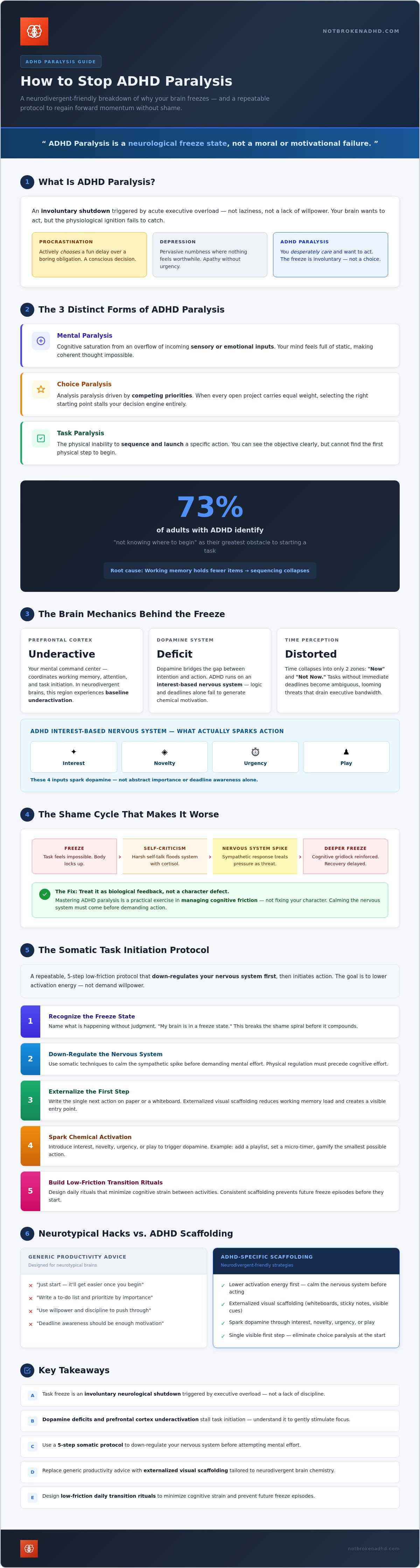
Key Takeaways
- Understand why task freeze is an involuntary neurological shutdown triggered by executive overload, not a lack of discipline.
- Discover how dopamine deficits and prefrontal cortex underactivation stall task initiation, and how to gently stimulate focus.
- Learn a repeatable five-step somatic protocol for how to stop ADHD paralysis by down-regulating your nervous system before attempting mental effort.
- Replace generic productivity advice with externalized visual scaffolding tailored to neurodivergent brain chemistry.
- Design low-friction daily transition rituals that minimize cognitive strain and prevent future freeze episodes.
What Is ADHD Paralysis and Why Willpower Cannot Fix It?
You sit at your desk, staring at an unanswered email. The clock ticks forward. Ten minutes pass, then forty, yet your fingers remain motionless above the keys. This is not casual laziness or intentional avoidance. ADHD paralysis is an involuntary shutdown triggered by acute executive overload. At its core, executive dysfunction impairs your brain's ability to sequence actions, manage working memory, and transition between states.
There is a foundational truth to understand about this state: ADHD paralysis is a neurological freeze state, not a moral or motivational failure.
Procrastination happens when someone actively chooses a fun delay over a boring obligation. Depression often brings pervasive numbness or apathy where nothing feels worthwhile. In contrast, during an ADHD freeze, you desperately care about what needs to be done. You want to act, but the physiological ignition fails to catch.
White-knuckling through this moment rarely helps. When you try to force yourself forward using harsh self-talk, your nervous system interprets the internal pressure as an active threat. Your sympathetic system spikes, locking the freeze response in even deeper. Figuring out how to stop ADHD paralysis requires calming this response rather than demanding immediate compliance.
The Three Distinct Forms: Mental, Choice, and Task Paralysis
ADHD paralysis rarely looks the same from day to day. It typically surfaces in three distinct expressions:
- Mental Paralysis: Cognitive saturation caused by an overflow of incoming sensory or emotional inputs. Your mind feels full of static, making coherent thought impossible.
- Choice Paralysis: Analysis paralysis driven by competing priorities. When every open project carries equal visual or emotional weight, selecting the "right" starting point stalls your decision engine.
- Task Paralysis: The physical inability to sequence and launch a specific action. You can see the objective clearly, but you cannot find the first physical step to begin.
Dismantling the Shame Cycle: Reframing Laziness as Neurological Freeze
Internal shame spirals fuel this breakdown. Berating yourself floods your system with cortisol, reinforcing cognitive gridlock and delaying recovery. Intentional avoidance is a conscious choice, while paralysis is the painful friction of wanting to engage and hitting an invisible wall. Instead of treating this state as a character defect, treat it as protective biological feedback signaling that your cognitive load has exceeded capacity. Once you understand this mechanism, mastering how to stop ADHD paralysis becomes a practical exercise in managing friction rather than fixing your character.
The Brain Mechanics: Why Executive Dysfunction Triggers Task Freeze
Behind the physical sensation of being frozen lies neurobiology, not flawed character. The prefrontal cortex serves as your mental command center, coordinating working memory, attention, and task initiation. In neurodivergent brains, this region experiences baseline underactivation. When a cognitive breakdown disrupts a person's ability to manage these internal controls, crossing the threshold into physical action becomes an uphill climb. Time blindness amplifies this challenge. The brain tends to organize time into only two distinct zones: "now" and "not now." Tasks without immediate deadlines turn into ambiguous, looming threats. Add ambient background noise or sensory clutter, and your executive bandwidth vanishes before you even start.
The Activation Energy Barrier and Dopamine Deficits
Task initiation requires neurochemical fuel. Dopamine acts as the chemical catalyst that bridges the gap between intention and action. While neurotypical systems release dopamine based purely on abstract importance, ADHD operates on an interest-based nervous system. It relies heavily on interest, novelty, urgency, and play. Logic and deadline awareness alone fail to generate chemical motivation. Understanding this dynamic explains why discovering how to stop ADHD paralysis depends on sparking safe chemical activation rather than relying on sheer willpower.
Working Memory Overload and the Inability to Sequence
Think of working memory as a mental scratchpad. In ADHD brains, this scratchpad holds fewer items simultaneously. When a multi-step task like filing paperwork or organizing a room hits your desk, the system easily crashes under the load. Research shows that 73% of adults with ADHD identify not knowing where to begin as their greatest obstacle to starting a task. Without a single, visible first step, sequencing collapses entirely.
Emotional dysregulation compounds this friction, making ordinary chores feel genuinely threatening. Learning how to stop ADHD paralysis means offloading that mental burden into clear, external steps. Relying on supportive tools like executive function educational content helps you organize tasks visually so your brain can finally find the starting line.
Comparing Task Initiation Methods: Neurotypical Hacks vs. ADHD Scaffolding
Most productivity advice assumes a linear brain. Typical strategies rely on internal discipline, urgency, and moral obligation. When applied to an executive system already locked in shutdown, conventional tips like "eat the frog" or "just sit down for five minutes" do not just fail; they backfire. Forcing compliance against a frozen nervous system triggers chronic exhaustion and burnout. Discovering how to stop ADHD paralysis requires trading willpower-dependent tricks for supportive external scaffolding that works alongside your natural brain chemistry.
Rigid time-blocking often provokes panic by creating an unforgiving schedule that disregards fluctuating energy levels. Neurodivergent scaffolding, by contrast, uses gentle, flexible pacing. Using an external tool, such as a visual pomodoro timer, provides time structure without the looming dread of rigid clocks. It renders time visible, tangible, and manageable, easing the transition into focused effort.
Sensory and Somatic Resets vs. Mental Reframing
You cannot talk a dysregulated nervous system out of a physiological freeze. While traditional advice suggests positive thinking or cognitive reframing, physical interventions bypass mental resistance directly:
- Temperature Shifts: Splashing cold water on your face or holding an ice cube activates the mammalian dive reflex, immediately slowing a racing heart rate.
- Vestibular and Proprioceptive Input: Changing physical posture, rocking gently, or doing a full-body shake signals physical safety to the brain stem.
- Auditory Anchors: Playing brown noise or rhythmic instrumental tracks provides steady, predictable background stimulation, soothing sensory overwhelm while boosting baseline dopamine.
External Visual Cues vs. Traditional Prioritization Matrices
Standard tools like Eisenhower matrices fall flat when executive overwhelm makes every single item feel urgent and impossible. Dense, sprawling lists flood your vision and stall decision-making. Single-item visualizers isolate one micro-step at a time, hiding everything else until that action finishes. This setup directly shelters working memory from visual static.
Body doubling offers another powerful form of environmental support. Working alongside another person, whether quietly in the same room or over a silent video stream, introduces ambient accountability. Their presence serves as a calming anchor, removing isolation and lowering the friction needed to start. Effective protocols for how to stop ADHD paralysis replace internal pressure with external, compassionate structure.
How to Stop ADHD Paralysis: A Step-by-Step Task Initiation Protocol
When freeze locks you in place, reasoning your way out will not work. You need a somatic, low-friction sequence that bypasses executive resistance entirely. This repeatable five-step protocol shows you how to stop ADHD paralysis in real time by down-regulating stress and resetting your ignition threshold.
Step 1 & Step 2: Reset the Nervous System and Lower the Bar
Step 1 focuses on releasing physical defensive tension. Take a long, slow exhale and drop your shoulders away from your ears. Unclench your jaw. Forcing mental concentration while your body stays locked in a threat response only cements the freeze.
Step 2 requires radical bar-lowering. Discard the expectation of completing the project. In fact, abandon the expectation of actually doing the work. Your only objective is physical contact with a single component:
- Desk Work: Sit in the chair and touch the keyboard with both hands.
- Cleaning: Pick up exactly one cup and move it near the sink.
- Administrative Tasks: Move the unopened envelope to the center of your desk.
Step 3 & Step 4: Isolate the Micro-Step and Add External Stimulation
Step 3 isolates the very first physical action. Refuse to look ahead to steps two or three. Open the blank document, tap "reply," or turn the water faucet on. That is the entire assignment.
Step 4 layers immediate sensory dopamine onto that single action. Pair the chore with sensory comfort: pour an iced drink, slip on noise-canceling headphones, or press play on an engaging podcast. Surrounding the friction with pleasant background stimulation provides the chemical cushion needed to bridge the initiation gap.
Step 5: Engage Gentle Timeboxing to Build Safe Momentum
Step 5 introduces low-stakes momentum. Commit to just three to five minutes of engagement using an external visual countdown. Crucially, grant yourself full, unconditional permission to walk away when that timer sounds. Knowing you have a safe exit route dissolves the panic that keeps you frozen.
Celebrate the micro-start itself as a complete victory. More often than not, physical movement creates its own quiet momentum. To master these transitions with low-friction systems, explore our downloadable ADHD guides and practical resources to transform how you initiate daily tasks.
Building Long-Term Scaffolding to Prevent Frequent Paralysis
Emergency protocols help break an active freeze, but lasting stability requires reshaping your daily ecosystem. Real momentum comes from eliminating friction before mental fatigue sets in. Establishing predictable transition rituals softens abrupt context shifts between tasks, giving your brain space to reset. Instead of constantly wondering how to stop ADHD paralysis after you are already immobilized, proactive scaffolding creates an environment where initiating action feels natural and low-stress.
Conducting regular friction audits helps uncover recurring bottlenecks. When you notice a specific task repeatedly triggering a shutdown, step back and examine the setup. The obstacle is rarely your capability; it is almost always a lack of visible, external structure.
Environmental Design: Removing Friction Points Before They Freeze You
Friction accumulates quietly. When your desk is buried in clutter or your digital desktop is crowded with dozens of unsorted files, every visual distraction chips away at working memory. Audit your spaces to remove hidden obstacles:
- Stage Tools in Plain Sight: Keep essential project supplies visibly assembled so you don't stall searching for materials.
- Streamline Digital Workspaces: Organize active projects into high-visibility folders and bookmark essential dashboards to bypass daily search fatigue.
- Use Automated Presets: Build standard templates for recurring documents and administrative tasks to bypass decision fatigue early in the day.
Gaining Clarity on Your Executive Profile with Structured Self-Checks
Every neurodivergent brain experiences friction differently. Your freeze might stem from working memory overload, intense sensory saturation, or task initiation challenges. Pinpointing your specific operational profile lets you build tailored defenses rather than relying on generic advice.
Using an online ADHD self-check tool helps clarify your personal symptom patterns and highlight where your executive system needs the most support. Pairing these insights with downloadable educational guides and executive function resources gives you practical playbooks built for your wiring. Exploring dedicated digital tools and interactive simulations validates your lived reality, replacing shame with supportive systems that keep you moving forward.
Reclaiming Your Momentum: Moving Beyond the Freeze
Breaking out of task paralysis is never a matter of sheer grit or harsh self-punishment. As you have seen, your nervous system freezes when executive demands overload your internal bandwidth. Lasting momentum happens when you replace shame with gentle somatic resets, shrink your initial physical actions into micro-steps, and let external visual cues do the heavy lifting.
Mastering how to stop ADHD paralysis takes practice, patience, and scaffolding built for how your brain actually operates. You don't need fixing; you simply need tools that accommodate your unique wiring. When you work with your neurodivergent chemistry instead of fighting it, starting becomes approachable rather than exhausting.
To deepen your understanding and identify your personal executive patterns, take the next step and explore our ADHD self-check tool and educational guides. With practical frameworks and compassionate resources in hand, you can dismantle overwhelm and move forward with quiet confidence.
Frequently Asked Questions
What is the difference between ADHD paralysis and laziness?
Laziness is a conscious choice to conserve energy or avoid exertion without personal distress. In contrast, ADHD paralysis is an involuntary executive freeze accompanied by significant internal distress, anxiety, and guilt. While someone choosing to relax feels content, an individual stuck in paralysis desperately wants to begin the task. Their neurological ignition system is temporarily offline due to cognitive overload or dopamine deficits, trapping them in place despite clear intentions.
Can ADHD paralysis happen even when you want to do the task?
Yes, it frequently happens with tasks you genuinely care about or actively want to complete. The ADHD brain does not lack motivation; it struggles with initiation chemistry. When an enjoyable or critical project feels complex, vague, or emotionally charged, your working memory overloads. The brain misinterprets this cognitive friction as a threat, triggering a freeze response that stalls your physical ability to start, regardless of your personal enthusiasm.
How do you break out of ADHD paralysis when you are on the couch?
Break couch freeze by targeting tiny physical sensations rather than the daunting task ahead. Start by wiggling your toes, rotating your ankles, or rolling onto your side. Do not attempt to stand up immediately. Once small physical movement returns, set an ultra-low threshold, like walking to the kitchen for a single glass of water. Knowing how to stop ADHD paralysis in this moment means activating your motor cortex with zero mental pressure attached.
What are the three types of ADHD paralysis?
The three distinct expressions are mental, choice, and task paralysis. Mental paralysis occurs when incoming sensory or emotional inputs saturate your processing capacity, creating brain fog. Choice paralysis strikes when you face multiple options and struggle to evaluate which project takes priority. Task paralysis happens when you have chosen a specific duty, but executive dysfunction prevents your brain from sequencing the physical first step to initiate movement.
Does ADHD paralysis mean you need to change your medication?
Not necessarily, though recurring paralysis warrants tracking your symptom patterns. Freeze episodes often stem from acute sensory overwhelm, fatigue, or poor environmental scaffolding rather than medication failure. While a downloadable ADHD medication guide can help you understand treatment mechanisms and prepare questions for your healthcare provider, never adjust dosages without professional guidance. Behavioral scaffolding and sensory resets should always accompany pharmacological support.
Why does ADHD paralysis cause physical exhaustion?
Being frozen is not restful. During an executive freeze, your internal sympathetic nervous system remains highly active. Your brain battles an intense cycle of guilt, self-monitoring, and cognitive friction, keeping stress hormones like cortisol elevated. This continuous mental conflict burns substantial glucose and physical energy. Even though you appear motionless on the outside, your physiology is exerting significant effort, leaving you physically drained once the episode passes.
How can a Pomodoro timer help with ADHD paralysis without causing anxiety?
A standard countdown often feels like a ticking threat, but a visual pomodoro timer reframes time as supportive scaffolding. Instead of pressuring yourself to produce work, set the timer for a non-binding three to five minutes. Use it simply to witness time passing rather than enforcing output. Learning how to stop ADHD paralysis with a timer works because you give yourself full permission to quit as soon as the session ends.


