

What if your struggle to start a simple project has nothing to do with willpower and everything to do with neurological friction? If you have spent years cycling through color-coded planners only to hit immediate burnout, you already know the heavy guilt of being labeled lazy or undisciplined. Standard advice fails neurodivergent minds because it treats task initiation as a moral choice rather than an environmental signaling challenge. Adopting effective executive functioning strategies begins with dismantling that shame and understanding how your nervous system actually handles cognitive load.
You deserve practical, shame-free executive functioning strategies that organize your daily life, reduce friction, and work with your brain rather than against it. In this guide, we will examine the biological mechanics behind executive function bottlenecks, explore how external scaffolding helps initiate multi-step tasks without emotional dread, and map out a sustainable daily workflow that honors your natural energy cycles.
Key Takeaways
- Understand how your prefrontal cortex regulates focus and cognitive load, clarifying why multi-step tasks trigger mental friction.
- Unpack the neurochemistry behind freeze states to break the cycle of self-blame and separate neurological bottlenecks from personal discipline.
- Apply actionable executive functioning strategies like micro-chunking to initiate overwhelming projects without emotional resistance.
- Develop a reliable external brain using digital scaffolding that offloads working memory and keeps critical routines visible.
- Replace rigid daily schedules with flexible workflows that protect your focus and adapt to natural energy cycles.
What Are Executive Functioning Skills and How Do They Function?
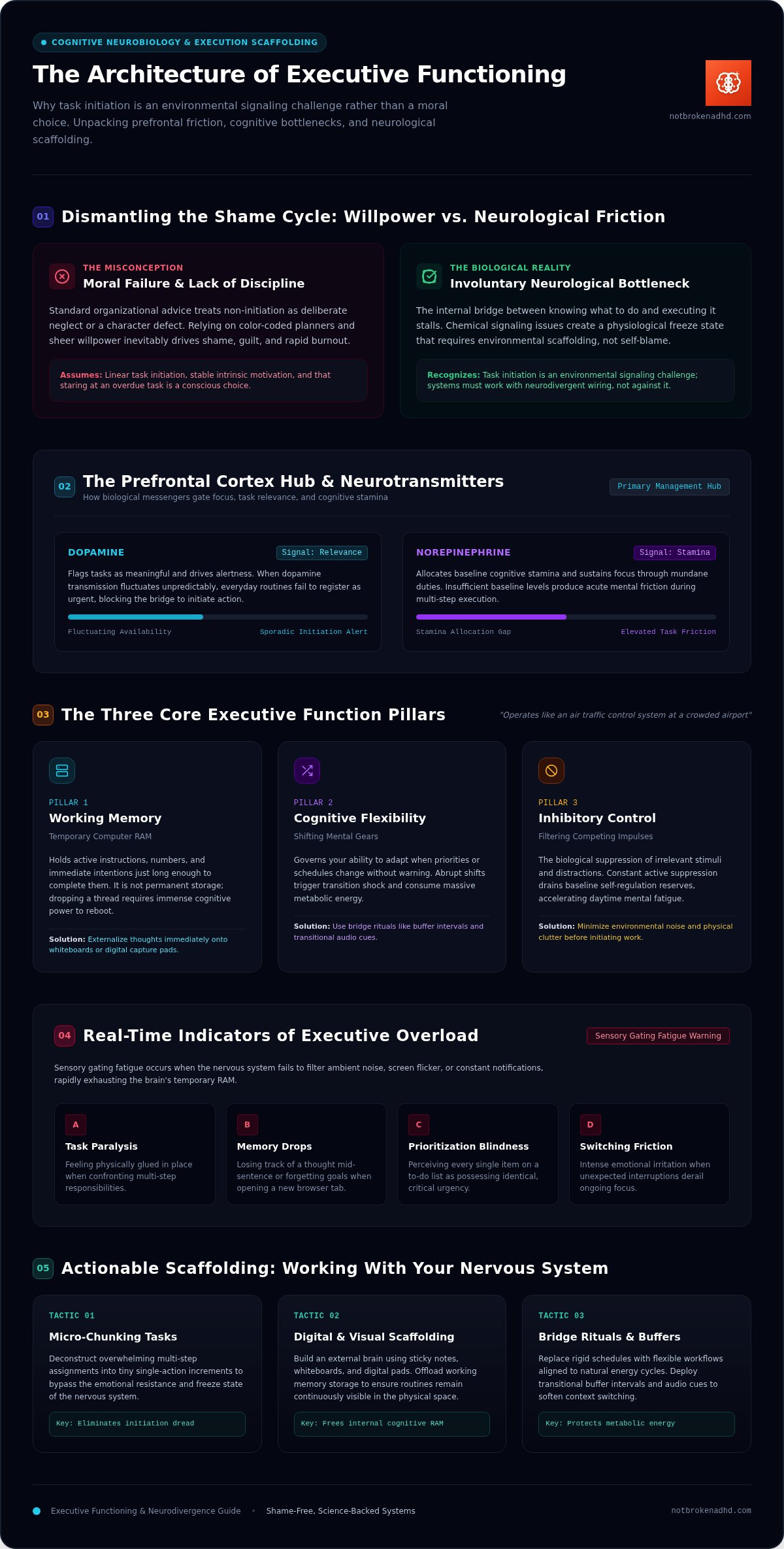
Think of your brain as a busy workplace where the prefrontal cortex serves as the primary management hub. In neuropsychology, executive functions are the set of cognitive processes that regulate focus, emotional responses, and goal-directed actions. They allow you to plan a project, hold instructions in mind, resist distractions, and pivot when circumstances shift. When these systems work smoothly, turning intention into execution feels straightforward.
For neurodivergent adults, this internal bridge frequently stalls. Staring at an overdue report while feeling physically unable to type isn't deliberate neglect or poor discipline; it is an involuntary neurological block. Conventional organizational methods fail because they rely on linear task initiation and stable intrinsic motivation. Meaningful change requires practical executive functioning strategies that acknowledge neurological differences rather than demanding impossible neurotypical compliance.
The Core Biological Role of the Prefrontal Cortex
The prefrontal cortex relies heavily on chemical messengers, primarily dopamine and norepinephrine, to flag tasks as relevant and allocate cognitive stamina. In a typical brain, baseline levels of these neurotransmitters rise reliably to help initiate and sustain focus on mundane duties. In neurodivergent brains, dopamine availability and transmission often fluctuate unpredictably. Without sufficient chemical signaling to spark alertness, the brain struggles to register everyday routines as urgent, creating a biological barrier between knowing what to do and actually doing it.
Signs You Are Experiencing Real-Time Executive Overload
Temporary situational fatigue happens after an exhausting week, but chronic executive dysfunction is a persistent bottleneck. It is frequently intensified by sensory gating fatigue, which occurs when your nervous system fails to filter out ambient background noise, screen flicker, or constant digital notifications, rapidly exhausting working memory.
Everyday indicators of acute cognitive overload include:
- Task paralysis: Feeling physically glued in place when facing multi-step responsibilities.
- Working memory drops: Losing track of a thought mid-sentence or forgetting an objective the moment you open a new browser tab.
- Prioritization blindness: Perceiving every single item on a to-do list as having the exact same critical urgency.
- Context-switching friction: Intense emotional irritation when an unexpected interruption derails your current focus.
Recognizing these friction points allows you to deploy targeted executive functioning strategies before your working memory crashes completely.
The Core Executive Function Pillars: Understanding Your Brain
Neuropsychology organizes self-management into three distinct operational pillars: working memory, cognitive flexibility, and inhibitory control. As research from the Center on the Developing Child highlights, executive function and self-regulation skills operate like an air traffic control system at a crowded airport. When any of these mechanisms stall, everyday tasks pile up into an intimidating mental gridlock.
Working Memory vs. Long-Term Retrieval
Working memory isn't your permanent storehouse of knowledge; it acts like temporary computer RAM. It holds instructions, numbers, and immediate intentions just long enough to execute them. If your mental RAM drops a thread, restarting that task requires immense cognitive effort. Externalizing thoughts onto whiteboards, digital capture pads, or sticky notes protects working memory, offloading data so your brain doesn't collapse under active retention strain.
Cognitive Flexibility and Shifting Mental Gears
Cognitive flexibility governs your capacity to adapt when schedules change or priorities shift without warning. Moving abruptly from a state of low stimulation to high-demand focus produces acute transition shock. Context switching burns massive metabolic energy. Gentle bridge rituals, such as playing a specific transitional song or setting a brief buffer interval between meetings, reduce friction and help reset your mental track smoothly.
Inhibitory Control and Managing Competing Impulses
Inhibitory control is the biological capacity to suppress irrelevant internal impulses and external distractions. It isn't a test of moral discipline. Every buzzing phone, desktop clutter pile, or background conversation actively drains baseline self-regulation reserves. When your brain is forced to suppress distractions constantly, mental fatigue sets in early.
Building targeted executive functioning strategies shields these core cognitive pillars from chronic depletion. If you want to identify which cognitive channels struggle most with everyday task friction, taking an interactive ADHD Self-Check Tool offers a clear, validating baseline for your personal self-management profile.
Overcoming the Shame Cycle: Executive Dysfunction vs. Moral Failure
From an early age, neurodivergent people are handed a toxic cultural script: if you cannot complete a simple task on time, you are lazy, unmotivated, or careless. This moral judgment ignores basic neuroscience. Chronic struggle with follow-through is an environmental signaling failure, not a character flaw. Confusing a neurological capacity deficit with a defect of character creates a deep reservoir of shame. This internal guilt feeds an avoidance loop, turning ordinary daily responsibilities into intimidating emotional threats.
To break this downward spiral, you need objective self-awareness rather than self-condemnation. Taking an ADHD Self-Check Tool Online helps pinpoint where your regulatory friction occurs. Pinpointing these friction points replaces confusion with actionable, shame-free executive functioning strategies.
The Anatomy of Task Initiation Paralysis
When an ambiguous task sits on your desk, your nervous system can perceive the uncertainty as a physiological threat. The brain triggers an involuntary freeze response. You sit entirely motionless, staring at a screen, fully aware of what needs attention but unable to press a key. Learning how to stop ADHD paralysis requires bypassing that biological threat response with ultra-low-friction micro-actions. Opening a blank document or typing a single sentence signals safety to your nervous system, allowing execution to begin without an emotional battle.
Dismantling Internalized Guilt and Rebuilding Self-Trust
Abandoned leather-bound planners, half-finished to-do apps, and forgotten habits do not represent personal failure. They are simply tools built for a different cognitive architecture. When traditional organizational systems fail to stick, beating yourself up releases cortisol, which further suppresses prefrontal cortex functioning. Self-compassion is not self-indulgence; it is a neurological necessity.
Rebuilding self-trust requires adjusting how you judge daily productivity:
- Measure capacity over compliance: Honor natural energetic peaks and valleys instead of expecting a flat, robotic output every day.
- Separate intent from execution: Remind yourself that wanting to do a task while being unable to start is the textbook definition of executive dysfunction, not indifference.
- Celebrate partial wins: Completing twenty percent of an overwhelming chore is infinitely better than zero percent trapped in shame.
Sustainable executive functioning strategies work only when grounded in deep self-compassion. Meeting your cognitive needs with curiosity rather than criticism dissolves the shame cycle, opening up mental space to build daily systems that actually last.
Tactical Executive Functioning Strategies for Daily Task Execution
Generic productivity advice tells you to sit down, write a to-do list, and push through. For a neurodivergent nervous system, that approach guarantees burnout. You need practical executive functioning strategies designed to lower activation energy, turn invisible time into visible cues, and inject natural interest into under-stimulating work.
Deploying these tactical habits allows you to bypass the neurological roadblocks outlined earlier, transforming overwhelming obligations into approachable, low-friction actions.
Micro-Stepping: Lowering the Activation Threshold
When a task feels massive, your brain registers it as an immediate obstacle. The solution is shrinking the entry point down to a single physical movement. You aren't "cleaning the kitchen"; you are picking up one blue plate and placing it in the sink. You aren't "writing an annual review"; you are opening a blank text file and typing a document title. Completing an absurdly small micro-action triggers a tiny burst of momentum, tricking the brain past its initial freezing threshold.
Visual Externalization: Making Time and Tasks Physical
Out of sight is out of mind. Digital folders, closed cabinets, and nested app menus make critical duties vanish entirely from working memory. Keep priority items physically present in your line of sight to stay grounded. Practical visual adaptations include:
- Analog time anchors: Use visual countdown timers that display disappearing red disks rather than abstract digital numbers.
- Drop zones: Place open entryway baskets for high-frequency items like keys, wallets, and badges so they never get lost.
- Visible project surfaces: Stick color-coded adhesive notes directly on your workspace monitor to keep current goals front and center.
Dopamine Pairing and Body Doubling Systems
Neurodivergent brains crave baseline stimulation to engage with low-dopamine tasks like expense reports or laundry. Dopamine pairing involves coupling a monotonous chore with a high-reward sensory input. Put on an engaging narrative podcast, play familiar upbeat music, or save your favorite snack exclusively for filing receipts.
When sensory pairing isn't enough, try body doubling. Working alongside another person, whether sitting quietly across a table or connected via an online study room, creates gentle social grounding. The shared presence keeps your attention anchored without requiring direct conversation. Integrating these targeted ADHD productivity hacks turns everyday friction into predictable, sustainable momentum.
To practice these techniques in a structured, distraction-free environment, explore the interactive focus tools and timing aids available at The ADHD Field Guide.
Building an External Brain: Sustainable Systems and Digital Scaffolding
Relying on working memory to track every recurring obligation guarantees cognitive exhaustion. An external brain is a dependable framework that stores routines, deadlines, and project steps outside your head. Sustainable executive functioning strategies treat organization as external infrastructure rather than an internal test of willpower. Unlike rigid traditional systems that demand unwavering perfection, true scaffolding bends without breaking. It provides quiet structural support when your energy dips, letting you pick up where you left off without guilt.
Pacing Focus with Structured Time Intervals
Open-ended workdays trigger severe initiation dread because the brain cannot perceive when the effort will end. The Pomodoro technique counteracts this by slicing your day into distinct, manageable blocks, such as twenty-five minutes of focused work followed by a five-minute pause. Using a dedicated pomodoro timer eliminates the mental math of pacing. Short, bounded sprints keep cognitive stamina intact, preventing the deep mid-afternoon crash that often follows unmanaged hyperfocus.
Curating Low-Maintenance Digital and Paper Systems
Many adults fall into the trap of over-engineering their productivity setups, spending days customizing intricate databases instead of doing their actual work. Keep your capture systems laughably simple. A single universal inbox, whether a blank notepad beside your keyboard or a minimalist digital capture note, lets you park stray thoughts immediately so they don't derail your train of thought. When life disrupts your cadence, a streamlined system takes thirty seconds to reset instead of requiring an entire weekend overhaul.
Long-Term Self-Compassion and Continuous Routine Tuning
Every organizational tool eventually loses its novelty. When an app or checklist format stops working for you, it is not a personal failure or a lack of character. It is simply system obsolescence, a predictable pattern for brains driven by interest and dopamine. Give yourself full permission to rotate tactics freely whenever novelty wears thin. Exploring self-directed educational guides and digital tools helps you cultivate a flexible personal toolkit rather than forcing yourself into a rigid, permanent mold. Adapting your executive functioning strategies to your current season of life ensures your daily systems remain supportive rather than punishing.
Moving Forward with Brain-First Momentum
Navigating daily responsibilities isn't a test of brute willpower. When you understand your prefrontal cortex and shed the moral weight of past paralysis, daily execution becomes manageable. Sustainable progress relies on honoring your natural cognitive rhythms, chunking tasks into friction-free steps, and letting an external brain carry the mental load.
Real change happens when you stop forcing yourself into neurotypical molds and start building supportive scaffolding. If you are ready to replace chronic overwhelm with steady clarity, explore downloadable ADHD guides and focus tools. Designed specifically for neurodivergent cognitive architectures and executive function challenges, these accessible, shame-free educational materials focus on real-world practical application. You don't need fixing; you just need executive functioning strategies that respect how your mind operates. Give yourself permission to experiment, adapt as your needs evolve, and trust your ability to move forward on your own terms.
Frequently Asked Questions
What is the fastest way to break out of executive dysfunction task paralysis?
The fastest way to break task paralysis is lowering physical resistance to an almost comical degree. Instead of trying to finish an entire assignment, commit to an isolated micro-step, like placing your fingers on the keyboard or opening a single tab. Physical movement shifts your nervous system out of a freeze response. Pairing that immediate action with low-demand sensory stimulation signals safety, initiating gentle forward progress without overwhelming your prefrontal cortex.
How do executive functioning strategies differ for adults compared to children?
While childhood interventions rely on external enforcement from teachers and parents, adult executive functioning strategies demand self-directed environmental scaffolding. Adults must independently balance competing personal responsibilities, professional deliverables, and domestic routines without external supervision. Effective adult systems prioritize offloading working memory through digital capture tools, establishing visual anchors across independent workspaces, and structuring daily workloads around fluctuating energetic capacity rather than rigid compliance.
Can executive functioning skills actually be improved, or are they permanent?
While neurodivergent brain wiring remains consistent throughout life, your day-to-day functional execution can improve dramatically with external systems. You don't alter your fundamental neurology; rather, you build compensatory infrastructure that bypasses cognitive bottlenecks. Leveraging practical executive functioning strategies, establishing visual triggers, and using structured interval pacing protects your cognitive reserves. Over time, reliable external routines reduce daily friction, making sustained progress achievable without demanding impossible increases in raw willpower.
Why do standard planners and to-do lists fail for neurodivergent people?
Standard planners fail because they assume linear energy levels and stable dopamine production. When a planner closes, its contents vanish from working memory, creating an immediate mental void. Static lists also trigger prioritization blindness, displaying trivial administrative chores and high-stakes projects with identical visual weight. If missed checkmarks trigger shame, the tool itself becomes a source of emotional dread, causing you to abandon the entire system within days.
What is the difference between ADHD executive dysfunction and general burnout?
ADHD executive dysfunction is a lifelong neurodevelopmental baseline affecting dopamine signaling and working memory, whereas burnout is an acquired state of deep nervous system exhaustion. Anyone can experience burnout from chronic overwork, prolonged emotional stress, or illness. However, unaddressed executive dysfunction frequently accelerates burnout because neurodivergent adults must constantly expend double the metabolic energy to initiate, track, and complete everyday tasks in environments designed for neurotypical brains.
How does working memory deficit directly impact everyday adult task management?
Working memory deficits act like an undersized temporary workspace, causing thoughts to drop out the moment an unexpected interruption occurs. You walk into a room and instantly forget your objective, or switch browser tabs and lose the email draft you were writing. In professional settings, this makes tracking multi-step workflows difficult without constant restarts. Offloading immediate items into external capture tools prevents critical details from vanishing mid-task.
Is executive dysfunction caused by low intelligence or a lack of motivation?
Executive dysfunction has no correlation with cognitive intelligence or authentic personal desire. Highly capable, deeply motivated individuals struggle with executive tasks because the breakdown lies in neurological execution mechanics, not comprehension or motivation. The prefrontal cortex experiences a signaling bottleneck when transferring an intellectual goal into physical activation. Calling this breakdown laziness confuses an involuntary neurochemical hurdle with a conscious moral choice.


