

What if the deadlines you missed this week weren't proof of poor discipline, but evidence of invisible cognitive friction? Conducting an executive function self assessment isn't about measuring your moral worth or replacing a formal clinical evaluation. It's simply about identifying where your mental gears catch, giving you a clear way to evaluate daily habits without unnecessary shame.
If you've spent years fighting the quiet sting of being labeled lazy or undisciplined despite putting in relentless effort, you aren't alone. It's exhausting to constantly wonder whether your dropped balls stem from everyday stress, chronic burnout, or neurological differences that standard productivity advice ignores.
In this guide, you'll discover how to evaluate your executive functioning skills objectively, identify daily friction patterns, and translate your self-assessment into actionable support strategies. Ahead, we break down the core skill areas behind task initiation and memory, explore practical tracking tools, and equip you with the vocabulary you need to advocate for yourself with healthcare providers and employers.
Key Takeaways
- Complete an executive function self assessment to evaluate your mental workflows objectively, identifying friction patterns without shame or judgment.
- Break down cognitive domains like working memory, shifting, and task initiation to pinpoint where your mental energy actually leaks.
- Use a multi-day observation approach across varied environments to gather reliable data and avoid snapshot bias.
- Distinguish between situational burnout, chronic stress, and underlying neurodivergence so you can choose the right language for healthcare discussions.
- Replace exhausting willpower with supportive, external scaffolding tailored specifically to your unique cognitive profile.
What Is an Executive Function Self Assessment?
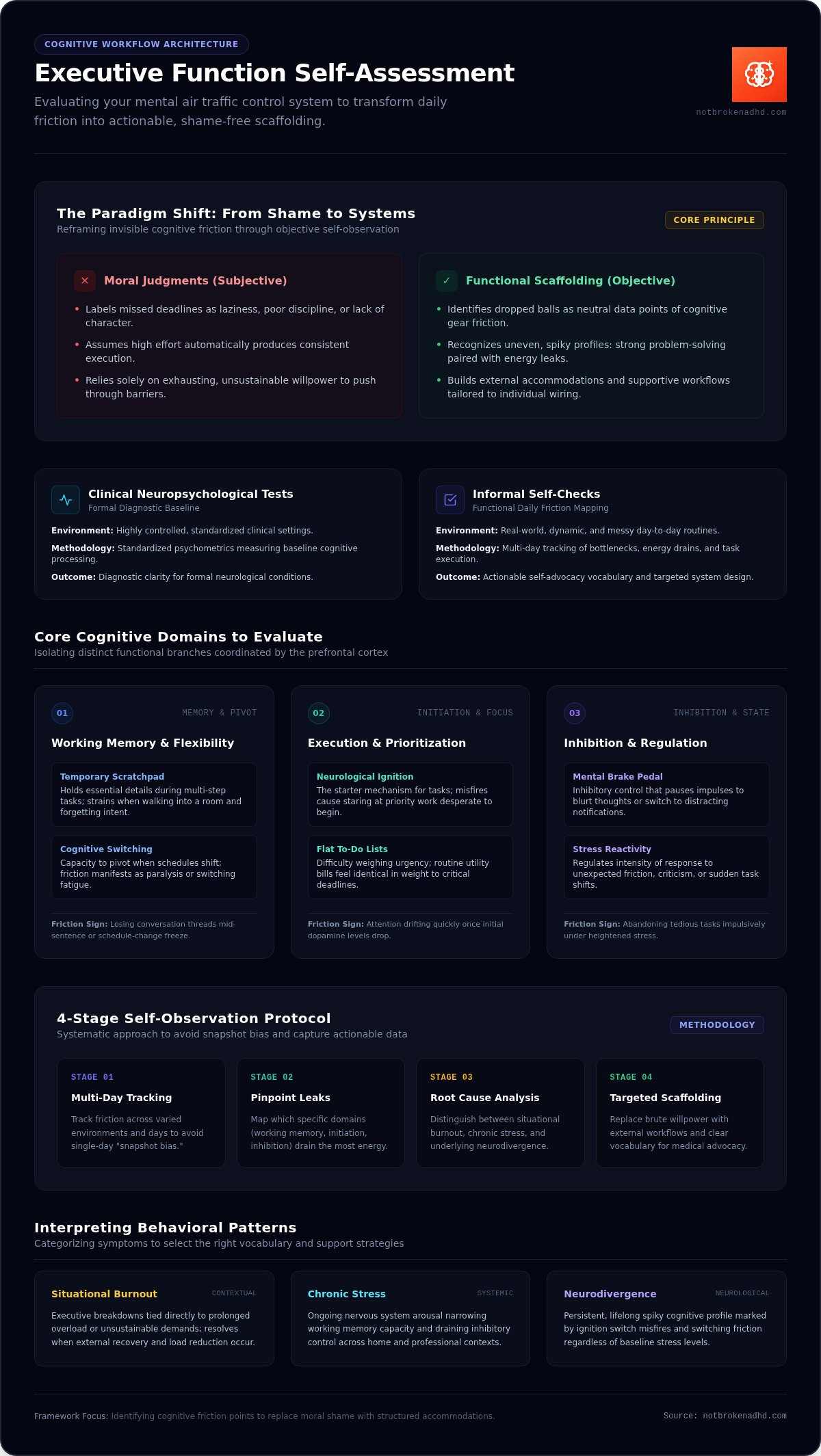
An executive function self assessment is a structured self-inventory measuring daily cognitive regulation. Rather than grading your intelligence or assessing your character, it evaluates how your brain handles practical, real-world demands. Your executive functions operate like a mental air traffic control system, coordinating skills such as working memory, cognitive flexibility, and impulse control. When this system encounters invisible roadblocks, everyday life can quickly feel overwhelming.
Unlike a clinical evaluation, a personal self-check focuses purely on functional friction points. It maps where your mental energy drains, whether you're initiating a complex work project, keeping track of daily responsibilities, or transitioning between tasks. Completing an executive function self assessment transforms vague, exhausting frustration into clear, neutral behavioral data you can actually use.
Clinical Neuropsychological Tests vs. Informal Self-Checks
It helps to understand where an informal evaluation ends and clinical testing begins. Formal neuropsychological evaluations rely on standardized psychometrics to diagnose formal neurological conditions. Clinicians measure cognitive processing in controlled, clinical environments to establish clinical baselines.
Informal self-checks serve a complementary but distinct purpose. They examine how cognitive bottlenecks disrupt messy, real-world routines. An informal screening won't give you a clinical diagnosis, but it empowers you to spot persistent patterns in daily life. This self-collected data provides clear, practical context if you choose to seek a formal medical evaluation later.
Why Objective Self-Observation Removes Moral Shame
From an early age, executive dysfunction is frequently mislabeled as laziness, carelessness, or a lack of discipline. When you drop balls despite intense, exhausting effort, it's easy to internalize those judgments as personal flaws. You end up convinced you just need more willpower.
Objective self-observation breaks that painful cycle. Evaluating your neurological wiring through a neutral lens shifts the focus from character flaws to skill accommodation. You aren't deficient; your cognitive management system simply requires different scaffolding to navigate high friction environments. Gathering clear behavioral data quiets the harsh inner critic, replacing chronic shame with curiosity and practical problem-solving.
The Core Cognitive Domains to Evaluate in Daily Life
Executive function is not a single, monolithic switch. It is a dynamic network of higher-level cognitive skills coordinated by the prefrontal cortex. When you conduct an executive function self assessment, evaluating these skills as separate branches helps pinpoint exactly where your daily energy leaks. Most adults do not struggle across every single area. Instead, they live with an uneven, spiky profile marked by brilliant problem-solving alongside steep, exhausting friction points. Isolating these distinct domains prevents you from applying the wrong productivity fixes to the wrong cognitive hurdles.
Working Memory and Cognitive Flexibility
Working memory acts as your brain's temporary scratchpad, holding essential details while you execute multi-step tasks. When working memory strains, you walk into a room and instantly forget your intent, or lose the thread of a conversation mid-sentence. Cognitive flexibility is your capacity to pivot when circumstances shift unexpectedly. If a sudden calendar change triggers intense irritation or mental paralysis, you aren't being difficult. You are experiencing cognitive switching fatigue.
Task Initiation, Prioritization, and Sustained Attention
Task initiation is the neurological ignition switch needed to start an activity. When this switch misfires, you can stare at a priority document for hours, desperate to begin yet unable to type a single word. Prioritization challenges compound this by flattening your to-do list, making a routine utility bill feel just as urgent as a critical work deadline. Sustained attention keeps you engaged once you start, but it drifts quickly when dopamine levels drop. Exploring structured executive function educational content can give you practical ways to untangle these specific initiation hurdles without forcing pure willpower.
Emotional Regulation and Inhibitory Control
Inhibitory control serves as the mental brake pedal. It pauses the impulse to blurt out thoughts, click on distracting notifications, or abandon tedious tasks. Emotional regulation determines how intensely you react to stress, unexpected criticism, or sensory overload. When cognitive reserves run low, this mental braking system thins out rapidly. The result is sudden emotional exhaustion, especially after navigating socially demanding workplaces.
How to Conduct Your Executive Function Self Assessment Step-by-Step
A reliable self-audit requires patient observation across varied environments. Rating your abilities during a single calm evening produces an inaccurate picture. Instead, track real-world performance over five to seven business days to eliminate snapshot bias. Treat this exercise as neutral operational data collection rather than a moral audit of your character. To start with a structured foundation, an interactive ADHD self-check tool online helps clarify your functional baseline before diving into the detailed steps below.
Step 1 & 2: Audit Daily Friction and Map Cognitive Domains
Begin by carrying a small notebook or opening a blank note on your phone. Record moments where daily workflows stall:
- Step 1 (Log the breakdown): Note the exact moment a task falls apart. Examples include leaving laundry wet in the washer, missing a scheduled check-in, or freezing before drafting a simple status report. Capture immediate sensory variables too, such as room temperature, ambient chatter, or clutter on your desk.
- Step 2 (Assign the domain): Categorize the root cause behind each breakdown. Did you miss the meeting because of working memory constraints, or did you delay the report because task initiation stalled? Separating the cognitive branch from the end result clarifies your actual bottleneck.
Step 3 & 4: Track Energy Fluctuations and Environmental Triggers
Your cognitive control fluctuates directly alongside your physiological reserves. Steps three and four help map these vital patterns:
- Step 3 (Chart daily energy): Note the hours when focus feels effortless and when severe mental fatigue sets in. Executive control typically drops sharply when blood sugar dips or late-afternoon burnout arrives.
- Step 4 (Identify environmental drain): Highlight external conditions that rapidly deplete your mental stamina. Open-plan offices, chaotic notifications, and frequent meeting interruptions quietly exhaust your working memory and emotional regulation long before the workday ends.
Step 5: Synthesize Patterns for Personal Use or Professional Review
Once you collect a week of raw notes, condense your observations into a one-page summary sheet. Identify your top two or three recurring bottlenecks. Documenting these specific operational hurdles gives you concrete, observable language to share with a physician or therapist. Describing how you lose short-term instructions under sensory overload leads to far more effective clinical conversations than simply saying you feel overwhelmed.
Interpreting Patterns: Executive Dysfunction, Burnout, or ADHD?
Executive dysfunction is a descriptive umbrella term, not a standalone medical diagnosis in manuals like the DSM-5-TR or ICD-11. It simply names a set of observable regulatory hurdles. When your executive function self assessment reveals widespread friction across multiple domains, determining the root cause shapes your next steps. Prefrontal cortex performance drops under severe physical stress, but lifelong neurodivergent conditions produce persistent friction that does not vanish during a quiet weekend.
Neurodivergent Profiles vs. Chronic Situational Exhaustion
Burnout represents acquired cognitive depletion. It develops when sustained emotional, professional, or caregiving demands outstrip your nervous system's capacity to recover. Chronic stress taxes the prefrontal cortex, causing temporary declines in working memory and cognitive flexibility. When a person experiencing burnout takes extended leave or reduces their workload, baseline cognitive efficiency gradually returns.
Neurodevelopmental conditions like ADHD follow an entirely different trajectory. These traits are present from early childhood and persist across every environment, including low-stress periods and vacations. An executive function self assessment highlights lifelong patterns rather than recent fatigue. Reviewing a structured comparison helps distinguish between these two states:
- Onset: Burnout emerges gradually during adulthood following prolonged stress. ADHD executive challenges trace back to childhood experiences before age 12.
- Consistency: Burnout fluctuates strictly based on current lifestyle demands and work strain. Neurodivergent friction remains present across diverse social, domestic, and professional settings.
- Recovery: Burnout improves with boundary-setting, deep physical rest, and nervous system repair. Neurodevelopmental wiring requires ongoing structural accommodations, workflows, and environmental design.
The Trap of Labeling Neurological Bottlenecks as Laziness
Differentiating executive paralysis from laziness is vital for emotional recovery. Laziness is an intentional, comfortable choice to avoid effort; a person simply does not care about the outcome. Executive paralysis feels completely opposite. It involves a frantic internal desire to act, accompanied by neurological freeze and escalating panic.
When you cannot initiate a critical task despite genuine effort, you aren't choosing avoidance. Your brain's activation mechanisms are stalling under inadequate dopamine signaling or heavy cognitive overload. Recognizing these moments as functional roadblocks strips away decades of accumulated guilt. If you want a structured way to separate these patterns and prepare for deeper clinical discussions, explore downloadable ADHD guides that explain how real-world executive workflows function.
Practical Next Steps: Building Systems Around Your Profile
Completing an executive function self assessment gives you invaluable clarity, but data alone will not change your daily reality. True relief comes when you translate those insights into external scaffolding. Never try to resolve executive dysfunction through sheer willpower or grit. Pushing harder against an unaccommodated nervous system only accelerates burnout. Instead, treat your environment like an extension of your mind, shaping physical spaces and digital workflows to offset your specific cognitive bottlenecks.
Externalizing Memory and Lowering Activation Energy
When working memory strains, stop forcing your brain to retain loose mental tabs. Offload instructions immediately into your physical space where they remain visible:
- Externalize your thoughts: Place whiteboards near your desk, keep physical capture notebooks open, and position visual checklists directly along your natural walking paths.
- Reduce startup friction: Lower task initiation thresholds by setting out supplies the night before. If you need to draft a complex proposal, open the blank file and title it before closing your laptop in the afternoon.
- Shrink the commitment: Break intimidating projects into tiny micro-actions requiring under two minutes to start. Typing one sentence is infinitely easier than writing a full brief.
- Use rhythmic pacing: Pair repetitive administrative duties with focus tools like a Pomodoro timer to create predictable intervals of effort without draining your battery.
Leveraging Specialized Educational Tools and Screenings
Standard productivity advice often fails neurodivergent brains because it assumes a baseline level of linear cognitive regulation. Real, lasting change requires resources built specifically around how your brain initiates, sustains, and switches attention. Exploring structured educational guides helps you replace self-criticism with practical, functional systems that actually stick.
When you understand how your cognitive profile operates, you can stop fighting your wiring and start building daily routines that support it. To explore interactive tools, pacing resources, and in-depth educational material tailored to neurodivergent adults, continue your journey with The ADHD Field Guide.
Moving From Self-Doubt to Cognitive Clarity
Dropping balls and missing deadlines are rarely questions of character. Instead, they are clear signals of an unsupported nervous system running against heavy friction. Completing an executive function self assessment gives you the objective language needed to dismantle old shame, isolate your personal bottlenecks, and distinguish temporary burnout from lifelong neurodivergent wiring. Once you pinpoint which cognitive branches are straining, you can stop relying on sheer grit and start designing workflows that actually protect your energy.
You don't have to navigate these daily challenges alone or guess your way through trial and error. To turn your insights into sustainable routines, explore downloadable guides and focus tools at The ADHD Field Guide. With interactive ADHD self-check resources, practical pacing tools, and shame-free educational materials, you can build reliable daily scaffolding. You aren't broken; your brain simply needs the right systems to thrive.
Frequently Asked Questions
Can an executive function self assessment diagnose me with ADHD?
No, an executive function self assessment cannot diagnose ADHD or any other medical condition. A formal diagnosis requires an evaluation by a licensed healthcare professional using standardized clinical frameworks such as the DSM-5-TR. A self-check acts as an educational screening tool. It highlights your practical friction points, validates personal struggles, and provides organized behavioral data that you can bring to an appointment with a medical provider.
What is the most common executive function skill deficit in adults?
Task initiation and working memory are among the most frequent bottlenecks reported by adults. Difficulties with task initiation create heavy neurological resistance when starting non-stimulating or multi-step duties, often resulting in paralysis. Weakened working memory causes individuals to lose track of short-term goals, misplace items, or forget verbal instructions. These specific hurdles frequently trigger cascading delays across daily work and personal schedules, increasing overall mental fatigue.
How is executive dysfunction different from general depression or anxiety?
While these challenges frequently co-occur, their root drivers differ. In depression, cognitive slowdown stems primarily from low mood, pervasive apathy, and lack of reward processing. In anxiety, racing worry and constant vigilance consume cognitive bandwidth, blocking working memory. Executive dysfunction, however, reflects a mechanical breakdown in the brain's regulatory system, where an individual desperately wants to act but struggles to initiate or sequence attention even when feeling calm.
Can executive functioning skills improve in adulthood?
Yes, adults can strengthen functional cognitive performance through environmental scaffolding and habit design. While you cannot simply rewire baseline neurology through sheer effort, neuroplasticity allows the adult brain to adapt. Implementing external memory aids, visual planning systems, digital timers, and regular dopamine-friendly routines significantly reduces daily friction. Over time, practicing these structured accommodations reinforces efficient habits, making complex routines far easier to manage without exhaustion.
What should I do if my self-assessment shows severe executive dysfunction?
If your executive function self assessment reveals severe disruption across daily routines, treat that information as helpful data rather than a personal failure. Begin by lowering immediate expectations and externalizing memory demands with basic checklists and focus timers. Next, compile your written observations and consult a qualified medical provider or mental health professional. Having concrete records of daily bottlenecks will help them evaluate targeted medical or therapeutic options.
Is executive dysfunction always caused by a neurodivergent brain?
No, executive dysfunction is a functional symptom, not an exclusively neurodivergent trait. Conditions like ADHD and autism naturally involve lifelong prefrontal cortex differences, but temporary or acquired factors also disrupt executive networks. Chronic physical stress, severe workplace burnout, sleep deprivation, major hormonal shifts, long COVID, and traumatic brain injuries can suppress cognitive regulation. Identifying whether symptoms are chronic or situational is essential for choosing the right restorative strategies.


