

What if an interactive ADHD experience could build empathy without showing you exactly what ADHD feels like? Clinical descriptions can seem distant from everyday life, so it’s understandable to look for something more tangible. A simulation may offer a glimpse of challenges with attention, distractions, or getting started. But ADHD isn’t the same for everyone, and no short activity can represent every person’s experience.
That distinction matters. An educational simulation can prompt useful questions, but it can’t diagnose ADHD or serve as evidence that you or someone else has it. Treat it as a way to explore an idea, not as a clinical assessment.
In this article, you’ll learn what an interactive ADHD experience can illustrate, where its limits are, and how to reflect on what stood out without turning a simulation into a label. You’ll also find questions and practical supports to explore next, including educational resources about ADHD and executive function. The goal isn’t to decide what ADHD feels like for everyone. It’s to leave with a clearer, more compassionate understanding.
Key Takeaways
- Interactive activities can make challenges with attention, planning, or working memory easier to discuss.
- An interactive ADHD experience offers one perspective, not a complete picture of how ADHD affects every person.
- Notice how the task, setting, effort, and helpful adjustments shape your experience.
- Use what stands out to form questions and explore practical educational resources.
- The ADHD Field Guide’s simulations are learning tools, not clinical assessments.
What Is an Interactive ADHD Experience, and What Can It Show?
Descriptions of ADHD can be hard to connect with. A list of symptoms may name difficulties with focus or organization, but it can’t always show what those challenges might look like during an everyday task. An interactive ADHD experience is an educational activity that invites you to explore a selected ADHD-related challenge through participation. It can make one idea easier to discuss, but it can’t recreate every person’s reality or determine whether someone has ADHD.
ADHD experiences vary. A person’s surroundings, the task at hand, and the support available can all shape what they find difficult or manageable. For foundational background, the overview of Attention-deficit hyperactivity disorder provides context on the condition and its diagnosis. A simulation offers something different: a focused learning prompt, not a complete picture.
How an ADHD simulation differs from reading an explanation
An article, video, or symptom list shares information for you to take in. An interactive activity asks you to engage with an idea. Taking part can make an abstract concept more concrete. Instead of only reading about competing demands on attention, you might reflect on how it feels to keep track of a task while other things call for your attention.
That reflection can open a conversation. What felt distracting? Was it hard to remember the next step? Did the task seem different when you had more time or fewer demands? The activity doesn’t prove that a person with ADHD would react the same way. It offers a specific scenario to consider, not an authentic or universal account of ADHD.
Who might find an interactive ADHD experience useful?
People exploring their own experiences may find a simulation useful as a starting point for reflection. If a task feels familiar, that reaction might help you name a question to explore. If it doesn’t, that doesn’t rule anything in or out. A brief activity isn’t a diagnostic test.
Family members, educators, and other supporters may also use an activity to think about how task demands affect someone’s day. Curiosity matters more than getting a particular result. Ask, “What made this task easier or harder?” rather than “Does this prove ADHD?” That keeps the focus on understanding and support, without reducing a person to a single activity.
How Interactive ADHD Experiences Turn Everyday Challenges Into Learning
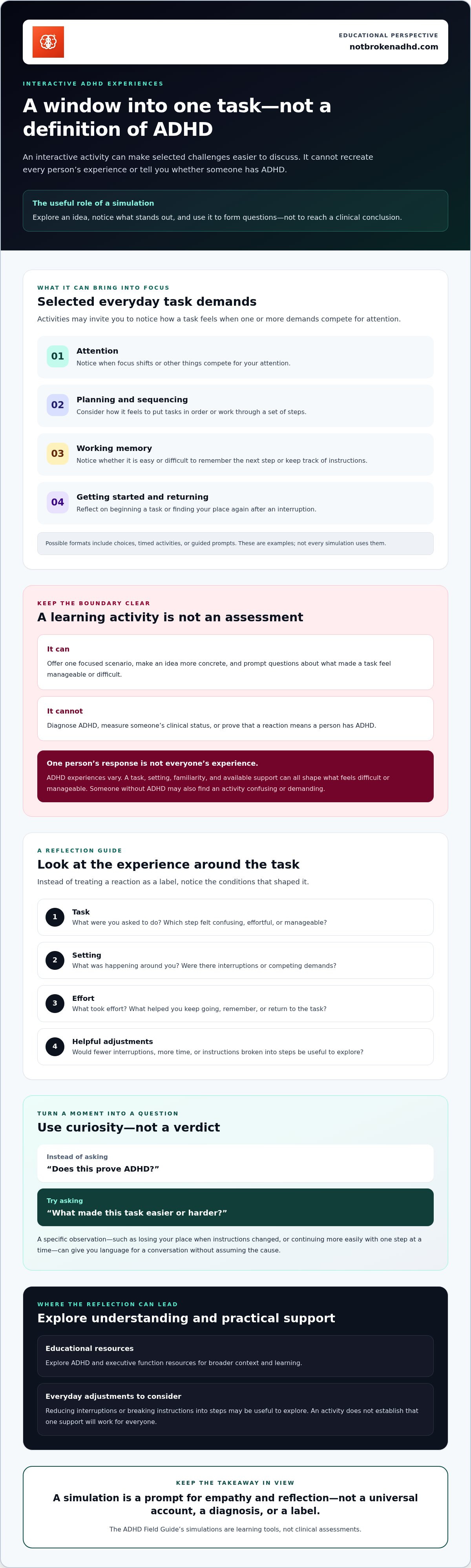
Everyday tasks can involve several demands at once: noticing what needs attention, remembering the next step, and returning to a task after an interruption. An interactive activity can bring one or more of these demands into view through choices, timed activities, or guided prompts. These are common educational formats, not a promise that every simulation uses them.
An educational simulation can illustrate selected ADHD-related task demands, but it cannot diagnose ADHD, measure an individual’s clinical status, or establish that their reactions indicate the condition. What happens during an activity is an observation about that moment and task, not a clinical conclusion about the person who tried it.
What an interactive activity may help someone notice
Imagine following instructions while notifications or other interruptions compete for your attention. An activity built around that kind of scenario might prompt you to notice when your focus shifts, which steps are easy to lose track of, or how competing demands affect your approach. Another activity might ask you to put tasks in order, bringing planning and sequencing into the conversation.
These examples are illustrative. A participant’s response can depend on the instructions, the setting, their familiarity with the task, and other circumstances. People with ADHD don’t all respond in the same way, and someone without ADHD might also find a particular activity confusing or demanding.
Why participation can prompt useful reflection
Reading about attention or working memory gives you terms for discussing them. Taking part in a task may give those terms a specific moment to refer to: “I lost my place when the instructions changed,” or “I could keep going when I had one step at a time.” This shared language can help a person, family member, or educator discuss what made a task feel manageable or difficult without assuming they know the cause.
Afterward, jot down which moment felt confusing, effortful, or unexpectedly manageable. Note what the task asked you to do and what was happening around you. Then consider whether an adjustment, such as reducing interruptions or breaking instructions into steps, might be useful to explore in everyday life. An activity can raise questions, but it doesn’t establish that a particular support will work for everyone.
For broader context, the National Institute of Mental Health offers a clinical understanding of ADHD, including information about symptoms and diagnosis. An interactive ADHD experience has a different purpose: it offers a focused learning prompt, not a substitute for clinical information or assessment. To explore educational activities, you can learn about ADHD simulations from The ADHD Field Guide.
What an Interactive ADHD Experience Cannot Tell You
A short activity can spotlight one challenge, but it can’t represent every ADHD brain. ADHD isn’t a single set of reactions, and a simulation can’t account for the full range of a person’s history, strengths, challenges, or supports. One person may recognize something in an activity; another may not. Neither response confirms or rules out ADHD.
An educational simulation illustrates a selected experience. It does not diagnose ADHD or replace professional assessment and care. Keep that distinction in mind, especially if an activity includes a score, a time limit, or a result that seems to describe you.
Why ADHD experiences differ from person to person
Attention and executive-function challenges can show up in different ways. The same person may find one situation manageable and another demanding, depending on the task, environment, available support, stress, or sleep. A simulation captures only the conditions it presents. It can’t show how someone’s experience may shift across settings or over time.
ADHD also shouldn’t be reduced to one dramatic scenario or a personality label. For a fuller range of perspectives, CHADD discusses what it feels like to have ADHD and how presentations can change throughout life. No single story or activity speaks for everyone.
How to interpret an activity without overreading it
Notice your reaction, then treat it as a prompt for reflection. Ask what the activity required, what conditions shaped your response, and whether anything helped. Those observations can give you language for a conversation, but they aren’t evidence for or against a diagnosis.
If an activity produces a score or outcome, don’t treat it as a standardized clinical result unless it is explicitly identified as a validated assessment and used in the appropriate clinical context. An educational simulation isn’t a diagnostic assessment. Its design, task, and conditions are limited, so comparing your result with someone else’s won’t establish who does or doesn’t have ADHD.
If you’re seeking diagnostic clarity, consider discussing your concerns with a qualified healthcare professional who can assess your experiences in context. You don’t need to arrive with a simulation result or prove that a particular task was difficult. Simply describe patterns you’ve noticed in daily life and ask what next steps may be appropriate.
How to Use an Interactive ADHD Experience for Thoughtful Reflection
A little preparation can help you get more from an activity without treating it like a test. Use it to explore one question, notice your reactions, and identify something you may want to understand better. Keep the focus on curiosity, not on deciding whether you have ADHD.
Before and during the experience: set a useful intention
Choose one question before you begin. For example: “What makes it harder to return to a task after an interruption?” or “How does keeping track of several steps feel?” A clear focus gives your reflection somewhere to start, instead of leaving you to judge the activity as a whole.
Try the activity at a comfortable pace. If it feels frustrating or tiring, pause or stop. You don’t need to push through to get a meaningful insight. Remember that one activity offers a narrow example shaped by its particular task and setting.
After the experience: connect observations to everyday life
Use this simple process to turn the activity into useful questions:
- Choose a question. Decide what you’re curious about, such as interruptions, planning, or switching tasks.
- Try the activity. Notice what happens without treating your performance as a score of your abilities.
- Record your reactions. Briefly note what felt difficult, what took effort, and what felt unexpectedly manageable.
- Add context. Write down what the task involved, what was happening around you, and whether anything helped.
- Reflect and ask. Consider what the activity didn’t capture, then turn your notes into a question for a trusted supporter or qualified professional.
For example, rather than concluding, “I struggled, so I must have ADHD,” you might note, “I lost track when I had to hold several steps in mind. Would written instructions make this task easier?” That observation doesn’t label or diagnose you. It points to a practical question you can explore in daily life.
For broader context on how planning, memory, and other everyday skills fit under executive function, you can read Executive Functioning: Neurodivergent Guide (2026). Keep your notes short and specific. The aim isn’t to create a case for or against a diagnosis, but to describe what you noticed and what might be worth discussing next.
To explore an activity with this reflective approach, explore ADHD simulations from The ADHD Field Guide. Treat each one as an educational prompt, and let your questions guide what you learn from it.
Where to Explore ADHD Learning Tools and Find Your Next Step
An interactive ADHD experience can help you notice questions worth exploring, but it isn’t clinical proof or a diagnosis. Your next step depends on what you’re looking for: diagnostic clarity, practical ideas for everyday challenges, or a broader understanding of ADHD. You don’t have to settle everything at once. Start with the question that matters most to you.
Choosing a next step that fits your question
If you’re wondering whether your experiences may relate to ADHD, consider discussing your concerns with a qualified healthcare professional. An online self-check may help you organize questions or reflect on patterns, but it can’t confirm a diagnosis. For more context on using one thoughtfully, see ADHD Self-Check Tool Online: Finding Clarity and Your Next Steps.
If your focus is a specific daily challenge, such as keeping track of steps or getting started on tasks, executive-function educational material may help you explore strategies and find language for describing what’s difficult. The ADHD Field Guide offers executive function resources, downloadable educational guides, and a Pomodoro timer among its learning tools. Choose resources that connect to your question, rather than feeling you need to try everything.
Explore simulations with realistic expectations
The ADHD Field Guide is an educational resource hub, not a clinical service. Its simulations can offer a structured way to explore selected ADHD-related experiences, while the ADHD Self-Check Tool is a separate educational resource. Neither replaces assessment or care from a qualified professional. Treat what you notice as a prompt for reflection: What did the activity make easier to name? What would you like to understand better? What support or adjustment might be worth discussing?
That approach leaves room for nuance. A simulation won’t tell you how every person with ADHD experiences a task, and your reaction isn’t a verdict about yourself. It can still help you find words for a conversation or decide what to learn about next.
If you’d like to continue exploring, Explore ADHD learning tools from The ADHD Field Guide. Use the simulations as learning prompts, then follow the questions they raise toward relevant educational resources or a conversation with a qualified professional.
Carry Your Curiosity Into a Useful Next Step
An interactive ADHD experience is most useful as a starting point for thoughtful questions, not a verdict about who you are. One activity can bring a selected challenge into focus, while your own experience remains shaped by your circumstances, tasks, and supports. Hold on to what you noticed, and let it guide what you want to learn or discuss next.
If you’re seeking diagnostic clarity, bring your concerns to a qualified healthcare professional. If you’re looking for practical learning, The ADHD Field Guide offers ADHD-specific simulations alongside executive-function educational content. Its ADHD Self-Check Tool is another educational resource, not a diagnosis.
Explore these tools at your own pace and choose what fits your current question. Explore ADHD learning tools and continue building understanding with care. You don’t need to have every answer today; one useful question is a meaningful place to begin.
Frequently Asked Questions
What is an interactive ADHD experience?
An interactive ADHD experience is an educational activity that invites you to explore a task or scenario related to ADHD. By taking part, you may find an abstract idea easier to describe or discuss. The activity only illustrates selected demands, though. It can’t reproduce every person’s experience, measure ADHD, or show whether someone meets diagnostic criteria. Think of it as a learning prompt, not a test.
Can an ADHD simulation show what ADHD feels like?
An ADHD simulation can illustrate a selected challenge, but it can’t show what ADHD feels like for everyone. A task may highlight distractions or competing demands, while leaving out the person’s wider daily life, circumstances, and supports. If you’re trying to understand someone else, use the activity as a reason to listen and ask respectful questions. Their own account matters more than any simulation.
Is an interactive ADHD experience a diagnostic test?
No. An interactive ADHD experience designed for education isn’t a clinical assessment and can’t diagnose ADHD or rule it out. If questions about attention, organization, or daily functioning are affecting you, consider discussing them with a qualified healthcare professional. You can use reflections from an activity to help describe what you’re curious about, but your reactions or results aren’t diagnostic evidence.
Who can benefit from an interactive ADHD experience?
People with ADHD, those wondering about their own experiences, and supporters may find an educational activity useful as a starting point for discussion. Its usefulness depends on the activity and the person taking part. Approach it with curiosity rather than as a test, and avoid assuming that one person’s reaction represents everyone with ADHD. A helpful next step may be to ask what the activity brought to mind.
Are online ADHD brain simulations accurate?
Accuracy depends on what a simulation is designed to illustrate and whether it clearly explains its limits. An online activity may offer a focused example, but it can’t capture the full range of ADHD experiences. Look for clear educational framing and be cautious about broad claims that a simulation shows exactly what ADHD is like. For health information, use reliable clinical sources rather than relying on an activity alone.
What should I do after trying an ADHD simulation?
Note what you noticed, what felt difficult, and what the activity left out. For example, write down which task demand stood out and whether anything made it easier. Use those observations to form a question for a qualified healthcare professional or trusted supporter, or explore educational resources for practical ideas. Don’t use the activity alone to decide whether you have ADHD or choose treatment.
Can an interactive ADHD experience help me understand someone else with ADHD?
It may give you a starting point for listening and asking more thoughtful questions, but it can’t stand in for another person’s perspective. A simulation presents a selected scenario, while ADHD experiences differ from person to person. Try asking what support feels useful in a specific situation, and listen without assuming you already understand. The activity can invite learning; the person’s own words provide essential context.


