

What if ADHD medication isn’t about fixing your brain, but reducing the friction between wanting to do something and getting started? If you’re unsure about side effects, confused by stimulants versus non-stimulants, or uneasy about medication stigma, those questions make sense. This adhd medication guide offers a calmer place to begin.
You’ll learn how the main medication classes differ, which benefits and side effects to discuss, and why finding a good fit can take time. Medication isn’t a measure of effort or character. For some people, it’s one tool that can make daily tasks feel more manageable.
We’ll also help you prepare for a conversation with your prescriber: what to share, what to ask, and how to track changes so you can tell whether a medication is helping. Along the way, we’ll cover practical considerations such as ongoing medication shortages and the newly FDA-approved Simtriyo, which isn’t yet available for prescription while it awaits DEA scheduling. You don’t need every answer before you start. You need a clearer next step.
Key Takeaways
- Use this adhd medication guide to compare stimulant and non-stimulant options, including differences between immediate- and extended-release forms.
- Prepare for a prescriber conversation by noting your goals, concerns, and everyday challenges. A self-check tool can help you organize observations to discuss.
- Track changes in focus, appetite, sleep, and heart rate so you can give your prescriber a clearer picture of benefits and side effects.
- Notice when symptoms return as medication wears off, and record when it happens to support a practical conversation about your treatment plan.
- Pair medication, if prescribed, with supportive routines and environmental changes that make everyday tasks easier to start and sustain.
Understanding the Role of Medication in ADHD Management
ADHD medication isn’t a personality change or a test of willpower. For some people, it can act as a bridge, reducing the friction that makes starting, organizing, or staying with a task feel unusually hard. The aim isn’t to turn you into someone else. It’s to make more room for the ways you already want to think, work, and live.
Think of glasses. They don’t change who you are; they help you see more clearly. Medication may similarly make focus or follow-through more accessible, though its effects vary from person to person. It may help, but it isn’t the only valid approach. Finding a suitable treatment is a conversation with a qualified prescriber.
How ADHD Medication Supports Executive Function
Executive functions help with tasks such as planning, remembering steps, and beginning work. When those tasks feel jammed, you might know what needs doing yet struggle to get started, an experience sometimes described as “ADHD paralysis.” Some people find that medication makes it easier to hold a task in mind, sort through distractions, or take the first step. Many ADHD medicines change the availability of chemical messengers that support activity in the prefrontal cortex, a region involved in planning, attention, working memory, and impulse control.
That doesn’t mean every task becomes effortless or that medication affects everyone the same way. A more useful question is whether daily life feels more workable, not whether you can suddenly do everything perfectly.
Medication vs. Skills: The “Pills Don’t Teach Skills” Philosophy
Medication may provide fuel; strategies offer a map. A reminder system, a visible task list, or breaking a project into smaller steps can help turn an intention into action. Combining medication, when prescribed, with executive functioning strategies can provide practical supports to use when focus or motivation shifts. For a broader view of options, explore comprehensive ADHD management strategies.
A holistic approach also considers your routines, environment, and individual needs. Medication doesn’t automatically teach planning skills, and strategies aren’t a substitute for medication if you and your prescriber decide it may help. The right balance can look different for each person.
Choosing medication isn’t “taking the easy way out.” It’s one possible support, not a measure of character or effort. Stigma can make it harder to ask questions, but you deserve clear information and a thoughtful discussion. This adhd medication guide can help you prepare and consider what “helpful” might look like in your day-to-day life.
ADHD Medication Guide: Stimulants vs. Non-Stimulants
ADHD medications generally fall into two groups: stimulants and non-stimulants. Neither is automatically the better choice. The right fit depends on your symptoms, health history, preferences, and response, all of which are worth discussing with a prescriber. This adhd medication guide explains the main differences in plain language. The NIMH guide to ADHD offers further information about treatment options.
Stimulant Medications: The Fast-Acting Support
Stimulants are commonly prescribed in two families: methylphenidates, including medicines often called Ritalin-based, and amphetamines, including Adderall-based options. Both affect the availability of dopamine and norepinephrine, chemical messengers involved in attention and focus, but they work through different mechanisms. Some people find one family more helpful or easier to tolerate than the other. Individual response varies.
Immediate-release (IR) forms generally act for a shorter period and may require more than one dose during the day. Extended-release (XR) forms are designed to release medication over a longer stretch. How long a specific medication lasts depends on its formulation and the person taking it, so ask your prescriber what timing to expect and what to track.
Non-Stimulant Alternatives: The Steady Approach
Options such as atomoxetine and guanfacine may be considered when stimulants aren’t suitable, haven’t helped enough, or raise concerns about side effects. Unlike many stimulants, non-stimulants may take weeks to show their full effect, rather than hours. They aren’t guaranteed to improve anxiety or sleep, but your other health needs and experiences can help shape a prescriber’s recommendation.
In 2026, the FDA approved Simtriyo (centanafadine) for ADHD in adults and children aged six and older. It’s a first-in-class medication that affects norepinephrine, dopamine, and serotonin reuptake and is classified as a central nervous system stimulant. As of late August 2026, it wasn’t yet available for prescription while awaiting DEA scheduling.
Shortages can also affect treatment choices in practice. As of August and September 2026, generic amphetamine mixed salts and generic lisdexamfetamine remained in short supply, with availability varying by strength, manufacturer, and pharmacy. If you can’t fill a prescription, contact your prescriber about possible alternatives rather than changing the medication or dose on your own.
There’s no simple test that predicts which option will work best for your brain. Your prescriber may consider the effect you’re looking for, other medications, side effects, and your daily schedule. A downloadable ADHD medication guide can help you organize questions for that conversation. The aim isn’t to pick a category based on labels, but to make an informed, individualized decision together.
Preparing for Your Consultation: What to Ask Your Doctor
You don’t need a perfect explanation to deserve a thoughtful appointment. Self-advocacy can be as simple as describing what’s difficult, what you hope might change, and what concerns you. Specific examples help: “I miss steps when I’m getting ready for work,” or “I can focus on urgent tasks, but I struggle to begin routine ones.”
Before your visit, you can use an ADHD self-check tool online to organize patterns and questions. It isn’t a diagnosis or a substitute for professional care. Bring notes about your sleep, caffeine, supplements, and other medications, too. These details can help your doctor consider your whole situation. The Mayo Clinic overview of adult ADHD treatment also describes treatment discussions that may include medication and other supports.
Essential Questions for Your Appointment
A written list can make it easier to speak up, especially if appointments feel rushed. Consider asking:
- “How will we know when the dose is right?” Ask what changes to track, how follow-up will work, and what side effects to report.
- “What should I do if I miss a dose?” Get instructions specific to the medication prescribed rather than guessing or doubling a dose.
- “Could this interact with my other medications, vitamins, or supplements?” Share a complete list, including caffeine habits if relevant.
If you feel brushed aside, bring the conversation back to a concrete example: “I hear that, but this is still affecting my ability to manage daily tasks. What could we look at next?” You can also ask why a recommendation was made or whether another professional opinion would be appropriate. Your concerns belong in the conversation.
Navigating the “Trial and Error” Phase
The first medication or dose may not be the right fit. Finding a helpful balance can take adjustment, and the best result isn’t necessarily the strongest effect. Clinicians sometimes describe this balance as a therapeutic window: enough benefit to support daily functioning while keeping unwanted effects manageable. Don’t change a prescribed dose on your own; ask your prescriber how to proceed.
For follow-ups, bring brief notes on what you noticed, when it happened, and how it affected your day. For example: “I started tasks more easily, but felt less hungry at lunchtime.” Include helpful changes as well as concerns. An adhd medication guide can help you prepare questions, but your prescriber can tailor medical advice to your circumstances.
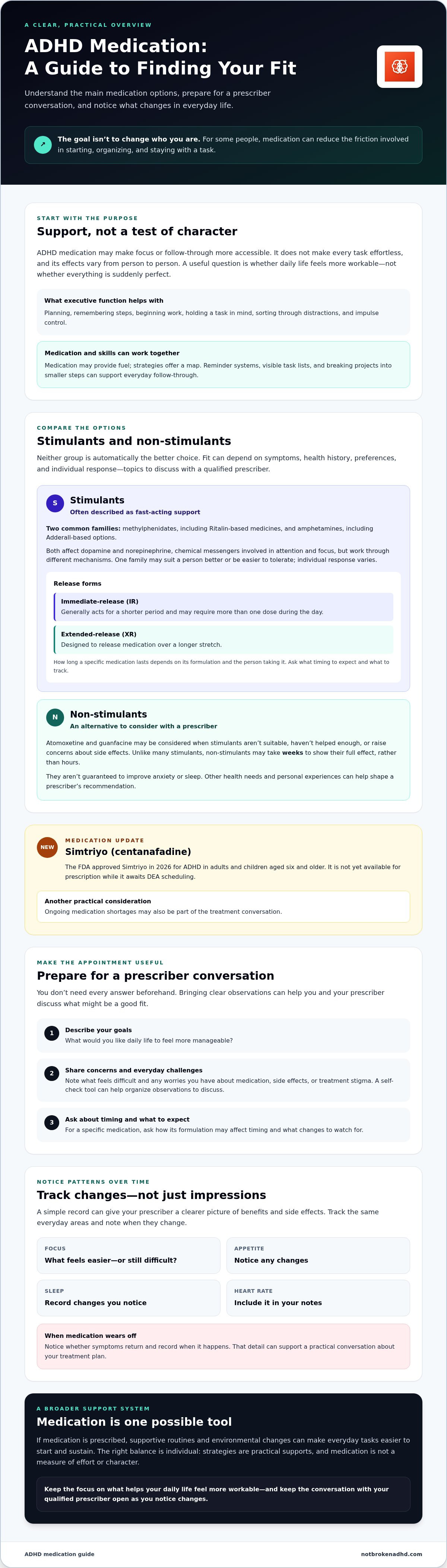
Tracking Progress and Managing Side Effects
A medication’s effect isn’t measured only by how focused you feel. Notice what changes in real life: Is it easier to begin a routine task? Are you finishing more steps, sleeping comfortably, and still feeling like yourself? Side effects matter, too. Appetite changes, dry mouth, sleep disruption, and changes in heart rate are worth recording and discussing with your prescriber.
Some people experience a “rebound effect” as medication wears off: ADHD symptoms or irritability may seem to return or intensify for a while. Timing can offer useful clues. If you feel unusually flat, disconnected, or unlike yourself, describe that clearly. Helpful calm should not mean losing your sense of self. Don’t adjust or stop a prescribed medication without guidance from your prescriber.
Common Side Effects and Mitigation Strategies
Small observations can help you and your prescriber decide what to address. For dry mouth, note when it occurs and whether drinking water helps. If your appetite dips, record when you’re eating and whether meals or snacks are easier before or after the medication’s strongest effects. Ask your prescriber for strategies suited to your medication and health needs. If sleep changes, log bedtime, wake time, and dose timing, then ask whether the schedule should be reviewed. Contact your prescriber about heart-rate changes or other physical symptoms that concern you.
Using a Medication Log for Clarity
Objective notes can help you and your prescriber spot patterns over time instead of relying on memory or a single difficult day.
Keep the log simple. Each day, note the medication and dose as prescribed, timing, sleep, appetite, mood, focus, physical symptoms, and when you notice a “crash” or rebound. Add a brief example, such as “started the report after lunch without rereading the same email repeatedly.” You don’t need a perfect record. A few consistent notes can be more useful than a detailed log you can’t maintain.
Also distinguish between feeling a medication and noticing it working. A strong sensation isn’t required for benefit. Practical changes, like forgetting fewer steps or getting started more easily, may be more informative. Bring your notes to follow-up visits and point out both gains and trade-offs. This adhd medication guide is a starting point, not a substitute for individualized medical advice.
Want a structured way to prepare for those conversations? Explore ADHD medication guides to support your tracking and appointment preparation.
Beyond the Prescription: Building Your Support Ecosystem
Medication, when part of your plan, doesn’t have to carry the whole load. Everyday supports can give focus somewhere useful to land: a clear next step, fewer distractions, and a routine that makes important tasks easier to begin. These supports aren’t a test of discipline. They’re ways to shape your surroundings around how you work.
Make tasks visible and easier to start. Put frequently used items where you’ll see them, keep a short task list in your line of sight, or break a large assignment into a first step you can complete quickly. Adjust your environment, too: move your phone out of reach, use headphones if they help, or choose a quieter spot when possible. Small changes can reduce the decisions between you and getting started.
Practical Tools for Daily Focus
A timer can give a task a clear beginning and end. Use the Pomodoro timer to set a focused work period and a planned break, including at times when you notice medication supporting your attention. There’s no need to force a particular schedule. Experiment with a rhythm that feels manageable and discuss medication timing with your prescriber.
Simulations offer another way to explore how attention and executive function challenges may feel in everyday situations. Notice what settings make it easier or harder to stay engaged, then use those observations to choose practical supports. External structure can help, too. Body doubling, such as working alongside another person who is also focused on a task, may provide a helpful sense of company or accountability. It doesn’t replace medication or medical guidance.
Next Steps with The ADHD Field Guide
You’re the expert on your own experience. Tools can help you notice patterns, but you decide what feels useful and what you want to bring to a professional conversation.
The ADHD Field Guide offers downloadable ADHD guides, an ADHD Medication Guide, executive function educational content, a Pomodoro timer, and simulations. Use the medication guide to prepare questions for your prescriber, and explore practical executive function resources for strategies you can adapt to daily life. These educational tools don’t diagnose ADHD or prescribe medication.
Start with one support, not a complete life overhaul. Choose a task that often gets stuck, make its first step visible, and try a timer or an environmental change. Keep what helps; adjust what doesn’t. An adhd medication guide can help you understand treatment options, while your observations can help shape supports that fit your life.
Take Your Next Step with More Clarity
Choosing whether to explore ADHD medication is personal. Stimulants and non-stimulants work differently, and finding a suitable option may take thoughtful conversations and adjustments with your prescriber. Your observations matter: tracking focus, daily functioning, and side effects can help you explain what’s changing and what support you need.
Medication is one possible tool, not a measure of character or a complete plan on its own. Practical routines and environmental supports can make everyday tasks more manageable, whether or not medication is part of your approach. This adhd medication guide is here to make the options easier to understand and your next conversation easier to prepare for.
Explore downloadable guides and practical ADHD management tools to help you prepare questions for your prescriber. These educational resources are not a substitute for professional medical advice.
Download the Complete ADHD Medication Guide
You deserve information that respects your experience. Move forward at your own pace, one clear question or helpful support at a time.
Frequently Asked Questions
How long does it take for ADHD medication to start working?
Stimulants can start having an effect the same day, while non-stimulants may take several weeks to show their full benefit. The timeline depends on the medication, its formulation, and your individual response. Rather than judging only by how you feel right after taking it, notice changes in daily tasks, focus, and side effects over time. Ask your prescriber when to expect a response and when to check in.
Can ADHD medication change my personality?
ADHD medication shouldn’t make you feel like you’ve lost your sense of self. Some people feel calmer or find it easier to pause and focus, while others may feel unusually flat, irritable, or unlike themselves. Those experiences are worth discussing with your prescriber, especially if they persist or interfere with daily life. Don’t change your dose on your own. Describe what feels different and when you notice it.
What is the difference between methylphenidate and amphetamine?
Methylphenidate and amphetamine are two different families of stimulant medication. Both affect dopamine and norepinephrine, chemical messengers involved in attention, but they work in different ways. A person may respond better to one family or find its side effects easier to manage; there isn’t a universal best choice. Your prescriber can consider your health history, other medications, goals, and response when discussing options.
What happens if I forget to take my ADHD medication?
If you miss a dose, check the instructions for your specific medication or contact your prescriber or pharmacist for advice. Don’t take an extra dose to make up for it unless a qualified professional tells you to. The right next step can depend on the medication and how late you remember. If missed doses happen often, mention it at your next appointment so you can discuss reminders or other practical supports.
Are there non-stimulant options for ADHD?
Yes. Non-stimulant options include medications such as atomoxetine and guanfacine. They work differently from stimulants and may take weeks to show their full effect, so ask your prescriber what timeline to expect. The right option depends on your needs, health history, and response to treatment. This ADHD medication guide can help you prepare questions, but a prescriber is the right person to discuss which choices may suit your situation.
Can I take ADHD medication only on work or school days?
That depends on the medication and your individual treatment plan. Some people wonder about taking medication only on certain days, but don’t change the schedule without checking with the prescriber who manages it. Ask what to do on weekends, holidays, or days with different routines, and whether stopping and restarting could affect you. Clear instructions can help you make a plan that fits your life safely.
How do I know if my dose is too high?
A dose may need review if you’re experiencing troublesome effects such as feeling unusually tense, restless, emotionally flat, or unable to sleep, or if you notice concerning physical changes. Keep track of what happens and when, then contact your prescriber to discuss it. Don’t lower, raise, or stop the medication on your own. Seek urgent medical help for severe or sudden symptoms, such as chest pain or difficulty breathing.
Will I have to take ADHD medication for the rest of my life?
Not necessarily. Whether to continue medication is an individual decision that can change as your needs, preferences, and circumstances change. Some people choose to take it long term; others discuss adjustments or alternatives with their prescriber. Review how it’s helping, any side effects, and what matters in your daily life together. Don’t stop or change a prescribed medication without first asking your prescriber how to do so safely.


