

The standard productivity timer wasn't built for a dopamine-seeking brain; it was practically designed to derail it. If you have ever set a countdown only to have a shrill buzzer yank you violently out of deep hyperfocus, you already know why traditional advice fails. Using an adapted pomodoro timer for ADHD focus isn't about forcing yourself into rigid twenty-five-minute boxes. It's about working alongside your natural cognitive wiring instead of constantly battling against it.
You already know how exhausting it is when a five-minute pause silently morphs into a two-hour rabbit hole, or how time blindness can make pressing "start" trigger intense dread. You don't lack discipline; your executive function simply runs on interest and dopamine rather than arbitrary clock ticks. In this guide, you'll discover how to adapt interval timing to support ADHD dopamine regulation, overcome time blindness, and sustain focus without burning out. From variable focus windows to low-friction sensory transitions, here is how to finally make time work for your brain.
Key Takeaways
- Understand why traditional 25-minute intervals disrupt hyperfocus and how interest-based nervous systems process time differently.
- Discover the sensory and visual features essential for choosing an effective pomodoro timer for ADHD focus.
- Learn a simple four-step method to customize work blocks around your real-time energy rather than arbitrary rules.
- Protect your momentum by replacing high-stimulation dopamine traps with nervous-system-regulating break activities.
- Explore how a low-friction focus timer paired with executive function guides can simplify daily task initiation.
Why Standard Pomodoro Fails the ADHD Brain
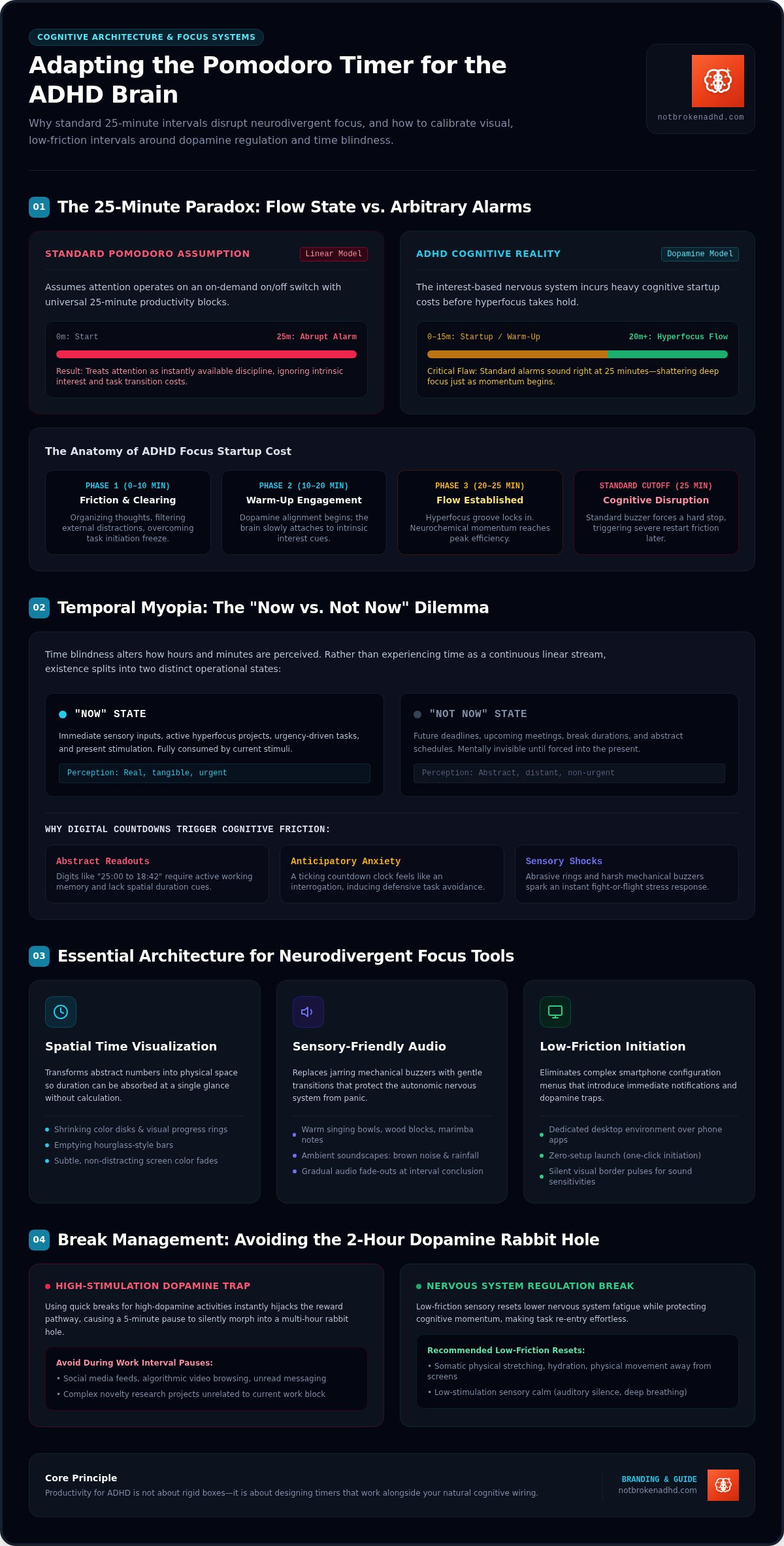
Mainstream productivity advice treats attention like an on-off switch. Set a clock, sit down, and produce results. The classic Pomodoro Technique assumes that twenty-five minutes represents a universal sweet spot for human cognition. For a neurotypical worker, that structure builds manageable discipline. For an interest-based nervous system, it often creates immediate dysfunction. An effective pomodoro timer for ADHD focus must account for dopamine dysregulation, variable attention spans, and intense friction during cognitive transitions.
ADHD brains do not regulate attention on demand. They run on novelty, urgency, and intrinsic fascination. When an activity lacks immediate neurochemical reward, a twenty-five-minute block feels like an insurmountable sentence. The brain anticipates the effort, panics, and retreats into task freeze. Conversely, when genuine interest takes over, rigid intervals become an active obstacle rather than a helpful guardrail.
The Conflict Between Hyperfocus and Arbitrary Alarms
Reaching deep concentration requires steep startup costs. It takes immense mental energy to organize thoughts, clear background distractions, and sink into a flow state. For many neurodivergent individuals, that warm-up period alone takes fifteen to twenty minutes.
Standard timers cut off that momentum right as the brain finally engages. Forcing a stop after twenty-five minutes shatters the delicate neurochemical groove of hyperfocus. Shifting focus away from a high-dopamine project causes genuine cognitive pain. Once broken, restarting that focus later requires another round of exhausting mental effort.
Time Blindness and the "Now vs. Not Now" Dilemma
Temporal myopia, commonly referred to as time blindness, fundamentally alters how people perceive the passage of hours and minutes. The ADHD mind rarely experiences time as a continuous, linear stream. Instead, existence splits into two distinct categories: now and not now.
Standard countdown tools fail to bridge this perceptual gap for several practical reasons:
- Abstract numerical readouts: Watching digital numbers drop from 25:00 to 18:42 conveys no visceral, spatial sense of remaining duration.
- Anticipatory anxiety: A digital clock ticking downward often feels like an interrogation, provoking defensive avoidance rather than steady immersion.
- Sudden sensory disruption: Harsh buzzers or sharp rings trigger a startling fight-or-flight response, heightening nervous system fatigue.
Without intuitive visual cues, an ordinary timer generates persistent friction. Selecting an adaptable pomodoro timer for ADHD focus requires shifting away from arbitrary rules toward tools that visually represent time, accommodate hyperfocus, and respect natural cognitive rhythms.
Essential Features of an ADHD-Friendly Focus Timer
Most office timers are blunt instruments. They click mechanically, flash harsh warning numbers, or blare shrill alarms. For an atypical nervous system, those inputs trigger an instant fight-or-flight response. When executive dysfunction creates serious difficulty initiating tasks, the interface itself must not add cognitive friction. A purposeful pomodoro timer for ADHD focus prioritizes sensory gentleness, spatial time visualization, and minimal configuration steps over rigid administrative rules.
Traditional phone apps often sabotage the very focus they promise. Unlocking a smartphone to set a simple countdown introduces immediate distraction traps, from unread messages to social media notifications. A dedicated, low-friction desktop tool preserves your attention by requiring no complex setup menus before you begin.
Sensory-Friendly Notifications and Auditory Design
Loud mechanical buzzers jar the autonomic nervous system. That sudden shock breaks focus through panic rather than calm awareness. ADHD-friendly tools replace abrasive sirens with softer sensory cues:
- Low-frequency chimes: Warm singing bowls, wooden blocks, or soft marimba notes alert the brain without triggering sensory defensiveness.
- Ambient soundscapes: Brown noise, rainfall, or gentle binaural rhythms that play during the work interval and gently fade out when time expires.
- Silent visual cues: Subtle screen color shifts or soft pulsing borders for individuals with sound sensitivities.
Visualizing Time with Progress Wheels and Color Fades
Static numbers fail to communicate duration. A digital display reading "14:22" requires working memory to interpret relative duration. In contrast, visual timers transform an abstract concept into physical space.
A shrinking color disk, an emptying hourglass bar, or a subtle progress ring shows how much time has passed at a glance. You don't have to calculate remaining minutes in your head. That visual anchor reduces cognitive load, grounds you in the present moment, and gently tethers drifting thoughts back to the workspace.
Customizable Intervals Beyond the 25-Minute Myth
Rigid intervals fail because human energy fluctuates throughout the day. An effective pomodoro timer for ADHD focus lets you change interval lengths instantly without restarting your session. If a complex spreadsheet sparks intense resistance, setting a low-stakes ten-minute sprint helps overcome initial task freeze. If you enter deep flow, a flexible tool lets you extend the session or switch to an open-ended count-up mode.
To reduce daily task friction, exploring the calm, visual tools at notbrokenadhd.com provides access to focus utilities built specifically around neurodivergent working styles.
How to Calibrate Your Work Intervals for Dopamine Flow
Forcing a tired nervous system into an arbitrary block guarantees frustration. Instead of treating interval length as a test of willpower, treat it as an adjustable dial. Evidence-based behavioral strategies designed to manage symptoms and improve functioning emphasize breaking tasks down and adjusting expectations to meet current capacity. Calibrating your focus blocks around your actual neurochemical energy creates a reliable bridge between intent and action.
A functional framework relies on flexibility rather than rigid compliance. Setting an adaptable pomodoro timer for ADHD focus starts with evaluating your current resources before you pick a duration.
Step 1: Assessing Daily Executive Bandwidth
Energy fluctuates daily. Some mornings offer abundant drive; others begin in an immediate mental fog. Match your timer increment to your present capacity:
- Low capacity (10–15 minutes): Ideal for days clouded by mental exhaustion or heavy emotional resistance. Keep barriers tiny.
- Moderate capacity (20–30 minutes): Best for structured, clear routines like replying to routine emails or sorting project files.
- High capacity (45–60 minutes): Reserved for creative immersion or deep analytical work when interest is already high.
Step 2: The 10-Minute Initiation Sprint
Initiation friction causes the greatest mental pain. When an overwhelming task sparks complete avoidance, set an ultra-short ten-minute countdown. Give yourself full permission to walk away when the alarm sounds. The goal isn't project completion; it's overcoming static friction.
Starting is often the entire battle. Once the first few minutes pass and the brain begins processing the problem, neurochemical momentum takes over. If the buzzer rings and you feel engaged, you can simply keep going. If the resistance remains impenetrable, stop. Stepping away without shame protects your self-trust.
Step 3: Implementing Flexible Rest Cycles
Traditional frameworks enforce a five-minute break after every work block, but cognitive replenishment rarely follows a strict schedule. Deep problem-solving burns significantly more executive fuel than routine sorting. Scale your downtime to reflect the actual mental effort expended.
Build in a two-minute quiet runway before your break ends. Use this buffer to glance back at your workspace and outline the very next physical action you need to take. Documenting that entry point prevents the disorientation that so often derails the start of your next focus block.
When you align your pomodoro timer for ADHD focus with real-time dopamine availability, timing shifts from a rigid demand into an empathetic guide.
Managing the Break: Escaping the Dopamine Trap
The work interval is only half the battle. For an interest-driven brain, what happens during the pause determines whether your session succeeds or dissolves entirely. Neurotypical advice treats five-minute breaks as opportunities to quickly scroll a phone or answer personal messages. For someone with executive dysfunction, opening an algorithmic feed is a recipe for disaster. The sudden influx of quick stimulation floods reward pathways, making a return to ordinary work nearly impossible.
Breaks are not entertainment periods; they are functional neurological resets. Using an adaptable pomodoro timer for ADHD focus means establishing clear boundaries around how you spend those restorative minutes.
High-Dopamine Traps vs. Low-Dopamine Resets
Algorithmic feeds and mobile games trigger rapid dopamine spikes. They hijack working memory and shatter whatever baseline momentum you built during your work block. Once trapped in a high-stimulation cycle, switching tasks requires a massive surge of activation energy you may not have left.
Protect your focus by building a menu of soothing, low-stimulation activities that rest your sensory system:
- Physical hydration: Step away from the screen to drink a full glass of cold water.
- Proprioceptive movement: Stretch your shoulders, roll your ankles, or walk to the window to reset your visual field.
- Sensory down-regulation: Close your eyes in a dimly lit room or step outside to feel natural light on your skin.
Overcoming the Transition Deficit When Breaks End
Switching tasks generates real neurological friction. Even with low-dopamine activities, the transition from rest back to effort can trigger avoidance. You can bypass this friction by leaving an easy trail back into your task before you stand up.
Use a physical notepad as a "parking lot." Write down the exact sentence or single click you will make the moment you sit down. Keep your active window open on your screen rather than closing tabs or locking your desktop. When the transition alarm sounds, you won't need to orient yourself or decide where to start; you simply follow the breadcrumb you left behind.
Pairing structured habits with practical strategies makes all the difference. To build a personalized work rhythm that respects your brain's natural cycles, explore downloadable guides and executive function tools designed to support sustainable daily focus.
Managing breaks mindfully keeps your nervous system regulated and ensures your pomodoro timer for ADHD focus remains an ally instead of a source of stress.
Using the ADHD Field Guide Timer for Sustainable Focus
Most productivity tools demand intense executive effort just to get started. You open an app, navigate complex preference tabs, configure tag systems, and select custom project labels. By the time you finish the setup, your fragile pool of activation energy is completely drained. The ADHD Field Guide built-in Pomodoro timer takes the opposite approach. Built specifically around neurodivergent executive challenges, it eliminates administrative friction so you can move straight into action.
Sustained focus is never about rigid perfection. It's about having accessible tools that meet your brain where it is today. A dedicated pomodoro timer for ADHD focus works best when embedded alongside comprehensive, practical education rather than operating as an isolated clock.
Streamlined Design for Executive Dysfunction
The interface strips away unnecessary visual noise. Initiating a focus block requires minimal clicks, ensuring your attention stays anchored on your actual work rather than getting lost in settings menus:
- Low-friction initiation: Launch a session with a single click instead of typing labels or navigating complicated dashboard menus.
- Calm visual progression: Monitor remaining time through clean, spatial cues that provide clarity without inducing panic.
- Adaptable session lengths: Adjust durations on the fly to match your immediate bandwidth, from quick activation sprints to extended deep-work windows.
Pairing Timers with Comprehensive ADHD Resources
An interval clock is simply one moving part within a broader life system. Timing intervals provide structure, but understanding why your attention wavers provides long-term relief. Pairing this digital focus tool with specialized downloadable ADHD guides gives you concrete frameworks to organize complex projects, conquer task paralysis, and manage daily transitions.
Interactive simulations and self-reflection tools allow you to observe cognitive friction without judgment. Recognizing how stress, fatigue, and interest shape your attention helps replace chronic self-criticism with neutral curiosity. Some days allow for multiple deep blocks, while others require low-demand maintenance. Both outcomes are valid.
By pairing a gentle pomodoro timer for ADHD focus with neuro-affirming educational resources, you build a sustainable routine tailored to your wiring. The goal isn't to force yourself into a neurotypical standard, but to create a supportive environment where your genuine strengths can emerge.
Building a Rhythm That Respects Your Wiring
Your attention isn't broken. It simply operates under a different neurochemical blueprint. Traditional productivity methods often demand rigid consistency that clashes with dopamine-driven nervous systems, turning arbitrary clocks into sources of guilt. Sustainable momentum comes from ditching fixed rules in favor of intuitive visual feedback, low-stimulation breaks, and adjustable session lengths.
Using a flexible pomodoro timer for ADHD focus transforms time from an invisible adversary into a gentle structure. When you match your work blocks to your daily bandwidth, you protect your energy and dismantle the shame of inconsistent output. Small, intentional adjustments create room for your natural strengths to surface without exhaustion.
You don't have to navigate these executive friction points alone. Take the first step toward a calmer workflow when you start your focus session with The ADHD Field Guide tools, where built-in focus timers and self-paced educational resources support your neurodivergent brain every step of the way.
Frequently Asked Questions
Why does the standard 25-minute Pomodoro timer not work for ADHD?
The standard twenty-five-minute interval clashes directly with the interest-based nervous system. Reaching a focused flow state often takes neurodivergent individuals fifteen to twenty minutes of cognitive warmup. Cutting off that concentration with a rigid alarm disrupts productive hyperfocus. At the same time, twenty-five minutes can feel painfully long for mundane tasks, triggering severe initiation avoidance.
How long should an ADHD Pomodoro interval be?
Intervals should range between ten and forty-five minutes depending on daily executive bandwidth and task complexity. When experiencing low energy or strong resistance, set a ten-minute sprint to clear activation friction. For deeply engaging or analytical projects, choose thirty to forty-five minutes. Adapting a pomodoro timer for ADHD focus means matching durations to real-time capacity.
What should adults with ADHD do during their timer breaks?
Adults with ADHD should prioritize sensory rest and low-dopamine activities rather than checking mobile devices. High-stimulation inputs like social media or gaming trigger dopamine traps that derail task reentry. Restorative breaks include drinking water, performing physical stretches, stepping outside for natural light, or quietly closing your eyes to reset working memory.
How do visual timers help with ADHD time blindness?
Visual timers make the passage of time concrete and physical rather than abstract. Neurodivergent brains often process time as simply "now" or "not now." Digital digits require mental calculation, whereas a disappearing color disk or shrinking bar communicates remaining duration at a glance. This visual anchor reduces working memory strain and grounds you in the current moment.
What is the Flowmodoro technique and is it better for ADHD?
The Flowmodoro technique tracks focused work by counting up instead of counting down. You work until your natural attention begins to fade, stop the clock, and calculate a proportional break based on elapsed time. This method is often superior for ADHD brains because it honors uninterrupted hyperfocus without forcing arbitrary stops during high-momentum creative flow.
Can using a Pomodoro timer help break ADHD task paralysis?
A timer breaks task paralysis by dramatically lowering the activation energy needed to begin. Committing to a massive, vague project causes immediate mental overwhelm and shutdown. Telling yourself to work for just ten minutes creates an accessible, low-stakes entry point. Overcoming that initial inertia often allows momentum to take over naturally.
Are digital timer apps better than physical visual timers for ADHD?
Both tools serve distinct needs depending on your immediate sensory environment and vulnerability to distraction. Physical visual timers eliminate the temptation of opening social apps on digital devices. However, dedicated desktop tools integrated into educational platforms provide greater interval flexibility, sound customization, and low-friction access. Choosing the right pomodoro timer for ADHD focus depends on which tool removes the most startup resistance for your workflow.


