

What if managing ADHD at work starts with making the hardest parts of your workday easier, rather than following a stricter productivity system? Getting started, sorting priorities, finishing tasks, and refocusing after interruptions can each call for a different kind of support. This managing ADHD at work guide starts with those friction points, then connects them to practical strategies you can test.
If unclear instructions leave you unsure where to begin, or distractions keep pulling you away from a task, it can be frustrating to feel like you should simply try harder. Instead, pinpoint what makes the task difficult. Is the first step unclear? Are several requests competing for your attention? Do you lose your place after interruptions? Once you name the obstacle, you can choose a strategy that fits your role and preferences.
This guide covers task initiation, prioritizing, focus, and follow-through, along with ways to make instructions and routines more workable. It also offers a practical framework for discussing support at work, if you choose to have that conversation.
Key Takeaways
- Notice recurring friction in tasks, timing, transitions, or your work environment to identify where support could help.
- Match a personal system, focus tool, environmental adjustment, or collaborative approach to the specific challenge.
- Choose one strategy and test it on a small scale before deciding whether to adjust it.
- Notice what changed and what remains difficult without turning progress tracking into another demanding task.
- Keep what helps, adapt what doesn’t, and build a flexible system around the work you do.
Managing ADHD at Work Starts with Naming the Friction Points
Struggling to begin a report, keep track of follow-ups, or shift gears after an interruption doesn’t mean you lack motivation or ability. A task’s demands may not match the support available. Naming that mismatch helps you look for a practical adjustment instead of turning a difficult moment into a judgment about yourself.
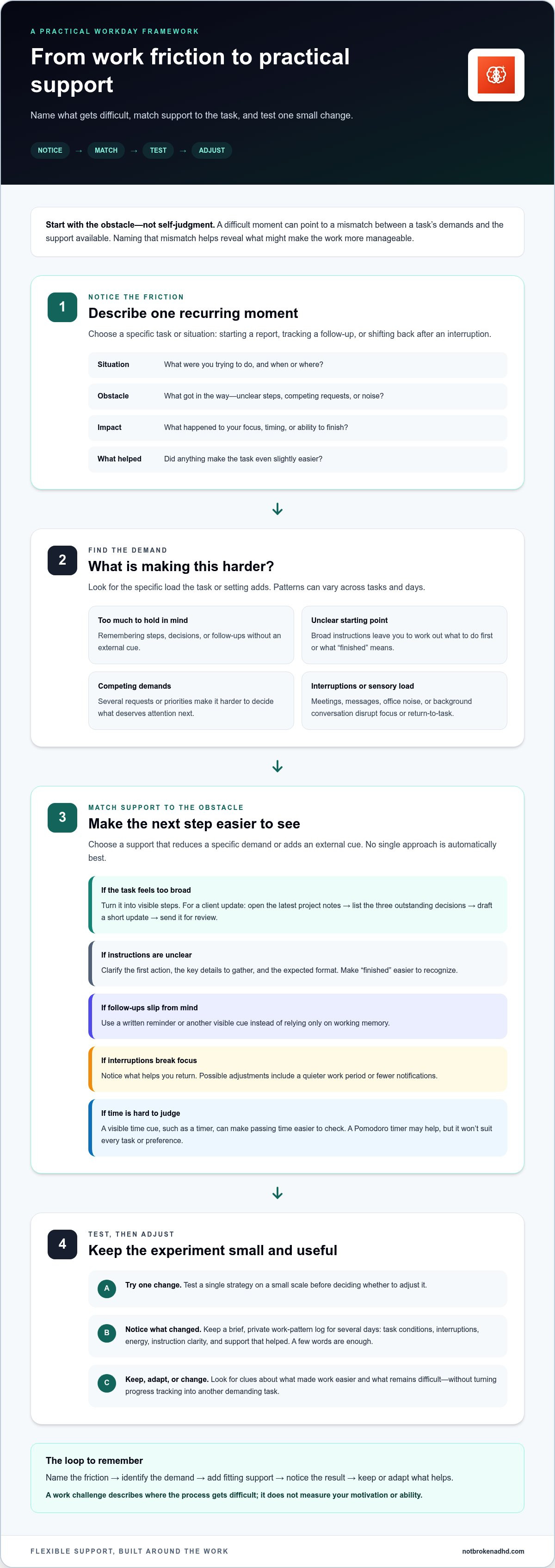
A workplace friction point is a recurring moment when a task, setting, or expectation becomes harder to manage. Describe one example using four prompts:
- Situation: What were you trying to do, and when or where?
- Obstacle: What got in the way, such as unclear steps, competing requests, or noise?
- Impact: What happened to your focus, timing, or ability to finish?
- What helped: Did anything make the task even slightly easier?
A work challenge describes where the process gets difficult; it doesn’t measure your motivation or your ability.
Which parts of work can feel harder with ADHD?
Friction may show up when you’re starting a task without a clear first step, shifting attention after an interruption, deciding which urgent request comes first, or remembering to track a follow-up. These activities draw on executive function: everyday mental skills that help you organize, plan, hold information in mind, and move between steps. The Attention deficit hyperactivity disorder (ADHD) overview discusses executive dysfunction as one area that can affect daily functioning.
The pattern can vary across tasks. You might become absorbed in an interesting problem yet find a routine form unusually hard to start. That contrast is useful information, not evidence that you could do every task if you simply tried harder.
How to spot patterns without blaming yourself
For several days, keep a brief, private work-pattern log. Note the task conditions, interruptions, your energy, how clear the instructions felt, and any support that helped. A few words are enough. Look for clues, rather than building a record of everything you think went wrong.
For example, note whether starting was easier after someone clarified the first step, or whether you lost your place when a meeting interrupted focused work. Look for patterns that could guide a small change. The ADHD-friendly daily routine checklist can also help you think through broader routines while keeping them flexible.
The first step in a managing ADHD at work guide is noticing, not fixing everything at once. Once you can name the point of friction, it becomes easier to consider what kind of support might fit.
Why ADHD Work Challenges Happen: Tasks, Time, and the Work Environment
A task can become harder when its demands leave too much to hold, sort, or remember at once. An assignment with unclear next steps asks you to decide what to do before you can begin. Competing priorities add another decision, while delayed feedback can leave you unsure whether you’re on track. Unanswered questions take attention that could otherwise go toward the work itself.
Time and transitions can add friction, too. Some people find it difficult to estimate how long a task will take; others may lose momentum when switching activities or returning after an interruption. These experiences aren’t universal and can vary by task or day. Sensory demands vary, too: office noise may distract one person, while frequent notifications or background conversation may be more disruptive for another.
Work support is most useful when it reduces a specific demand or adds an external cue. That might mean making the next action visible, clarifying what “finished” means, or setting a reminder outside your working memory. The most useful strategies connect a real point of difficulty to support that fits it.
How task design affects focus and follow-through
“Prepare the client update” is a broad instruction. It doesn’t say where to start, what information to include, or how the finished update will be used. A clearer version might specify the first action, the key details to gather, and the expected format. That reduces guesswork before the task begins.
Visible steps can make a large project easier to approach by turning an open-ended demand into a sequence. For example: open the latest project notes, list the three outstanding decisions, draft a short update, then send it for review. This won’t make every task effortless, but it gives your attention a concrete place to land and makes progress easier to see.
How time pressure and sensory demands shape the workday
A meeting can break up a work block; an open-plan office can add background sound; messages can arrive just as you’re rebuilding focus. Each shift may require you to stop, remember where you were, and decide what deserves attention next. Notice which conditions tend to interrupt you and what helps you return to the task.
A time estimate is a prediction, such as “this may take half an hour.” A visible time cue, such as a timer, makes the passing time easier to check without relying on that prediction alone. A Pomodoro timer is one possible focus aid, though it won’t suit every task or preference. The ADHD Field Guide’s executive function educational resources offer practical strategies to explore and adapt to your needs.
Compare ADHD Work Strategies: Personal Systems, Tools, and Workplace Support
Once you’ve identified a friction point, choose support that addresses it directly. A missed follow-up may call for a written reminder; frequent interruptions may call for a quieter work period or fewer notifications. Neither approach is automatically better. The key question is whether it reduces the demand that’s getting in your way.
Use this comparison as a starting point, not a ranking. A personal system or focus tool is often straightforward to test on your own. An environmental adjustment or a conversation with a colleague or manager may fit better when the work setting or shared expectations are part of the problem.
| Friction point | Strategy | Best fit | Possible limitation |
|---|---|---|---|
| Details or next steps are easy to lose | Checklist, written steps, or reminder | Tasks with repeatable steps or follow-ups | May need regular updating |
| Starting or pacing focused work feels difficult | Timer or planned work interval | A task that can be approached in a defined block | Fixed intervals may interrupt some tasks |
| Messages or background activity break concentration | Reduce notifications or try a quieter work period | Work that benefits from fewer interruptions | May depend on job duties or team needs |
| Verbal instructions or shifting priorities are hard to track | Request written priorities or a brief meeting recap | Work with changing requests or important details | Requires coordination with others |
When a personal system or focus tool may help
If small details disappear between steps, a checklist or written next action can keep them visible, especially when you need to return to a task later. Downloadable ADHD guides can help you explore ways to externalize reminders and steps. Choose a format you’ll actually use, rather than one that creates extra upkeep. A Pomodoro timer is another option for adding structure to starting or pacing focused work. Adjust the interval, pause it, or skip it when a fixed rhythm doesn’t fit the task.
When environmental or collaborative support may fit better
If interruptions repeatedly break your concentration, muting nonessential notifications during a focused period or finding a quieter place to work may help. If spoken directions are easy to lose, you could suggest written priorities or a short recap after meetings. Frame these as practical ideas to discuss and adapt with your team, not guaranteed accommodations or universal entitlements.
Start small. Try one low-effort change, such as writing down the next action or silencing one source of alerts for a work block. Notice whether it addresses the friction point and whether it creates a new burden. If the difficulty is built into how work is assigned, shared, or interrupted, a personal tool may not be enough on its own. Compare options by how well they fit, then refine your choice based on what actually supports your work.
Build a Workday Plan You Can Test, Adjust, and Return To
A workday plan doesn’t need to solve every challenge at once. Treat it as a small experiment: choose one friction point, try one strategy that targets it, then notice what happens. This keeps the plan manageable and gives you useful information, even if the first approach needs adjusting.
How to run a manageable strategy experiment
Start with an observable goal. For example: “I’ll begin my priority task before checking messages.” Then choose one cue, tool, or environmental change to support it, such as writing the first action on a sticky note or placing your phone out of sight. Try the change over a brief, defined period, such as several workdays, and review what you notice. Change one element at a time so you can tell what helped.
- What changed? Did you start sooner, return to the task more easily, or miss fewer steps?
- What remained difficult? Was the cue easy to miss, or did an interruption still break your focus?
- What will you adjust? Keep, simplify, or replace the strategy based on what you learned.
A note or quick check mark is enough. Tracking should make the experiment clearer, not become another task to manage.
Shape the plan around how your work happens. For remote work, a calendar block or visible next step may provide structure between meetings. In an office, you might test a quieter work period or reduce nonessential notifications. For shift-based work, a short handover note can make changing tasks or priorities more visible. In collaborative roles, a shared written task list may make ownership and next actions easier to revisit. Choose what fits your duties and team; one format won’t suit every schedule.
If a project feels too broad to start, an ADHD task management guide can offer ways to break work into steps. The ADHD Field Guide’s executive function resources and tools can also help you explore approaches at your own pace.
How to discuss support at work if you choose
You don’t have to disclose a diagnosis to describe a work barrier or ask whether a practical change is possible. If you decide to raise it, prepare a concise outline: what part of the work is difficult, how it affects the task, what change you’d like to try, and how you’ll know whether it helps. For example: “I lose track of verbal follow-ups after meetings. Could we try sending a brief written recap of action items?”
Workplace policies and accommodation processes vary by location, so don’t assume one approach applies everywhere. You can choose how much to share and whether to start with a practical conversation. Experiments that don’t require a conversation are another option.
Choose Your Next ADHD-at-Work Support Without Expecting a Perfect System
You don’t need a flawless routine to make work feel more manageable. Use a simple decision path: identify one recurring friction point, choose support that targets it, try it, and adjust based on what you learn. A strategy can be useful even if it only makes one part of the day easier. Flexibility isn’t failure; it’s how you shape a system around the work you actually do.
For example, if planning a project feels difficult, make the next steps visible. If beginning is the sticking point, a cue or focus interval may be a better first experiment. If the obstacle is distress or difficulty that reaches beyond a particular task, a workplace tool alone may not be the support you need. There’s no single solution that fits every person or every workday.
Which educational tool could support your next step?
The ADHD Field Guide offers self-guided educational materials and tools to explore after you’ve identified what you want help understanding or practicing. Executive function guides cover topics such as planning and follow-through. A Pomodoro timer can provide a visible focus interval, though you can adapt or skip timed sessions if they don’t suit your task. Interactive simulations offer educational experiences, not assessments or diagnoses.
Think of these resources as possibilities, not instructions. You might use a guide to consider different approaches, then test just one idea in your workday. A timer may make a focus period more visible, but it won’t address every barrier, such as unclear priorities or frequent interruptions. Keep the strategy if it helps; change it if it adds effort without easing the specific difficulty.
When additional support may be useful
If ADHD-related symptoms or distress are affecting your wellbeing, you may want to consider speaking with a qualified health professional. Educational resources can support learning and self-management, but they aren’t a substitute for clinical evaluation, diagnosis, or treatment. You get to decide what kind of support feels appropriate and when to seek it.
Progress can be quiet: a clearer next step, fewer lost follow-ups, or a work routine you can return to after it gets disrupted. This guide is a starting point, not a demand to fix everything at once. Keep what supports you, adapt what doesn’t, and allow your system to change as your work changes.
Explore self-guided ADHD and executive function resources to find educational tools for your next workday experiment.
Take One Practical Step Into Your Next Workday
Your next step doesn’t have to be a complete system. Choose one work moment you’d like to make easier, then try a small change and learn from it. A managing ADHD at work guide is useful when it helps you find a starting point, not when it adds pressure to get everything right.
If you’d like ideas to explore at your own pace, The ADHD Field Guide offers downloadable ADHD and executive function educational guides, an ADHD Self-Check Tool, interactive simulations, and a Pomodoro timer. These resources support learning and self-management, but they aren’t a diagnosis or a substitute for clinical care.
Explore practical ADHD guides and tools for your next step. Start with what feels relevant now, and adjust as you learn what works for you.
Frequently Asked Questions
Can ADHD make it harder to manage work tasks?
Yes, ADHD can make some work tasks harder when they rely heavily on attention, planning, or holding steps in mind, though experiences differ and not every work difficulty is caused by ADHD. You might find it harder to decide which request comes first, begin an open-ended assignment, or remember to follow up after a meeting. This guide offers practical education and ideas for self-management, not diagnosis.
What is the best way to manage ADHD at work?
There’s no single best method for everyone. Start by identifying one recurring barrier, such as losing track of requests that arrive through several channels. Then choose a strategy aimed at that problem and test it before adding more tools. Clearer task instructions, an external reminder, or a change to your work environment may be useful starting points. Use this managing ADHD at work guide to consider what fits your role and preferences.
Can a Pomodoro timer help with ADHD at work?
A Pomodoro timer may help some people by creating a cue to begin and a visible endpoint for a focus interval. That structure can be useful for a task that feels hard to start or pace. Fixed intervals may interrupt other kinds of work or clash with your schedule, though. Adjust the timing or stop using it if it doesn’t fit. A timer is an optional aid, not a treatment or guaranteed solution.
Should I tell my employer that I have ADHD?
Whether to disclose ADHD is a personal decision, and you can first identify the work barrier you want to address. For example, you might ask to receive project changes in writing without sharing more personal information than you’re comfortable with. If you’re considering formal disclosure or an accommodation request, workplace policies and legal protections vary by location. Check relevant local guidance for your circumstances rather than relying on general advice as a legal answer.
What ADHD accommodations can help at work?
Possible changes include written instructions for a new assignment, a brief summary of meeting decisions, fewer avoidable interruptions during focused work, or clearer agreement about which deadline takes priority. The best fit depends on the task, workplace, and person doing the work. To raise an idea, explain the barrier and how the change might help you complete a work responsibility. A request isn’t a guarantee, and examples aren’t universal legal entitlements.
How do I stay focused at work with ADHD?
Try reducing one distraction, placing the next work action somewhere visible, or using a focus cue that feels realistic for the task. For instance, you might silence nonessential alerts while drafting but keep urgent work channels available. Strategies vary across people and settings, so test one change and review whether it helped you return to the work. Difficulty focusing isn’t a personal failing, and one approach doesn’t have to work for every task.
Can I manage ADHD at work without medication?
This article can’t determine what treatment you need. Practical work strategies and educational tools may support routines, planning, or focus, but they don’t replace personalized medical advice. Medication and workplace strategies also aren’t mutually exclusive; some people use more than one kind of support. If you have questions about treatment options, discuss your situation with a qualified health professional. You can explore work strategies while making treatment decisions with appropriate guidance.


