

What if the best planner isn’t the one with the most features, but the one that makes your next step easier? If generic planners feel hard to start or keep using, you’re not failing at organization. The system may simply ask for more than you need right now. The right printable ADHD management tools can make a specific challenge, like getting started or keeping track of tasks, feel more manageable.
You don’t need to map out your whole life on paper. A tool that helps with one recurring snag may be a better starting point than a packed planner. If you stop using it for a while, you can adjust it and begin again without catching up on every missed day.
This guide compares practical printables, from task lists and time-planning sheets to habit and goal trackers, so you can choose one that fits your current needs. You’ll also find ways to personalize it and pair paper supports with digital ADHD resources, including executive-function education and a Pomodoro timer from the ADHD Field Guide. Start small, and keep what helps.
Key Takeaways
- Choose printable ADHD management tools by the task you want to make easier, such as remembering, prioritizing, or getting started.
- Keep the tool simple. Adapt it or use it intermittently instead of treating every blank space as something to catch up on.
- Compare paper and digital formats based on what matters in your day, including visibility, portability, reminders, and setup effort.
- Start with one recurring point of friction and choose a format that makes the next action clear.
- Complement paper-based support with ADHD Field Guide resources, including executive-function education and a Pomodoro timer.
What Printable ADHD Management Tools Can, and Cannot, Help With
Printable ADHD management tools are external supports: they put information or a next step somewhere you can see it, rather than relying on memory alone. A task list, routine chart, or prompt sheet can help you remember, organize, prioritize, or begin everyday tasks. A printable ADHD tool is a practical external aid that makes a task or plan easier to see and act on.
A worksheet can support daily planning, but it can’t diagnose or treat ADHD. It’s a planning aid, not a substitute for clinical assessment or care. Its value is in helping with a specific moment, such as keeping track of an appointment or deciding what to do first.
If you abandon a tool, that doesn’t mean you’ve failed. It may be too detailed, hard to access, or designed for a routine that doesn’t match your life. Simplify it, change how you use it, or set it aside. The point is support, not perfect completion.
Which everyday challenges can a printable support?
Choose a format based on the friction you notice. For example:
- Task lists make commitments and open tasks visible, so you don’t have to keep rehearsing them in your head.
- Visual schedules lay out routine steps in order, making it easier to see what comes next.
- Prompts can cue you to begin, pause, or return to a task after an interruption.
Keep the content concrete. “Open the document” is easier to act on than “work on project.”
Why does a tool need to fit the person using it?
Usability depends on your attention, energy, surroundings, and preferences. A detailed daily page may feel reassuring in a quiet space but burdensome during a busy day. A single visible reminder may work better than a multi-step routine. There’s no one layout or schedule that suits everyone.
Helpful structure reduces decisions or makes the next action clearer. A rigid system can do the opposite if it adds tracking, catch-up work, or guilt about missed days. Leave room to adapt: cross out unused sections, write less, or restart without filling in what you missed. If a printable creates more work than it removes, try a simpler approach.
Some printables draw on time management techniques, such as breaking work into focused intervals or sorting tasks by priority. Use these ideas as a starting point and adjust them to fit your day. The best support is the one that helps with a real, recurring challenge.
Match Printable ADHD Tools to the Executive-Function Task
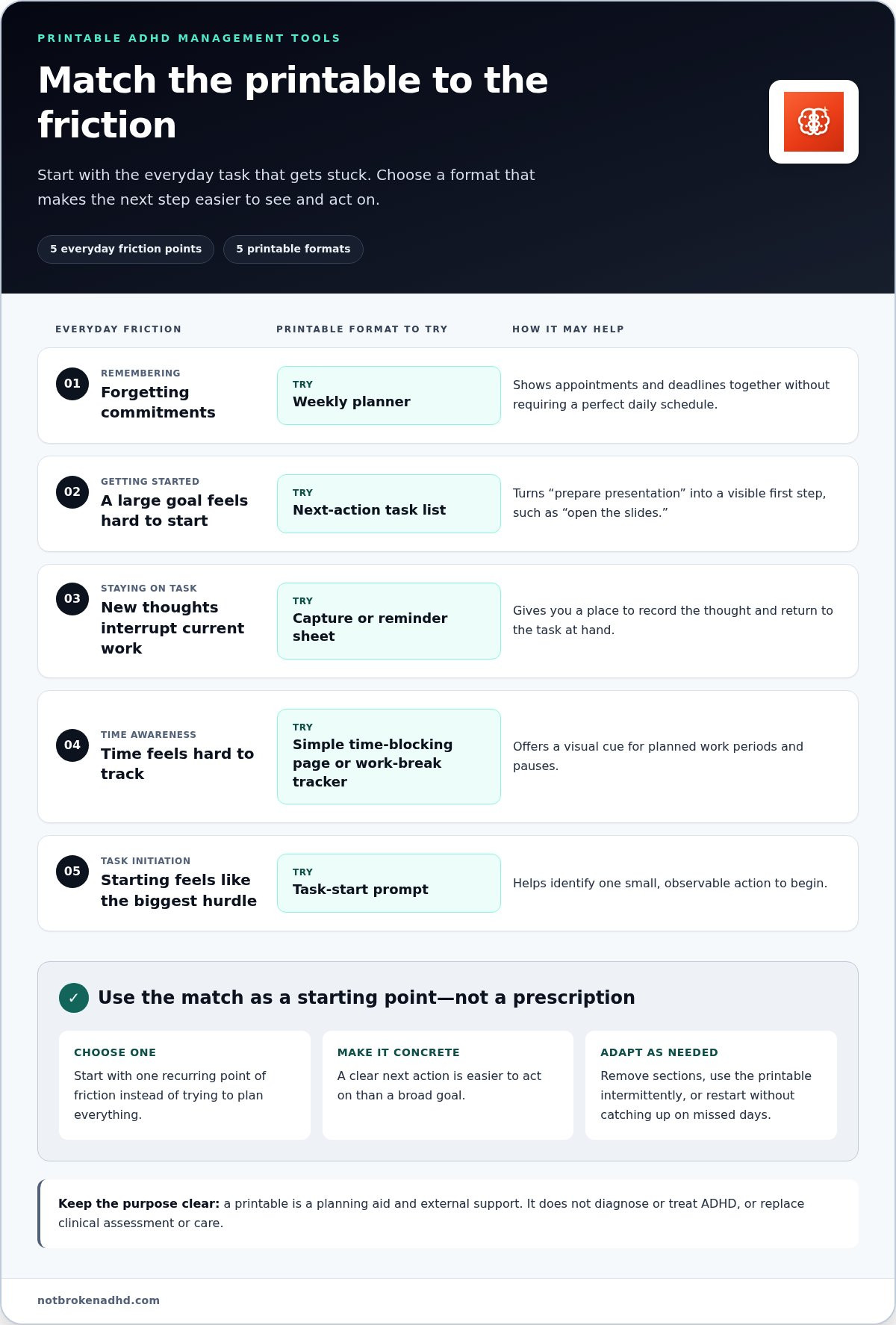
Instead of looking for one planner that covers everything, start with the task that regularly gets stuck. Is it remembering commitments, choosing what matters first, sensing how much time has passed, or beginning? Matching the format to the friction can make printable ADHD management tools more practical and less demanding.
A tool is useful when it makes the task you need to act on visible. Use the table as a starting point, not a prescription. Remove sections, write directly on a blank page, or use a printable only on days when it helps.
| Everyday friction | Printable format to try | How it may help |
|---|---|---|
| Forgetting commitments | Weekly planner | Shows appointments and deadlines together without requiring a perfect daily schedule. |
| A large goal feels hard to start | Next-action task list | Turns “prepare presentation” into a visible first step, such as “open the slides.” |
| New thoughts interrupt current work | Capture or reminder sheet | Gives you a place to record the thought and return to the task at hand. |
| Time feels hard to track | Simple time-blocking page or work-break tracker | Offers a visual cue for planned work periods and pauses. |
| Starting feels like the biggest hurdle | Task-start prompt | Helps identify one small, observable action to begin. |
Tools for planning, prioritizing, and remembering
A weekly planner can show appointments, deadlines, and open space at a glance. It doesn’t need to dictate exactly how each day should unfold. A task list can separate the next action from the larger goal: “find the form” is easier to approach than “sort out paperwork.” If a new reminder pops up while you’re focused, jot it on a capture sheet and decide later when to act on it.
Tools for time awareness and getting started
Time-blocking pages are estimates, not promises that every task will fit neatly into a slot. Leave room to adjust. A visual timer or work-break tracker can provide an optional cue to check in, pause, or resume, rather than a scorecard for productivity. For task initiation, write a prompt that points to an action you can picture doing: gather the materials, write one sentence, or set up the workspace.
For broader information about ADHD and everyday management, explore CHADD resources for adults with ADHD. The ADHD Field Guide also offers executive-function educational resources to complement a paper-based approach.
Printable vs. Digital ADHD Tools: Choose the Format You’ll Use
Paper and digital supports can both make a next step easier to notice. The better fit depends on where you are, what you need to remember, and how much setup feels manageable. A printable may stay in view on your desk, while a digital tool can travel with you and provide reminders. Neither format is automatically better.
| Consideration | Paper tool | Digital tool |
|---|---|---|
| Visibility | Can be placed near the task or routine it supports. | May be easy to open on a device you already use. |
| Portability | Needs to be carried or available where you need it. | Can be accessed on a compatible device. |
| Reminders | Usually relies on you seeing the page. | May offer alerts or timer cues, depending on the tool. |
| Setup and upkeep | Requires printing, storing, and updating pages. | May require choosing a tool and learning its setup. |
When a paper-based tool may feel easier
A page can be placed where the task happens: a checklist by the door, for example, or a planning sheet beside your workspace. If handwriting or checking off a visible item feels satisfying, paper can provide a tangible cue without adding another screen to your day. Printing, keeping pages easy to find, and updating them take effort too. A sheet that gets buried may stop being useful.
When an interactive or digital support may fit better
If you move between places or tend to miss paper reminders, a digital support may be easier to keep nearby. Alerts can cue a task, and a timer can signal when to begin or pause. These features may reduce how much you need to hold in memory, but notifications can also compete for attention. Choose settings and tools that feel supportive rather than noisy.
The ADHD Field Guide’s Pomodoro timer is a digital focus aid that can sit alongside a paper plan. For more context on executive-function supports, explore the Executive Functioning: Neurodivergent Guide (2026). You might use a printable to choose a task, then a digital timer as a cue to start. Or keep the whole routine on paper. Let your day shape the mix.
There’s no need to pick one format for everything. A hybrid approach can pair a visible paper checklist with a digital reminder for an appointment, for instance. Keep the combination small enough to maintain. If one part becomes another task to manage, simplify it. The aim is a system that fits your attention, environment, and routine, not a perfect setup.
How to Choose and Use One Printable ADHD Tool
A useful first experiment doesn’t need to become a complete planner system. Start with one recurring moment that causes friction, then choose a page that makes the next action easier to see. This keeps printable ADHD management tools focused on a real need rather than adding another large project to manage.
Start with one friction point, not a complete life overhaul
Ask yourself what feels hardest right now: remembering, prioritizing, noticing time, or getting started? Pick one situation, such as losing track of errands or putting off opening an important document. Then try one simple tool for that situation. Keep the first version short enough to understand at a glance.
- Name the snag. Describe one recurring moment in plain language, such as “I forget what I need before leaving home.”
- Choose a small support. Try a short checklist, a simple task list, or a page with one clear prompt. Avoid building a full system before you know what would help.
- Make the next action visible. Write a specific step you can do, rather than a broad goal. “Put keys and lunch by the door” gives you a clearer cue than “get organized.”
The page doesn’t need to look polished. It needs to make sense to you in the moment you’ll use it.
Adapt the tool and review whether it helps
Try the page where the friction happens. Does it help you see what to do next, or does it take extra effort to interpret? Remove sections that feel distracting, confusing, or irrelevant. If you rarely look at the page, consider whether it needs to be simpler or placed somewhere more visible.
Use it when it’s useful, and let the format change with your needs. A missed day doesn’t create a debt to repay. You can pick it up again, alter the layout, or set it aside. Learning that a tool doesn’t fit is useful information, not a failure to stay consistent.
If routines are part of the challenge, the ADHD-Friendly Daily Routine: A Flexible Checklist for 2026 offers another perspective on building a routine with room to adjust. For related executive-function education, explore ADHD executive-function resources and choose one idea to pair with your printable.
Explore ADHD Field Guide Resources Alongside Your Printable
A printable can make a task visible; learning about ADHD can offer context for why a particular support may feel useful. The ADHD Field Guide brings these approaches together through downloadable ADHD guides and executive-function education. Use what you learn to shape your paper tool around a real need, rather than expecting a worksheet to solve every challenge.
Combine practical supports with clear ADHD education
Executive-function skills support everyday activities such as organizing, remembering, and starting tasks. Learning about them can help you understand why an external cue, checklist, or timer might be useful. The Executive Functioning: Neurodivergent Guide (2026) offers a related learning path, while ADHD-focused interactive simulations provide educational experiences that can build understanding. Neither is a clinical assessment or a promise of a particular outcome.
The ADHD Field Guide’s downloadable guides cover ADHD and medication education. They can build background knowledge alongside the tool you’ve chosen, but educational information isn’t individualized medical advice. If a printable helps you notice that a task needs a clearer cue, adjust the page without treating the change as a measure of success or failure.
Choose a next step that feels manageable
It’s easy to collect resources faster than you can use them. Instead, choose one guide or tool that connects to the friction you’re working on now. If your focus is learning about executive function, start there. If you want to reflect on ADHD-related experiences, the ADHD Self-Check Tool can support that reflection. It doesn’t diagnose ADHD, and its results aren’t a substitute for a professional assessment.
Educational resources can complement printable ADHD management tools, but they don’t replace individualized diagnosis, clinical care, or medical advice. Keep the next step small: read one relevant guide, explore one educational tool, or pair a paper prompt with a digital focus aid. You don’t have to build a whole system at once.
Explore the ADHD Field Guide’s educational resources and choose a next step that fits your current needs: Explore ADHD Field Guide resources.
Take One Small Step Toward a System That Fits
The most useful printable ADHD management tools support a specific task, not an ideal version of your whole life. Start with one recurring point of friction, choose the simplest format that makes the next step visible, and adjust it if it adds pressure instead of easing the task. Paper and digital supports can work together if that combination feels manageable.
Educational resources can add context to the strategies you try. The ADHD Field Guide offers downloadable educational and medication guides, an ADHD Self-Check Tool for reflection, interactive simulations, and a Pomodoro timer. These resources can complement everyday supports, but they don’t replace individualized diagnosis or medical advice.
Choose one small next step, whether that’s simplifying a page you already have or learning more about executive function. Explore ADHD Field Guide resources and find information that fits your current questions. Start simply, make changes as you go, and keep what helps.
Frequently Asked Questions
What are the best printable ADHD management tools?
The best printable ADHD management tools are the ones that make a specific task easier to see or begin. Try a weekly planner to view commitments, a short task list to identify next actions, or a reminder sheet to capture thoughts without losing your place. If time awareness is the sticking point, a simple time-blocking page may help. Start with one format that addresses a current challenge, then adjust it to fit.
Do ADHD printable planners actually help?
An ADHD printable planner can help by placing tasks, commitments, or routine steps somewhere visible, so you don’t have to keep everything in mind. Its usefulness depends on whether the layout suits your needs and is easy to access. A planner isn’t a fix for every difficulty, and leaving it unused doesn’t mean you’ve failed. Try simplifying the page or changing where you keep it if using it feels like extra work.
What should I include in an ADHD daily planner?
Include only the details that help you decide what to do next. You might add appointments, a short list of priorities, one next action for a larger task, and a place to capture reminders. A simple time cue or routine prompt may also be useful. Leave out sections that don’t serve your day. A planner doesn’t need to account for every hour or task to provide practical support.
Are printable ADHD tools better than digital apps?
Neither format is better for everyone. Printables can offer a visible, tangible cue, while digital apps may provide portability, alerts, or timers. Think about where you need support and what you’ll remember to check. Paper requires printing and storing; digital tools require device access and setup. You can also combine formats, such as keeping a paper task list and using a digital reminder for an appointment.
Can printable ADHD tools help with executive dysfunction?
Printables can offer external structure for tasks affected by executive-function challenges, such as remembering, prioritizing, or starting. A checklist can show routine steps, while breaking a large goal into one visible action may make it easier to approach. These tools support planning and task management, but they don’t remove every barrier or work the same way for everyone. Simplify the format if it adds pressure rather than making a step clearer.
How do I make an ADHD planner easier to stick with?
Make it easy to start and easy to restart. Choose one page for one recurring need, keep the next action clear, and place the planner where you’re likely to notice it. Remove sections you don’t use. If you stop using it, you don’t need to fill in missed days before returning. You can resume, change the layout, or try a different format. The aim is useful support, not perfect consistency.
Are ADHD worksheets a substitute for diagnosis or treatment?
No. An ADHD worksheet can help organize daily tasks or support personal reflection, but it can’t diagnose or treat ADHD. An online self-check can offer a structured way to reflect on experiences, but it isn’t a diagnosis either. For questions about symptoms, diagnosis, or treatment, seek guidance from a qualified health professional. Educational resources can help you learn, but they don’t replace individualized clinical care or medical advice.


