

If you’ve been asking “what is adhd,” conflicting explanations can make it hard to know what’s reliable or whether your everyday experiences deserve a closer look. Trouble starting a task or keeping track of details isn’t a character flaw. It may help to understand how attention and organization can be affected by differences in brain development.
ADHD is a neurodevelopmental condition, but it doesn’t look the same in every person or situation. Some people mainly experience difficulty with attention and organization; others may notice restlessness or acting before thinking. Context matters, too, which can make ADHD easy to misunderstand.
This guide explains ADHD in clear, non-stigmatizing language, how it can affect daily life, and why its patterns vary. You’ll also learn how exploring information differs from getting a clinical assessment, and what informed next steps can look like. The goal isn’t to label yourself from a list of experiences. It’s to replace confusion with a grounded understanding so you can decide what kind of support or learning may be useful.
Key Takeaways
- Learn what is adhd in plain language and why it’s understood as a neurodevelopmental condition, not a personal failing.
- See how differences in attention, activity, and impulse regulation can show up in varied ways across people and settings.
- Separate evidence-based explanations of ADHD from common assumptions that oversimplify its causes.
- Understand why a self-check can support reflection but can’t establish a clinical diagnosis.
- Explore informed next steps, from noting concerns and relevant history to seeking a qualified clinical assessment.
What Is ADHD? A Clear Definition of Attention-Deficit/Hyperactivity Disorder
ADHD, or attention-deficit/hyperactivity disorder, is a neurodevelopmental condition that can affect how a person regulates attention, activity, and impulses. Its effects vary. Someone may find it hard to stay with a routine task, pause before responding, or keep track of steps, while focusing deeply on an absorbing interest may feel easier. ADHD doesn’t mean a person is inattentive or active every moment.
If you’re asking “what is adhd,” start here: it’s a recognized condition, not a measure of someone’s character or potential. Difficulty following through can be mistaken for not caring, and restlessness can be mistaken for choosing to disrupt. But a person’s struggles aren’t proof that they’re lazy, unintelligent, or not trying. The word “disorder” describes patterns that can interfere with everyday functioning; it doesn’t define a person’s worth or identity.
What does “neurodevelopmental” mean in everyday language?
Neurodevelopmental describes how the brain develops and functions. In ADHD, differences in brain-based regulation can shape how a person manages focus, activity, and impulses. That may affect ordinary moments, such as shifting from one task to another or remembering what to bring before leaving home. These examples can help explain the term, but no single behavior defines ADHD.
A neurological difference isn’t a verdict on intelligence, motivation, or effort. A person can understand what needs doing and still have trouble organizing the steps or getting started. They can care about a commitment and still lose track of time. Recognizing that distinction makes room for complexity while leaving space to develop strategies that fit a person’s needs.
What does ADHD stand for?
ADHD stands for attention-deficit/hyperactivity disorder. The name points to symptom areas used to describe the condition, not a checklist that requires everyone to show the same mix. “Attention-deficit” doesn’t mean a person can never focus, and “hyperactivity” doesn’t mean they’re visibly moving all the time. Some difficulties are less obvious to other people.
The name can make ADHD sound like it is simply about paying attention or being unusually energetic. In practice, the picture is more nuanced. A person may struggle to direct or shift attention when a task feels repetitive, yet become absorbed in something engaging. Another may experience inner restlessness more than noticeable movement. These examples illustrate possible experiences, not a way to identify ADHD on their own.
For a broader overview of the condition and related topics, see Attention deficit hyperactivity disorder. A clear starting definition is useful, but it isn’t the whole story. Understanding ADHD means looking beyond the name to the person, their circumstances, and the patterns they experience.
How ADHD Affects Attention, Activity, and Impulse Regulation
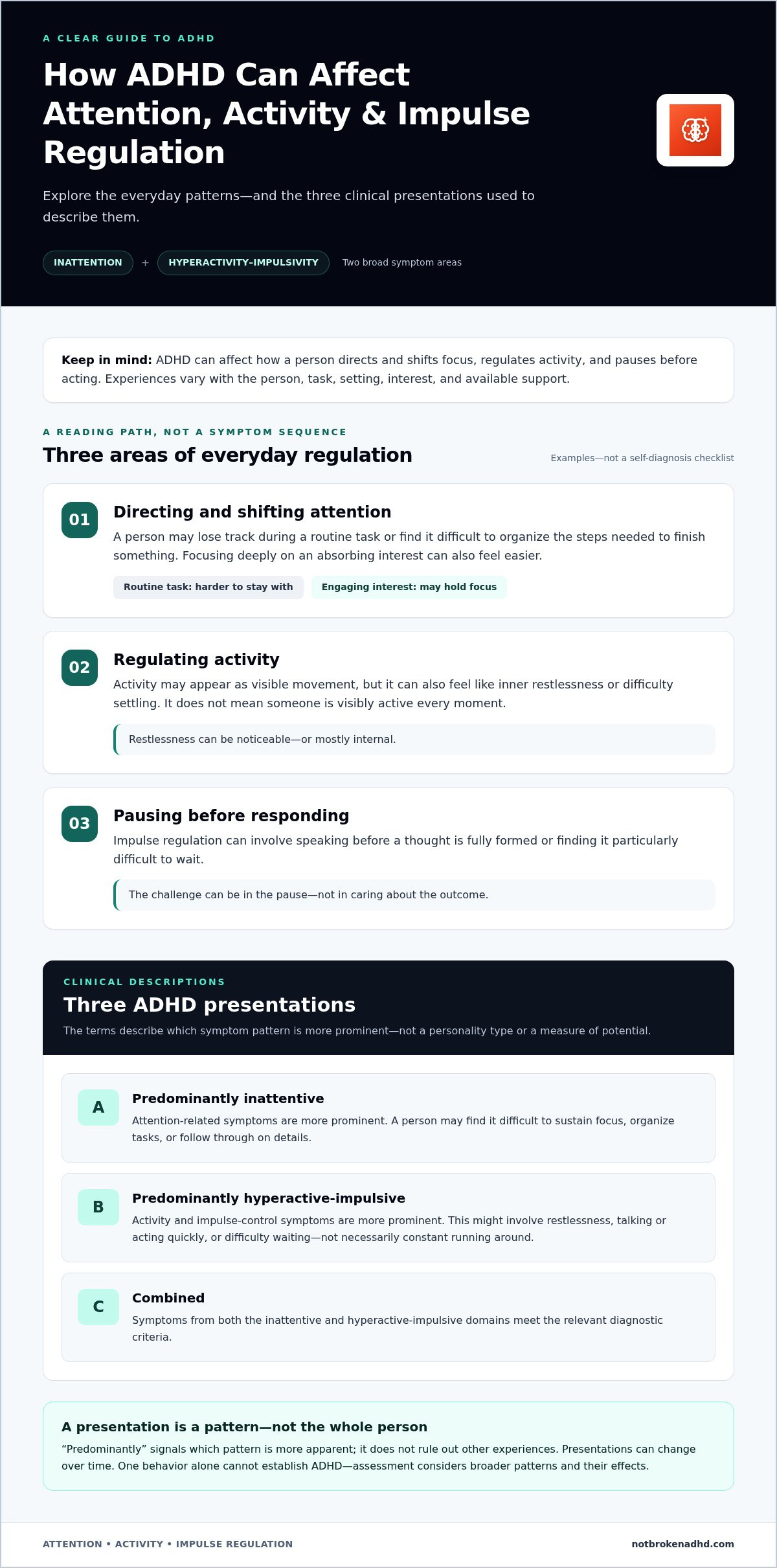
ADHD can affect more than whether someone pays attention. It can influence how they direct and shift focus, regulate activity, and pause before acting or speaking. These patterns may make some everyday tasks harder, even when the person understands what to do and wants to do it. The National Institute of Mental Health (NIMH) on ADHD describes symptoms across two broad areas: inattention and hyperactivity-impulsivity.
Attention regulation isn’t simply the ability to concentrate. A person might follow an engaging conversation closely but lose track during a routine task, or have trouble organizing the steps needed to finish an assignment. Activity can mean visible movement, but it can also feel like inner restlessness or difficulty settling. Impulse regulation relates to pausing and considering what comes next; a person might speak before a thought is fully formed or find waiting particularly difficult.
What are the three ADHD presentations?
Clinical language describes three presentations, based on the pattern of symptoms a person experiences. These terms describe a current pattern, not a personality type, fixed identity, or measure of potential.
- Predominantly inattentive presentation: Attention-related symptoms are more prominent. A person may find it difficult to sustain focus, organize tasks, or follow through on details.
- Predominantly hyperactive-impulsive presentation: Symptoms related to activity and impulse control are more prominent. This might involve restlessness, talking or acting quickly, or difficulty waiting, rather than a constant need to run around.
- Combined presentation: Symptoms from both the inattentive and hyperactive-impulsive domains meet the relevant diagnostic criteria.
“Predominantly” matters. It signals which symptom pattern is more apparent, not that the other experiences are impossible. Presentations can also change over time, so a label shouldn’t be treated as a complete description of someone’s life.
Why can attention and self-regulation feel inconsistent?
Focus and self-regulation can shift with the setting, task demands, interest, and available support. A person may be absorbed in a preferred project yet struggle to begin paperwork with several unclear steps. A quiet workspace, written reminders, or a predictable routine may make some tasks easier to manage. That variation doesn’t mean the person is choosing when to struggle.
One behavior alone can’t establish ADHD. Most people sometimes lose focus, feel restless, or respond quickly; assessment considers broader patterns and their effects, rather than treating an isolated moment as proof. If you’re learning what is adhd to better understand your own experiences, the ADHD self-check for reflection offers a structured starting point. It can support noticing patterns, but it can’t provide a clinical diagnosis.
ADHD doesn’t look identical in everyone because symptom patterns, daily demands, and helpful supports vary from person to person. Keeping that in mind makes room for individual experience without turning a presentation into a stereotype.
Why ADHD Can Look Different Across People, Ages, and Settings
ADHD doesn’t show up in a vacuum. The same person may manage one situation comfortably and find another exhausting, depending on how much structure, time, or support is available. Expectations matter, too: sitting quietly through a lesson, keeping track of a busy household, and switching between work tasks all place different demands on attention and self-regulation.
How can ADHD experiences change with age and responsibilities?
As responsibilities shift, different challenges may become easier to notice. A child may struggle with classroom routines or remembering school materials. Later, coordinating work deadlines, household tasks, appointments, and relationships can put new pressure on planning and follow-through. A person who once had substantial structure from caregivers or teachers may find that managing more tasks independently takes extra effort.
Visible behavior can change with age, too. Outward movement may become less noticeable, while restlessness feels more internal or difficulties with organizing and managing time stand out. That doesn’t mean ADHD has disappeared. People also differ in their strategies, strengths, and support needs. If you’re looking for adult-specific signs, focus on how patterns affect daily functioning rather than expecting every familiar childhood behavior to remain unchanged.
Why does the setting matter when understanding ADHD?
Some environments provide helpful structure without anyone having to create it. A clear schedule, reminders, and short, well-defined tasks may make it easier to keep moving through the day. In a less structured setting, open-ended tasks, interruptions, or time pressure may make the same person’s difficulties more apparent. Interest and demands play a part as well.
These examples show how context can shape what someone notices. They illustrate possible support needs, not signs that prove a diagnosis.
| Context | Demands that may stand out | Possible helpful support |
|---|---|---|
| Home | Keeping track of chores, belongings, or changing plans | Visible reminders and routines |
| School | Following multi-step instructions or staying with independent work | Clear steps, check-ins, and reduced distractions |
| Work | Prioritizing tasks, meeting deadlines, or switching between requests | Written priorities and planned task breaks |
| Relationships | Remembering arrangements or waiting to respond in a tense moment | Shared calendars and time to pause before replying |
Strengths can also emerge differently by setting. Someone may contribute lively ideas in a collaborative discussion and still need help tracking follow-up tasks. A quiet space may support careful work, while a fast-moving group may make it easier to generate ideas. Neither moment tells the whole story.
Occasional forgetfulness or restlessness is part of human experience. Clinicians look for an ongoing pattern that began during childhood, appears across more than one setting, and interferes with functioning. A single difficult week, workplace, or relationship can’t establish ADHD. If you’re wondering “what is adhd” in relation to your own life, noticing patterns across settings can help organize questions, but only a qualified clinical assessment can determine whether ADHD is the explanation.
What Causes ADHD, and Which Common Assumptions Miss the Evidence?
There isn’t one known cause of ADHD. Current understanding points to a combination of influences on brain development and function, with genetics playing an important role. Researchers continue to study how different factors may contribute, so it’s more accurate to talk about risk and influence than to name one simple explanation.
That distinction matters. If you’re asking “what is adhd” and why it happens, an explanation that blames a person or their family can create shame without reflecting the evidence. ADHD isn’t established as the result of poor parenting, lack of discipline, or eating too much sugar. Those claims may sound straightforward, but they don’t explain the complex patterns involved.
What is known about genetics and ADHD risk?
ADHD can run in families, and genetic factors are understood to play an important role in the likelihood of developing it. The National Institute of Mental Health’s overview of ADHD describes ADHD as a disorder with genetic and neurobiological influences. This points to a meaningful connection, not a single “ADHD gene” that determines what will happen.
Inherited likelihood isn’t certainty. A family history may be relevant, but it can’t by itself confirm that someone has ADHD, and a person doesn’t need to know of a relative with ADHD to experience it. Genes are one part of a developing picture, not a personal fault or a prediction of someone’s abilities.
Does one factor explain ADHD?
No single factor explains every person’s ADHD. Researchers also study brain structure and function and possible prenatal influences, but the full range of causes and how they interact isn’t settled. A risk factor can be associated with a greater likelihood; it doesn’t prove what caused ADHD in a particular person. Risk factors can help explain likelihood, but they don’t provide a complete explanation of ADHD.
This is why blame-based assumptions miss the point. Parenting approaches can shape a child’s routines and support, but they aren’t established as the cause of ADHD. Likewise, sugar isn’t an established cause. Food, sleep, stress, and daily routines can affect how someone feels or functions, but that’s different from showing that they caused a neurodevelopmental condition. A family’s choices shouldn’t be treated as a shortcut explanation.
It’s also okay for science to leave some questions open. A careful answer can name what evidence supports, including genetic influence, while acknowledging what researchers are still investigating. That balance avoids replacing one oversimplification with another.
If you’d like to reflect on experiences that prompted your questions, use the ADHD self-check tool as a starting point. It can help organize observations for learning, but it can’t identify the cause of difficulties or provide a clinical diagnosis.
How ADHD Is Assessed and Where to Find Helpful Next Steps
Learning about ADHD can help you make sense of experiences, but it isn’t the same as finding out whether you meet the criteria for a diagnosis. An online questionnaire or self-check tool can prompt reflection; its score can’t diagnose ADHD. Assessment involves a qualified clinician looking at a broader pattern, its impact, and other possible explanations. One frustrating day or a single answer on a quiz can’t tell the whole story.
What can a clinical ADHD assessment involve?
Assessment is a clinician-led process, not a single test. A clinician may ask about current concerns, developmental and health history, and how difficulties affect daily life. Depending on the situation, they may also consider information from other people or records. The details can differ because each person’s circumstances and questions are different.
The aim is to understand patterns, not to confirm a label based on one behavior. Difficulty focusing, for example, can have more than one explanation. A clinician considers how long concerns have been present, whether they show up in different settings, and whether they interfere with functioning. They may explore other factors that could contribute to similar difficulties. The outcome depends on the information gathered and the person’s circumstances; an assessment doesn’t guarantee a particular answer.
If you’re considering an assessment, it may help to take a few manageable steps:
- Note what’s concerning you. Jot down situations where attention, organization, activity, or impulse regulation feels difficult, and how those experiences affect everyday tasks.
- Seek a qualified clinical assessment. Bring your concerns to a clinician who can evaluate ADHD and consider other possible explanations.
- Share relevant history. Discuss when you first noticed the patterns, where they occur, and what has helped or made things harder. Include examples from different stages of life if you can.
You don’t need a perfect timeline or a complete record before asking questions. Notes can simply help you describe what you’ve noticed.
How can readers continue learning at their own pace?
Personal reflection and clinical assessment serve different purposes. A self-check can help you organize observations and identify questions to explore, but it can’t provide a diagnosis. If you’re still asking “what is adhd” or wondering how it may relate to everyday life, treat educational tools as a starting point for learning, not a verdict about yourself.
For practical reflection, the ADHD Self-Check Tool can help you gather your thoughts before deciding what to do next. You might note examples, the setting, what was happening at the time, and whether the challenge is recurring. This isn’t about building a case against yourself. It’s a way to make questions easier to discuss if you choose to seek an assessment.
You can also explore an executive-functioning guide for everyday context on skills such as planning, organizing, and following through. Take what’s useful, at your own pace. Understanding ADHD doesn’t require having every answer today; one informed next step is enough.
Take the Next Step at Your Own Pace
Understanding “what is adhd” can be the start of a more useful question: what would help me understand my own needs? You don’t have to settle every question at once. Notice what feels difficult, what comes more naturally, and which routines or supports make a difference. That reflection can be valuable whether or not you decide to seek an assessment.
If you’d like a practical way to keep learning, explore accessible ADHD resources, including downloadable guides on ADHD and executive functioning, interactive simulations, and a self-check tool for reflection. These resources can offer ideas and context, but they aren’t a substitute for clinical assessment.
Explore accessible ADHD learning resources and choose a place to begin that feels manageable. The ADHD Field Guide offers educational tools, including guides, simulations, and a Pomodoro timer, to support learning and everyday task management. Start with the resource that best fits the question you’re exploring.
Frequently Asked Questions
Is ADHD a learning disability?
ADHD and learning disabilities are different, though a person can experience both. ADHD may make it harder to manage instructions, materials, or the steps of an assignment; a learning disability can affect a particular skill, such as reading, writing, or mathematics. For example, unfinished written work can have different explanations. If school or work tasks remain difficult, noting where the difficulty occurs can help guide a conversation about possible support or assessment.
Can ADHD occur alongside anxiety or autism?
Yes. ADHD can occur alongside anxiety, autism, or other conditions, but one doesn’t automatically mean a person has another. Some experiences can overlap. For instance, avoiding a crowded event might relate to sensory strain, worry, attention demands, or more than one factor. It can help to note what happens, when it happens, and what makes it easier. A qualified clinician can consider those concerns in context.
Does ADHD affect sleep?
Some people with ADHD experience sleep difficulties, but trouble sleeping by itself doesn’t show that someone has ADHD. Sleep can be affected by routines, stress, health, and other factors, and poor sleep can also make daytime focus harder. If sleep problems persist or interfere with daily activities, consider discussing them with a qualified healthcare professional. General sleep suggestions may be useful, but they can’t identify the cause of an individual’s sleep concerns.
Can someone have ADHD without being hyperactive?
Yes. A person can have ADHD without obvious physical restlessness. For some, attention-related challenges are more noticeable, such as losing track of a conversation or struggling to organize a multi-step task. Those experiences can also have other explanations, so one example can’t establish ADHD. If a pattern is affecting everyday life, recording when it occurs and what helps may offer useful context for a conversation with a qualified clinician.
Is ADHD always diagnosed in childhood?
No. Some people are first assessed as adults, perhaps after work, study, or family responsibilities make longstanding challenges more noticeable. A clinician may ask about earlier life as well as current concerns, so memories of school routines or feedback from caregivers can be useful if available. Not remembering every detail doesn’t settle the question either way. A qualified clinician can consider a person’s history and present-day functioning together.
Can an online ADHD test diagnose ADHD?
No. An online test or self-check can’t confirm ADHD, even if the result feels familiar. It may help you put concerns into words or identify examples to discuss, such as frequently missing deadlines despite trying different planning methods. If you’re searching “what is adhd” and wondering whether it fits your experience, treat online results as prompts for reflection, not a clinical conclusion. Diagnosis requires a qualified clinician’s assessment.
Can ADHD be outgrown?
ADHD often continues beyond childhood, though its effects can shift as a person’s circumstances and responsibilities change. Visible restlessness may become less obvious, while managing schedules or several competing tasks may become more challenging. A broad description can’t predict how one person’s experience will develop. If your needs change, you can discuss current difficulties and useful supports with a qualified clinician rather than assuming that past strategies will always work.


