

Trying harder can make recovery harder. When a shower, email, or simple meal feels impossible to start, it’s easy to assume you’re lazy or not trying enough. But executive dysfunction can make planning, starting, and finishing everyday tasks take far more effort. If that effort has been piling up, overcoming executive dysfunction burnout may start with less pressure, not a bigger plan.
You don’t have to wait until you feel fully motivated to take a small step. This guide explains why your capacity may feel reduced, how difficulty differs from lack of effort, and what practical recovery can look like on a low-capacity day.
You’ll find ways to lower demands, make tasks easier to begin, and build support around you at a manageable pace. You’ll also learn when self-help may not be enough and when reaching out for additional support could be a helpful next step. No blame, and no demand to fix everything at once.
Key Takeaways
- Recognize how difficulty starting or following through can reflect executive-function challenges, not a lack of effort.
- Use the burnout cycle to notice how rising demands and compensating effort may affect your capacity. It is not a diagnosis.
- Compare practical supports, such as reducing demands, externalizing reminders, and asking for help, to find what feels manageable.
- Approach overcoming executive dysfunction burnout one small step at a time, without trying to clear your entire backlog.
- Check in with yourself over time to see what feels easier, what still drains you, and whether additional support may help.
What Executive Dysfunction Burnout Can Feel Like, and Why It Is Not Laziness
You know the message needs a reply. The dishes are waiting, and you have a rough idea of what to make for dinner. Yet starting any of it feels out of reach. You may care about these tasks and still struggle to begin, decide what comes first, or keep going once you start. That gap between intention and action can be frustrating, especially when you’re already worn down.
Executive dysfunction is difficulty managing actions, attention, or follow-through. It can affect planning, shifting between tasks, remembering what you meant to do, and bringing an activity to a close. The phrase executive dysfunction burnout describes an experience; it is not a formal diagnosis. For a broader overview of the term, see What is Executive Dysfunction?
Reduced capacity means having less access to the skills or energy a task requires. It isn’t proof that you’re lazy or don’t care.
How executive dysfunction can show up during burnout
Different parts of a task can become difficult in different ways. Starting might mean sitting with an unopened bill, even though you know it needs attention. Sequencing can turn getting ready into a tangle: choosing clothes, finding what you need, and leaving on time all compete for attention. Remembering may look like intending to answer a message, then losing track of it. Finishing might mean beginning paperwork but getting stuck before submitting it.
These hurdles aren’t interchangeable. A reminder may help you remember, but it may not make a task easier to start. A clear first step may help with starting, but not with staying focused long enough to finish. Your experience may include some of these examples, a different mix, or none of them. You don’t need to match a checklist for your difficulty to deserve care and practical support.
Why effort alone may not restart a depleted system
When tasks stall, self-criticism can arrive quickly: “I should be able to do this.” But shame adds another demand. Now you’re managing the task and worrying that struggling with it says something bad about you. That extra emotional load can make it harder to think clearly or choose a first step. Pushing harder may not solve the barrier, especially if the task already requires more planning or attention than you can readily access.
Needing a reminder, a smaller task, help with a practical step, or time to recover doesn’t mean you’re unwilling or incapable. It may mean the current setup asks more of you than you can manage right now. When overcoming executive dysfunction burnout, understanding the barrier is more useful than judging yourself for meeting it. One difficult stretch, or a list of familiar struggles, can’t establish a diagnosis. If these changes persist or affect daily life, consider discussing them with a qualified health professional.
How the Executive Dysfunction Burnout Cycle Builds
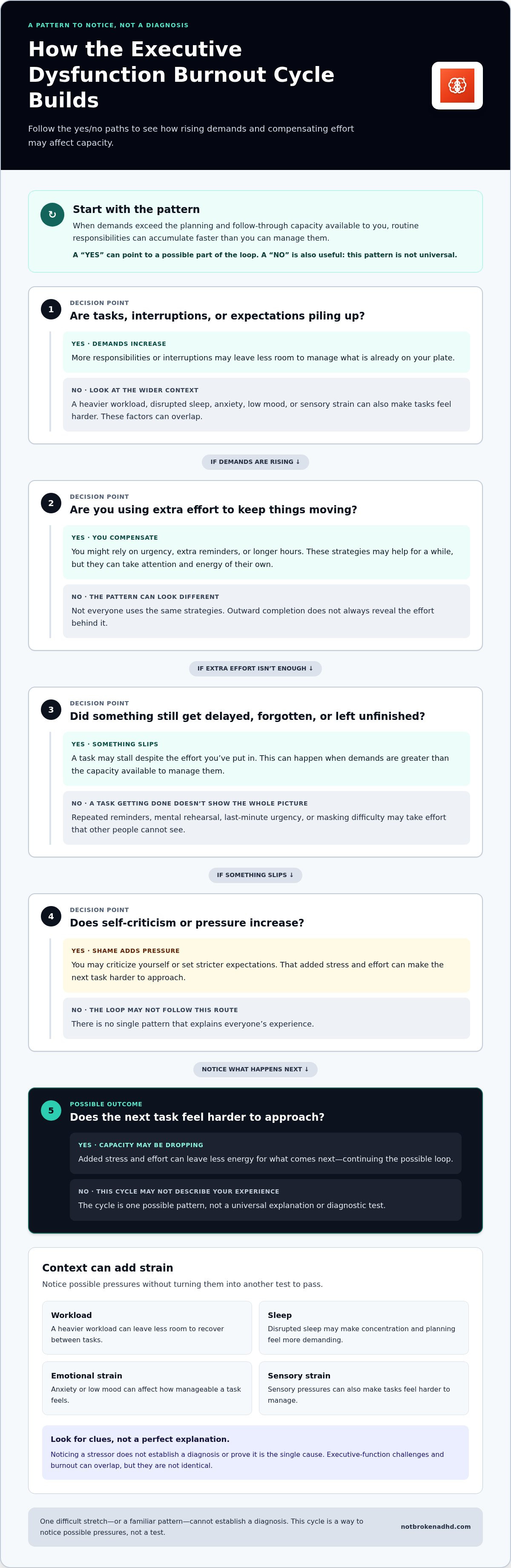
A difficult stretch can become a loop. Demands rise, you work harder to keep up, and the extra effort may help for a while. But it can also leave less energy for the next task. When something gets missed, shame can prompt even more compensating effort, while your capacity is already shrinking.
When demands exceed the planning and follow-through capacity available to you, routine responsibilities can accumulate faster than you can manage them.
- Demands increase. Tasks, interruptions, or expectations pile up.
- You compensate. You rely on urgency, extra reminders, or longer hours to keep things moving.
- Something slips. Despite the effort, a task is delayed, forgotten, or left unfinished.
- Shame adds pressure. You may criticize yourself or set stricter expectations.
- Capacity drops. The added stress and effort can make the next task harder to approach.
This is one possible pattern, not a universal explanation or diagnostic test. Executive-function challenges describe difficulties managing actions, attention, or follow-through. Burnout describes a state of exhaustion associated with prolonged stress; the World Health Organization uses the term specifically for chronic, unmanaged workplace stress. The experiences may overlap, but they aren’t identical. Cleveland Clinic’s Understanding Executive Dysfunction offers further context on how these challenges can affect daily functioning.
The hidden effort behind everyday functioning
Some people use strategies that aren’t obvious to others: setting repeated reminders, mentally rehearsing each step, waiting for last-minute urgency to create momentum, or masking difficulty so they appear to be coping. These approaches can sometimes help someone get through a task, but they can take attention and energy of their own. Outward completion doesn’t always reveal the strain behind it, and not everyone with ADHD or executive-function challenges uses the same strategies.
When stressors make tasks feel harder
The cycle may intensify when other pressures are present. A heavier workload can leave less room to recover between tasks. Disrupted sleep may make concentration and planning feel more demanding. Anxiety, low mood, or sensory strain can also affect how manageable a task feels. These factors can overlap. Noticing one doesn’t establish a diagnosis or prove it is the single cause.
Observe the context without turning it into another test to pass. You might briefly note what was happening on a harder day, such as workload, sleep, noise, or emotional strain. Look for clues, not a perfect explanation. Overcoming executive dysfunction burnout often involves adjusting the demands and supports around you, rather than trying to identify one fault in yourself. If learning more feels useful, executive-function educational resources can offer a starting point for exploring support strategies.
Which Supports Help During Executive Dysfunction Burnout, and Which Can Add Pressure?
When capacity is low, the best support is often the one that removes a barrier without creating a new job to manage. Before adding a productivity system, a strict routine, or an ambitious goal, look for friction you can take away. Could you make the task smaller? Could one nonessential demand wait? Could you make the next step easier to see?
Use the comparison below as a guide, not a checklist to complete. The effort involved depends on the day, the task, and what feels supportive to you.
| Support | Effort required | When it may help | When it may feel like pressure |
|---|---|---|---|
| Reduce demands | Low to moderate | When the task list is larger than your current capacity | If postponing something creates a risk or more stress later |
| Externalize a reminder | Low | When remembering the next step is the main barrier | If managing several apps or alerts becomes another task |
| Ask for practical help | Variable | When someone can share a task, clarify a step, or sit nearby | If asking feels unsafe, complicated, or like another obligation |
| Add a routine or timer | Low to moderate | When a light structure makes starting or shifting easier | If it becomes rigid or turns into a measure of productivity |
Low-effort supports for a low-capacity day
Make just the next step visible. Write one note, set one reminder, or put one needed item where you’ll see it. Shrink the task to a version that fits today, such as opening the paperwork rather than completing it. Postpone a nonessential demand if it’s safe to do so, or choose a simple default, like a familiar meal. Body doubling or asking someone for practical help may suit some situations, but both are optional. The right support should lighten the load, not create another performance test.
For more background on how planning, attention, and follow-through interact, the executive functioning guide offers a deeper overview. Read it when you have the space; you don’t need to study it before trying one small adjustment.
When routines and timers help, and when to pause them
A flexible routine can reduce repeated decisions, especially when it includes a lower-energy version. A timer can act as an external cue to begin, pause, or check in. It isn’t a score, and stopping when it rings doesn’t mean you failed. If routines or timers start prompting guilt, simplify them or set them aside. Ideas for adaptable structure are available in this flexible ADHD-friendly daily routine.
Overcoming executive dysfunction burnout isn’t about adopting every helpful-sounding strategy. It’s about finding supports that match your capacity now, then adjusting them as your needs change. The ADHD Field Guide’s Pomodoro timer and executive-function educational content offer optional ways to explore structure and task support.
A Gentle Step-by-Step Plan for Overcoming Executive Dysfunction Burnout
A recovery plan shouldn’t become another demanding project. Think of the steps below as options you can move through at your own pace, not a test you have to finish. Skip one, repeat another, or adapt the sequence to fit the energy and support you have today.
The first recovery step can be removing a demand, not adding a habit.
- Pause. Before tackling the backlog, take a moment to notice what’s happening. Are you hungry, thirsty, tense, overwhelmed by noise, or unsure where to begin? You don’t need to solve everything. A pause can help you avoid automatically responding to every demand as if it’s urgent.
- Reduce. Make a quick, rough distinction between what needs attention soon, what matters but can wait, and what can be deferred. This isn’t a full productivity system. Choose one demand to simplify, postpone, share, or shrink. If you have several messages to answer, perhaps one essential reply is enough for now.
- Choose one need. Ask what would support you most in this moment. That might be food, water, rest, a quieter space, or handling a time-sensitive responsibility. There’s no fixed recovery schedule to follow. Rest and basic needs matter, and what’s available to you may change from day to day.
- Externalize one step. If you decide to act, turn the vague task into a visible, physical action. Instead of “sort the paperwork,” try “put the envelope on the table” or “open the form.” Write that step down or set one reminder if it helps you see what comes next.
- Review gently. After trying the step, check whether it reduced friction or added pressure. You can stop there. If you have more capacity, choose another small action. If not, let the attempt count without turning it into a promise to do more.
Make starting easier, not more impressive
Small adjustments can make a first action more reachable: place the item you need within view, clear one spot to work, or leave a document open to the relevant page. A timer may help you begin or remember to pause, but use one only if it feels supportive. You don’t have to earn rest by working until it rings. If task breakdown is the sticking point, the ADHD task management guide offers ideas for turning a broad task into manageable actions.
Overcoming executive dysfunction burnout isn’t about clearing the entire backlog in one burst. It’s about adjusting the next demand to fit the capacity you have, then noticing what helps. The ADHD Field Guide’s downloadable guides and executive-function resources offer ideas to explore when you’re ready. They are options, not requirements for recovery.
How to Protect Recovery and Find the Right Next Support
Recovery doesn’t have to mean returning to your previous output as quickly as possible. It can mean finding a more workable balance between demands, support, and the capacity you have now, then adjusting as things change. Some days may feel easier than others. That variation doesn’t erase what’s improving or mean you have to start over.
Notice progress without creating another performance test
A check-in can be brief and informal. Ask yourself:
- What feels a little easier than it did before?
- What still takes more energy than I have available?
- Is there one support or demand I could change?
You might notice that you’re missing fewer essentials, or that beginning one task takes less effort. You don’t need to track these observations every day, build a streak, or assign yourself a score. A note when it feels useful is enough. Progress can be subtle and uneven. A harder day doesn’t automatically mean recovery has failed; it may be a cue to revisit the demands and supports around you.
Consider qualified professional support if difficulties persist, worsen, or disrupt several parts of daily life. A health professional can help explore what may be contributing and discuss appropriate care. You don’t need to arrive with a perfect explanation or wait until you’re unable to manage anything. If you’re at immediate risk of harming yourself or someone else, seek local emergency support now.
Use educational tools as optional support
Learning about executive function may help you find language for your experience and consider practical supports. The ADHD Field Guide offers an ADHD Self-Check Tool, interactive simulations, downloadable guides, and a Pomodoro timer. These are optional educational and task-support tools, not clinical diagnosis or treatment, and they aren’t a substitute for medical or mental-health care. Use what feels helpful and leave the rest.
Overcoming executive dysfunction burnout doesn’t require a perfect plan or a return to doing everything the way you did before. It can involve noticing what’s changed, keeping supports that help, and seeking more support when self-guided steps aren’t enough. If you’d like to explore practical learning tools at your own pace, explore ADHD Field Guide resources.
Let Your Next Step Match the Capacity You Have
Recovery doesn’t need a dramatic turning point. It can begin with noticing what would make the next day a little more workable, then allowing that answer to change as your needs shift. You’re not behind because your pace is different. Overcoming executive dysfunction burnout can mean building a way forward that respects your limits, instead of measuring yourself against what you used to manage.
If you’d like a gentle place to explore ideas, ADHD-focused downloadable guides, interactive simulations, and a built-in Pomodoro timer offer different ways to learn or experiment with task support. Choose only what feels useful. These educational resources aren’t a substitute for professional care when you need it.
Explore ADHD Field Guide resources at your own pace, and take what helps, one step at a time. You deserve support that meets you where you are.
Frequently Asked Questions
How long does executive dysfunction burnout usually last?
There’s no standard timeline, and “executive dysfunction burnout” isn’t a formal diagnosis with a set recovery period. How long difficulties last can depend on what’s driving them, whether demands change, and what support is available. Instead of measuring recovery against a deadline, notice whether daily life is becoming more manageable. If your capacity keeps shrinking or there’s no improvement, consider talking with a qualified health professional about what else may be affecting you.
Can executive dysfunction burnout happen without ADHD?
Yes. Executive-function difficulties can occur without ADHD, and feeling depleted or unable to manage tasks doesn’t by itself identify the cause. Stress, sleep disruption, low mood, health concerns, and other circumstances may affect how well you can plan or follow through. Consider whether the change is new, ongoing, or linked to a particular situation, but avoid using that pattern to diagnose yourself. A qualified professional can help assess persistent concerns.
Can ADHD medication prevent executive dysfunction burnout?
ADHD medication may help manage some ADHD symptoms for some people, but it can’t guarantee that burnout won’t happen or remove every source of strain. Workload, sleep, health, and available support can matter too. If you take medication and still feel depleted, that’s useful information to discuss with your prescriber. Don’t start, stop, or change a dose on your own; a prescriber can help consider benefits, side effects, and next steps.
Does resting alone help executive dysfunction burnout?
Rest can help, but it may not be enough on its own if the conditions draining you remain unchanged. For example, time away may offer relief, while returning to an overloaded schedule brings the same strain back. Recovery can include rest alongside practical changes, such as revisiting deadlines or sharing responsibilities where possible. Rest doesn’t have to follow a perfect routine to count. If exhaustion persists despite opportunities to rest, seek professional advice.
How can I explain executive dysfunction burnout to my manager?
You can focus on the work impact and a specific adjustment, without sharing personal details you’d rather keep private. For example: “I’m having difficulty keeping several changing priorities organized. Could we confirm the top priorities in writing and review deadlines together?” A clear request gives your manager something concrete to respond to. If discussing it feels difficult, draft a few sentences beforehand or use your workplace’s usual process for raising support needs.
Can executive dysfunction burnout affect sleep or physical wellbeing?
It can coincide with changes in sleep or physical wellbeing, though those changes can have many possible causes. You might notice trouble winding down, disrupted sleep, muscle tension, headaches, or shifts in appetite during a stressful period. Don’t assume burnout explains every symptom. If a physical change is new, persistent, worsening, or interfering with daily life, discuss it with a healthcare professional. Sudden or severe symptoms may need prompt medical attention.
When should I seek professional help for executive dysfunction burnout?
Consider professional support when difficulties persist, worsen, or interfere with work, relationships, self-care, or other parts of daily life. You can start by describing what has changed, when it began, and how it affects you; you don’t need to know the cause first. A qualified health professional can help explore possible contributors and suitable care. If you’re at immediate risk of harming yourself or someone else, contact local emergency support now.


