

What if the chronic exhaustion, abandoned projects, and constant overwhelm you carry aren't character flaws at all? For millions of people, they are the lived consequences of untreated adhd in adults. With roughly 36.5% of diagnosed adults receiving no formal care, countless individuals spend years masking their internal friction, relying on crisis-driven adrenaline to meet deadlines, and wondering why keeping up with adulthood feels impossibly harder for them than everyone else.
You aren't broken, and you aren't lazy. It's deeply draining to fight your own nervous system each day, especially when the quiet shame of messy finances and strained relationships starts to compound. We're here to cut through the clinical jargon and validate your lived experience, showing you how unmanaged neurological differences shape your work, focus, and health without an ounce of judgment.
Ahead, we will map out where unmanaged symptoms quietly compound, connect your lifelong hurdles directly to executive dysfunction, and explore practical, low-friction strategies to help you regain daily clarity and control.
Key Takeaways
- Reframe chronic disorganization and internal restlessness as neurological executive dysregulation rather than personal shortcomings.
- Understand how the consequences of untreated adhd in adults silently compound across career performance, personal finances, and daily household stability.
- Unpack the emotional toll of unmanaged symptoms, particularly the chronic secondary anxiety that stems from anticipating dropped balls and strained relationships.
- Learn the vital difference between standard neurotypical burnout and neurodivergent executive exhaustion to finally dismantle the myth of laziness.
- Identify low-friction, self-directed strategies to observe your cognitive patterns and begin rebuilding daily clarity on your terms.
What Untreated ADHD in Adults Looks Like Beyond the Stereotypes
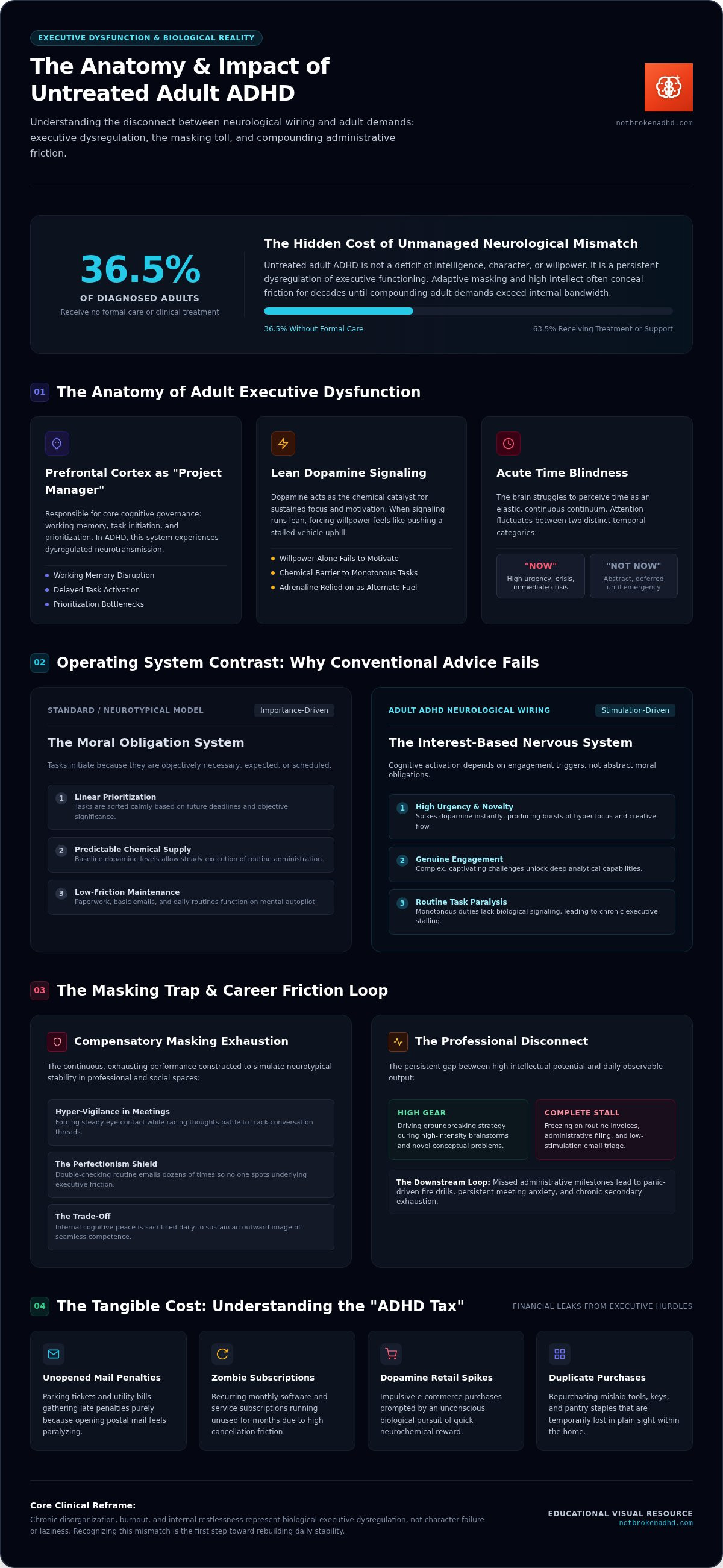
Instead of running across classrooms, adult hyperactivity lives behind the eyes. It shows up as relentless mental restlessness, rapid shifts between competing ideas, and deep, quiet fatigue. At its core, untreated adult ADHD is not a deficit of character, intelligence, or willpower; it is a persistent dysregulation of executive functioning. As clinical research in Adult attention deficit hyperactivity disorder illustrates, these neurological patterns persist from childhood into adult life, even if they were never identified early on. High intelligence or adaptive masking often hides the struggle for decades, until the compounding responsibilities of adulthood outstrip coping bandwidth. The downstream consequences of untreated adhd in adults stem from this exact mismatch between neurological wiring and daily adult demands. Simply put, adult executive dysfunction is best understood as operating an interest-based nervous system, one that activates around urgency, novelty, and genuine engagement rather than sheer moral obligation.
The Anatomy of Adult Executive Dysfunction
The prefrontal cortex acts as the brain's project manager. It handles working memory, task prioritization, and cognitive activation. In an ADHD brain, dopamine signaling runs lean. Dopamine is the chemical messenger responsible for motivation and sustained focus. Without steady chemical signaling, forcing attention through willpower feels like pushing a stalled vehicle uphill. This neurobiological gap also produces acute time blindness. The brain struggles to sense the passage of time accurately, leaving people caught between two distinct mental states: "now" and "not now." Deadlines appear abstract until they become emergencies, which warps project estimations and daily routines.
The Masking Trap and Compensatory Exhaustion
Many adults survive by constructing an elaborate performance known as masking. Masking is the intense, continuous effort to simulate neurotypical behavior in social and professional spaces. You double-check routine emails dozens of times. You force steady eye contact while your thoughts race. You maintain hyper-vigilance during meetings to avoid losing the thread.
This constant vigilance takes a severe physical toll. Perfectionism quickly becomes an armored shield. If everything is flawless, no one will spot the underlying executive friction. Over time, these compensatory habits form the quieter, invisible consequences of untreated adhd in adults, trading internal peace for the outward appearance of stability.
The Cumulative Impact on Career, Finances, and Daily Stability
When executive dysregulation goes unaddressed, it rarely stays confined to one corner of life. Instead, it quietly spills across work, money, and domestic routines. The consequences of untreated adhd in adults compound over time, turning ordinary administrative requirements into persistent friction points that slowly drain daily resilience.
Professional Underperformance and the Career Friction Loop
Many professionals experience a painful disconnect between their intellectual potential and observable daily output. You might drive groundbreaking strategy during a brainstorm, only to stall completely when submitting routine invoices or answering basic emails. This isn't a lack of drive. As research supported by the National Institute of Mental Health shows, hurdles with sustained attention, task initiation, and working memory are core biological realities of the condition. Without novelty or urgency, routine tasks stall out, leading to last-minute fire drills, missed deadlines, and persistent meeting anxiety.
The Real Financial Cost: Understanding the ADHD Tax
Beyond career strain, unmanaged executive hurdles create a tangible monetary toll often called the ADHD tax. When working memory and organization fluctuate, money quietly leaks away through preventable administrative errors:
- Unpaid parking tickets and bills that gather penalties purely because opening mail feels paralyzing
- Recurring monthly subscriptions that run unused for months due to cancellation friction
- Impulsive retail spending spikes prompted by an unconscious pursuit of quick dopamine
- Repurchasing mislaid tools, keys, or household pantry staples that were lost in plain sight
Tax preparation and long-term financial planning trigger intense avoidance, turning simple bureaucratic duties into looming sources of guilt and debt.
Domestic Chaos and the Burden of Incomplete Tasks
At home, multi-step domestic chores like laundry and dishes create continuous friction. Each task demands initiation, sequencing, and completion, yet working memory often drops the thread midway through. Wet clothes sit forgotten in the washer, clutter gathers into overwhelming "doom piles," and visual disorganization keeps the nervous system on edge. If you find yourself caught in these exhausting daily loops, exploring practical executive function educational content can provide a low-barrier first step toward understanding how your brain manages domestic systems.
Emotional Health and the Silent Erosion of Relationships
Emotional health often carries the heaviest hidden toll. Living with perpetual executive friction creates a continuous state of anticipatory dread. You constantly wait for the other shoe to drop. You brace for the next missed reminder, forgotten anniversary, or overlooked detail. This chronic vigilance generates intense secondary anxiety. Over time, secondary depression often stems from this chronic unaddressed overwhelm, exhausting personal reserves after years of fighting an unseen battle. Among the most painful consequences of untreated adhd in adults is how quietly this internal storm erodes self-worth and destabilizes close personal connections.
Rejection Sensitivity and Emotional Dysregulation
Executive function doesn't stop at organizing physical tasks; it also regulates emotional impulses. An ADHD nervous system processes emotional inputs with high immediacy and intensity. A neutral remark from a supervisor or a subtle shift in a partner's tone can register as crushing personal rejection. This reaction triggers emotional flooding, leaving the prefrontal cortex temporarily unable to modulate the surge of distress. To protect against this acute vulnerability, many adults retreat into defensive withdrawal, going silent or abruptly pulling away to guard against perceived judgment.
The Parent-Child Dynamic in Adult Partnerships
In romantic relationships, unmanaged executive hurdles frequently distort everyday equality. When one person repeatedly struggles with household execution, the other partner often steps in to manage schedules, bills, and chores. An exhausting parent-child dynamic quickly takes root. The non-ADHD partner feels overwhelmed by the uneven mental load, while the ADHD partner feels micromanaged, diminished, and constantly scrutinized. As documented perspectives on ADHD symptoms in adulthood demonstrate, dropped tasks are neurological lapses, not evidence of apathy. Yet without shared language, simple forgetfulness is easily misinterpreted as intentional disrespect. Acknowledging that these friction points are functional consequences of untreated adhd in adults removes blame, allowing couples to replace chronic frustration with supportive, externalized routines.
Untangling the Cycle: Burnout, Misdiagnosis, and the Laziness Myth
Growing up with an unregulated nervous system often means carrying a heavy internal label: lazy, unmotivated, or careless. These moral judgments obscure biological reality. When you peel back the layer of self-blame, the chronic consequences of untreated adhd in adults reveal a system running on empty, not a failure of character.
The Crucial Difference Between Executive Dysfunction and Laziness
Laziness is an enjoyable, intentional choice. It looks like deciding to rest, watching a favorite show, and actually feeling restored. Executive dysfunction is an agonizing state of paralysis. You sit frozen, desperately wanting to start your taxes, fold the laundry, or open an email. Your pulse spikes with panic, yet your brain cannot generate the neurochemical ignition required to move. Berating yourself only makes it worse. Internalized self-criticism depletes dopamine stores further, locking task initiation behind an even thicker wall of dread.
Autistic and ADHD Burnout vs. Everyday Stress
Everyday work stress typically softens after a restful weekend or a brief holiday. Neurodivergent burnout does not. This state represents a profound collapse of functional capacity caused by decades of chronic masking, hyper-vigilance, and sensory overload. Standard wellness advice like meditating or taking a bath usually falls flat because it assumes an executive system that is already functional. Without structural cognitive accommodations, chronic sensory friction and executive strain compound until basic physical tasks feel immobilizing.
The Misdiagnosis Maze in Adult Mental Health
Because masking successfully conceals outward disruption, millions of adults spend years bouncing between incorrect psychiatric labels. Inattentive patterns and internal restlessness are frequently misdiagnosed as treatment-resistant depression or generalized anxiety, especially in women. Standard medications targeting serotonin rarely resolve dopamine-driven task initiation barriers. Treating secondary anxiety while ignoring the underlying executive dysfunction leaves the root problem untouched. To begin separating your actual cognitive wiring from chronic anxiety, you can use an interactive ADHD self-check tool to objectively map your everyday cognitive friction.
Rebuilding Agency: Grounded Steps for Navigating Adult ADHD
Realizing that lifelong friction stems from neurology changes everything. It reframes past struggles, but awareness alone doesn't eliminate daily administrative hurdles. Addressing the consequences of untreated adhd in adults doesn't require overhauling your life overnight. Sustainable relief comes from building practical scaffolds outside your head, taking low-friction steps that meet your nervous system where it actually lives.
Step 1: Documenting Your Executive Baseline
Begin by observing where your days lose momentum. Pay attention to specific patterns across task initiation, working memory, and emotional overwhelm. Notice when you freeze on routine paperwork or lose focus during unstructured afternoons. Using an ADHD self-check tool online offers a structured, private way to translate vague personal frustration into concrete functional data without shame. Gathering these patterns helps you separate temporary life stress from persistent neurological differences across various settings.
Step 2: Externalizing Your Brain Function
Stop relying on unassisted biological memory. An ADHD working memory drops items quickly, so design your physical environment to carry the cognitive weight for you:
- Use clear visual anchors, like open storage bins and visible checklists, so essential items stay in sight.
- Capture every obligation in a single task pad rather than scattered sticky notes.
- Run short, structured focus intervals using an integrated Pomodoro timer to bypass task initiation paralysis.
Build forgiving daily routines. Leaving generous buffer time between commitments prevents minor delays from triggering full shutdown mode.
Step 3: Preparing for Meaningful Support
Objective notes give you tremendous leverage. If you choose to seek a formal medical evaluation down the road, concrete documentation keeps conversations anchored in real-world functional hurdles rather than abstract feelings. In the meantime, self-paced executive function guides can help you build supportive daily habits on your own schedule.
Unlearning decades of internalized moral labels takes patience. Discovering how the consequences of untreated adhd in adults have shaped your story is not an ending; it is the grounded starting point for finally regaining daily clarity and control.
Moving From Self-Blame to Practical Clarity
Living with chronic overwhelm doesn't mean you've failed at being an adult. When you trace the real consequences of untreated adhd in adults, from career friction and domestic chaos to secondary anxiety, the pattern becomes clear: your struggle was never a character deficit. It was an unsupported nervous system trying to navigate an environment built for different wiring.
Dismantling years of internal shame takes time, but you don't have to untangle that knot all at once. Building simple external scaffolds, honoring your natural energy rhythms, and tracking your cognitive patterns can restore your sense of daily agency. When you're ready to take a gentle, low-friction next step, explore our interactive ADHD tools and guides to understand your brain with practical, neurodiversity-affirming clarity.
Your past hurdles don't define your future capacity. With compassionate systems designed around your real cognitive needs, daily life can finally start feeling manageable.
Frequently Asked Questions
Can untreated ADHD in adults worsen as you get older?
ADHD itself does not degenerate neurologically over time, but the friction often intensifies as adult responsibilities multiply. Major life transitions like advancing in a career, managing a household, parenting, or experiencing hormonal shifts add heavy cognitive demands. When daily executive loads permanently outstrip your coping reserves, unmanaged symptoms feel significantly more disruptive, leading to deeper physical fatigue and severe functional burnout.
What happens if an adult with ADHD chooses to remain undiagnosed or untreated?
Leaving ADHD unaddressed often accelerates chronic stress and functional friction. The compounding consequences of untreated adhd in adults frequently show up as career stagnation, recurring financial penalties, and fractured relationships. Over time, compensating through sheer adrenaline causes nervous system exhaustion, elevating the risk of chronic secondary depression, anxiety disorders, and total burnout. Without external support or scaffolds, daily life requires unsustainably high effort.
How do you tell the difference between adult ADHD and chronic anxiety or depression?
Look at the sequence of symptoms. Primary depression or anxiety typically features persistent low mood or pervasive worry regardless of circumstance. In contrast, ADHD-related distress is usually episodic and directly follows executive hurdles, such as freezing before a deadline or losing crucial paperwork. Roughly 69.6% of adults with ADHD have a co-occurring mental health condition, making it essential to distinguish primary emotional disorders from secondary anxiety born from chronic executive overload.
Is it possible for high-achieving professionals to have untreated adult ADHD?
Yes, high intelligence and structured routines often mask executive challenges for decades. Many successful doctors, executives, and academics thrive in fast-paced, high-stakes environments where urgency supplies the dopamine their brain lacks. However, this outward achievement usually comes at an immense personal cost. Behind the scenes, these professionals often battle intense domestic disorganization, sleep deprivation, and extreme compensatory anxiety just to keep up appearances.
Why do women with ADHD often go undiagnosed until adulthood?
Historically, diagnostic criteria focused almost entirely on disruptive, hyperactive behaviors typical of young boys. Women and girls more commonly present with inattentive traits, such as daydreaming, internal restlessness, and quiet disorganization. Socialized to be cooperative and conscientious, women frequently develop intensive masking habits and perfectionism. These survival strategies hide internal friction until adulthood responsibilities, motherhood, or hormonal changes overwhelm their coping mechanisms.
Can lifestyle changes and executive function tools help manage adult ADHD without medication?
Yes, practical external systems create tremendous daily stability, whether used alone or alongside medical interventions. The consequences of untreated adhd in adults diminish significantly when you stop relying on mental memory. Structuring your space with clear visual anchors, running focus intervals using an integrated Pomodoro timer, and studying executive function educational resources help externalize task management. These accessible scaffolds build daily momentum without requiring pure willpower.
What is the first step an adult should take if they suspect they have ADHD?
Start with low-friction self-reflection rather than rushing into an intimidating medical process. Documenting your daily friction points using an interactive ADHD self-check tool gives you an objective snapshot of your cognitive patterns. Once you identify how executive dysfunction impacts your routines, you can explore downloadable ADHD guides to build supportive systems, or bring your documented patterns to a qualified medical provider for a formal assessment.


