

What if your inability to concentrate has nothing to do with a lack of discipline? You care deeply about your goals, yet you still find yourself frozen at your desk, overwhelmed by open tabs and paralyzed by an unstructured task while the afternoon slips away. It is an exhausting cycle of time blindness, missed deadlines, and panicked hyperfocus. When typical productivity advice fails, finding practical adhd focus strategies for adults becomes an essential tool for daily regulation rather than just a way to check off boxes.
You likely know the heavy guilt of abandoning another rigid planner app or detailed scheduling system after just four days. That internal friction isn't a personal failure; it's executive dysfunction at work. In this guide, you'll discover neurodivergent-friendly focus systems and external scaffolding that work with your dopamine pathways instead of fighting them. We'll explore how to initiate tough projects without dread, balance digital tools and timers, and build steady momentum you can actually maintain.
Key Takeaways
- Reframe chronic task initiation hurdles as functional neurobiology, separating low dopamine availability from personal motivation or character.
- Discover practical adhd focus strategies for adults that replace rigid schedules with external cognitive scaffolding and visual cues.
- Harness the calming presence of body doubling and structured accountability to dissolve task paralysis without judgment.
- Shape your physical and auditory sensory environment to minimize distractibility without triggering exhausting all-or-nothing cleaning spirals.
- Build an adaptable, guilt-free daily focus routine equipped with compassionate reset protocols for low-energy recovery days.
Understanding the Adult ADHD Brain: Executive Dysfunction Versus Willpower
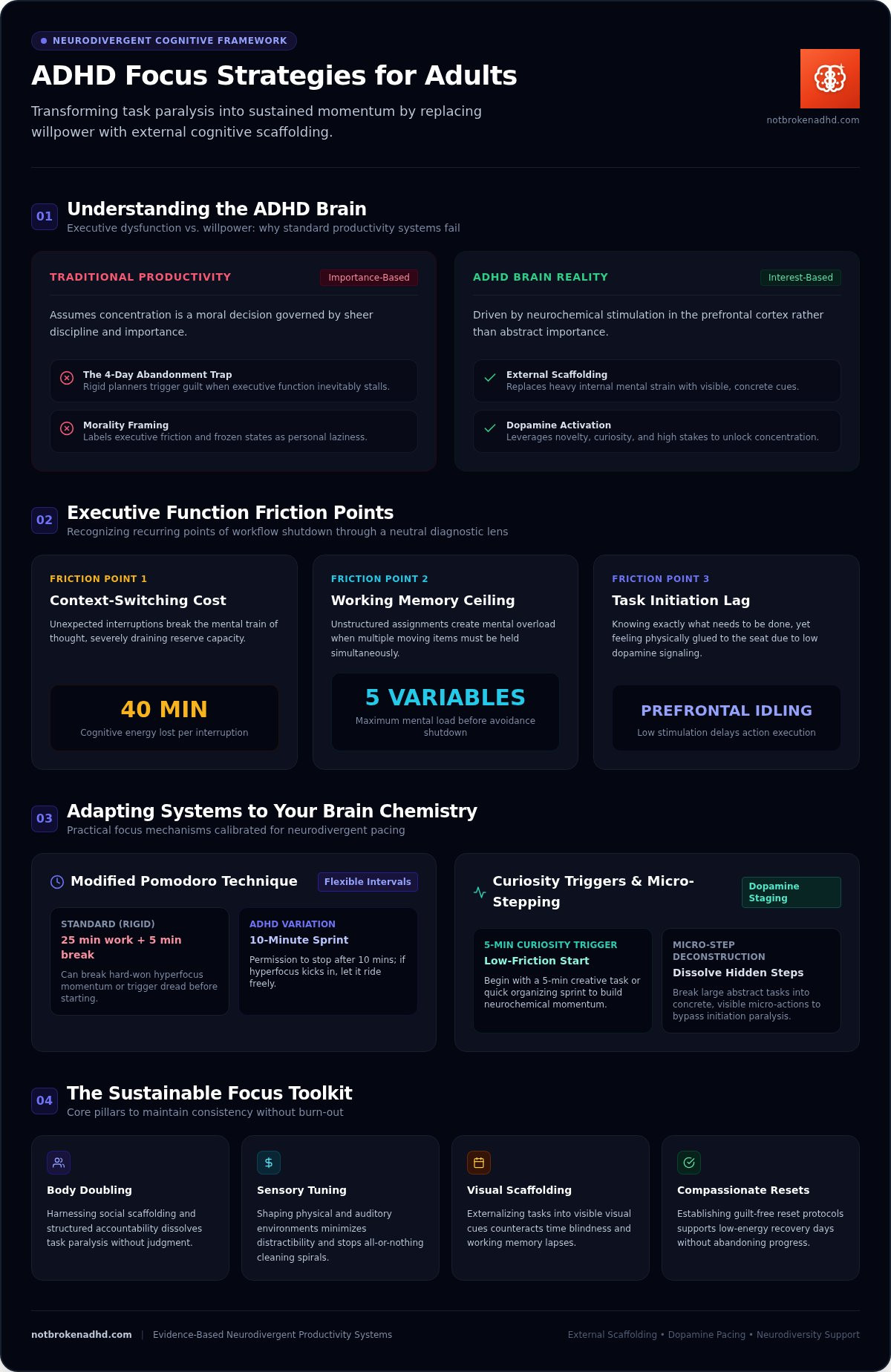
Mainstream productivity advice treats focus as a moral decision. If you miss a deadline or sit staring at a screen for hours, traditional culture labels it laziness. In reality, clinical research on Adult attention deficit hyperactivity disorder reveals a neurodevelopmental difference in regulation, not a shortage of character. Executive dysfunction occurs when the brain's internal management network struggles to prioritize, organize, and execute actions on command. Your brain runs on an interest-based nervous system rather than an importance-based one, which explains why generic time-management planners consistently fall short.
Working memory capacity plays a direct role in these sudden shutdowns. When an unstructured assignment demands holding five moving variables in mind at once, the neurodivergent brain quickly hits a cognitive ceiling. The mental overload triggers immediate avoidance. That is why genuine adhd focus strategies for adults do not rely on sheer grit; they replace mental strain with visible, external systems.
The Role of Dopamine in Sustained Attention
The prefrontal cortex acts as the central command hub for sustained attention. In neurotypical brains, steady dopamine signaling creates sufficient baseline stimulation to process low-interest administrative tasks. In the ADHD brain, dopamine availability is irregular. Low stimulation leaves the prefrontal cortex idling.
Urgency acts as an emergency substitute. A looming crisis triggers noradrenaline and dopamine surges, granting sudden clarity. Novelty, fascination, and high stakes ignite focus effortlessly, while routine tasks like filing receipts or answering emails stall indefinitely. Sustainable adhd focus strategies for adults must artificially inject this missing stimulation instead of waiting for a panic-induced crisis.
Recognizing Your Unique Executive Function Bottlenecks
Executive dysfunction rarely shows up the same way twice. It helps to observe your recurring points of friction through a neutral, diagnostic lens rather than self-reproach. Common patterns include:
- Task initiation lag: Knowing what needs to be done, yet feeling physically glued to your seat.
- Context-switching fatigue: Losing forty minutes of cognitive energy whenever an unexpected interruption breaks your train of thought.
- Working memory lapses: Forgetting the primary goal the moment you click into a new browser window.
Gaining clarity on where your workflow stalls is the first step toward building real solutions. Pinpointing your personal baselines with an ADHD self-check tool online allows you to identify specific processing hurdles before redesigning your daily routines.
Core Focus Strategies for Adults: Adapting Systems to Your Brain
Most productivity advice assumes a baseline state of calm concentration. For a neurodivergent mind, forcing focus against an empty dopamine reserve feels like pushing a boulder uphill. Effective adhd focus strategies for adults do not demand superhuman discipline. They establish physical scaffolding that lowers the barrier to entry, transforming abstract intentions into visible, concrete steps.
Sequencing tasks around natural brain chemistry changes the equation. Instead of forcing yourself to tackle your heaviest spreadsheet first thing in the morning, start with a low-friction curiosity trigger. A five-minute creative task or a quick organizing sprint provides the neurochemical momentum needed to transition smoothly into demanding projects.
Modifying the Pomodoro Technique for Neurodivergent Minds
The standard Pomodoro method prescribes twenty-five minutes of effort followed by a five-minute break. For ADHD adults, that rigid structure can backfire. If an alarm goes off just as your brain enters deep flow, stopping shatters hard-won momentum. Conversely, facing twenty-five minutes of a dry project often triggers dread.
A neurodivergent variation uses flexible intervals. Try a ten-minute sprint to cross the starting line, with full permission to stop once the timer sounds. If hyperfocus kicks in, let it ride. When you need adaptable structure, testing a dedicated pomodoro timer calibrated for neurodivergent pacing offers gentle boundaries without interrupting genuine deep work.
Overcoming Task Initiation Paralysis with Micro-Stepping
Task initiation lag often stems from hidden steps. An entry like "finish quarterly report" is not a single action; it is a dozen tiny decisions tangled together. Your working memory looks at the aggregate weight and freezes.
Micro-stepping shrinks that initial action down to a two-minute physical threshold:
- Open the document and type a single placeholder sentence.
- Clear three rogue coffee cups off your desk to create physical breathing room.
- Locate the single login password needed for the portal and stop there.
Once you clear that initial friction, your nervous system registers progress. The brain shifts out of defensive shutdown and naturally leans into the next movement.
Externalizing Time to Combat Time Blindness
To an ADHD brain, time exists in two distinct categories: "now" and "not now." Standard digital numbers on a monitor fail to convey the physical passing of hours. That disconnect frequently leads to panicked hyperfocus right before missed deadlines, an issue supported by clinical insights found through The ADHD Field Guide research summaries on adult cognitive pacing.
Replace digital numerals with analog visual timers that feature a disappearing colored disc. Seeing time evaporate as a physical shape makes intervals real. Pair these tools with mandatory fifteen-minute buffers between obligations. These gaps allow your attention to reset smoothly before the next focus block begins.
Body Doubling and Accountability: Leveraging Social Scaffolding Online
Working in complete isolation often turns minor distractions into major detours. When no one is watching, an wandering thought easily leads to thirty minutes of unrelated web browsing. Body doubling alters this dynamic by using the quiet presence of another human being as an attentional anchor. You aren't collaborating on the same project; you are simply working alongside someone else. That subtle social mirror provides external grounding, keeping your mind tethered to the task at hand without creating exhausting social obligations.
Among practical adhd focus strategies for adults, virtual body doubling has emerged as one of the most reliable ways to bypass task avoidance. It replaces the isolating pressure of self-motivation with shared environmental momentum.
The Mechanics of Virtual Body Doubling
An under-stimulated nervous system often interprets tedious tasks as physically uncomfortable. The non-judgmental presence of a peer provides a modest baseline lift in neurological arousal. That small lift is often all your prefrontal cortex needs to cross the starting line.
Virtual sessions strip away typical conversational demands. Participants typically log on, declare a single bite-sized objective in the text chat or via a quick thirty-second check-in, and mute their microphones. Seeing another person quietly typing or reviewing documents creates a shared container of focus. You don't have to perform or entertain; you simply work together in parallel silence.
Comparing Virtual Co-Working Options and Formats
Different tasks and energy levels demand different forms of social scaffolding. Choosing the right setup depends on how much friction you feel toward the work in front of you:
- One-on-one structured sessions: Two individuals meet on camera, declare their goals, and work silently for a set block of time before checking back in. This format offers high accountability, making it ideal for high-dread administrative duties.
- Drop-in co-working rooms: Large group video rooms allow you to enter and leave without scheduling ahead. They offer lower social pressure, perfect for days when your energy is brittle or unpredictable.
- Asynchronous text threads: Checking in via message threads creates a written trail of intentions and completions. While it offers less immediate real-time grounding, it fits erratic workdays with frequent meetings.
Matching the accountability format to your current mental state turns social presence into reliable support rather than another overwhelming chore.
Optimizing Your Cognitive Environment: Managing Sensory Input and Distractions
Traditional productivity guides love to advocate for a sterile, empty desk. They tell you to eliminate every sound, sit upright, and clear away all physical objects. For an ADHD brain, that advice often backfires. A sensory vacuum does not create calm focus; it creates an echo chamber where internal chatter grows deafening. Sustainable adhd focus strategies for adults treat sensory input as fuel to be dialed in, rather than a threat to be eliminated entirely.
Physical workspace zoning helps prevent context collapse. If you work, relax, eat, and sleep in the exact same spot, your brain struggles to read the room. Creating a designated work perimeter gives your nervous system an unambiguous cue. Even small adjustments, like turning on a specific desk lamp exclusively during focus hours, help establish clear cognitive boundaries.
Calibrating Sensory Input for Optimal Arousal
An under-stimulated brain seeks out distractions to keep its arousal levels stable. Pin-drop silence often magnifies minor ambient noises, like the hum of a refrigerator or traffic outside. Providing steady background stimulation occupies that restless layer of your attention so your higher-order thinking can engage.
Experiment with continuous soundscapes rather than variable playlists with lyrics. Heavy low frequencies, such as brown noise, smooth out jarring auditory spikes. Lo-fi beats provide a steady rhythmic anchor, while binaural beats offer gentle acoustic consistency. Pair this with physical outlets for restless energy:
- Keep silent, tactile fidget tools within arm's reach to occupy active fingers during video calls.
- Use a balance board or a standing desk converter to invite subtle postural shifts while reading.
- Place textured foot pads under your workspace to discharge physical tension without breaking focus.
Constructing Digital Guardrails and Reducing Friction
Digital environments are engineered to exploit dopamine-seeking tendencies. Relying on sheer restraint to avoid checking a notifications feed is an unfair fight. You need external friction that blocks impulsive clicks before they derail your workday.
Install strict website blockers that run automatically during designated focus windows. Log completely out of social platforms on your work browsers, forcing yourself to enter two-factor authentication codes every time you feel an impulsive urge to scroll. Keep your desktop display radically minimal by utilizing single-window modes. If clutter feels overwhelming, sweep non-essential desk items into a temporary container instead of spiraling into an all-day deep-cleaning detour. For more practical frameworks on structuring your daily workflow, explore the downloadable ADHD guides to set up lasting environmental scaffolding.
Creating a Sustainable Focus Toolkit: Educational Scaffolding and Next Steps
Building an effective focus routine is an iterative experiment, not a one-time test of will. You do not need an overnight life overhaul to see meaningful improvement. Attempting to re-engineer every habit at once inevitably leads to executive function burnout. Instead, sustainable adhd focus strategies for adults rely on layering small adjustments over time. When an unproductive afternoon leaves you drained, practicing a calm, non-judgmental reset matters far more than obsessing over lost hours. Pick one single shift to test today, observe how your nervous system responds, and adjust without guilt.
Moving from Chronic Guilt to Systemic Support
Abandoned planners and discarded apps carry tremendous emotional baggage. We often interpret a lapsed routine as personal failure. In truth, a system that stops working is simply neutral data. It tells you that the initial novelty has worn off and your prefrontal cortex needs fresh friction-reducing cues.
Accepting that your tools will change periodically prevents shame spirals. Swapping highlighters, changing your digital layout, or rotating sensory tools breathes fresh novelty into daily operations. While self-guided educational scaffolding provides strong everyday support, it also works hand-in-hand with medical care. Learning how your brain processes attention equips you to have grounded, informed conversations with healthcare professionals if you decide to explore clinical treatments.
Accessing Structured ADHD Self-Help Resources
You don't have to invent external scaffolding from scratch. Structured executive function educational content, practical workbooks, and downloadable ADHD guides offer pre-built frameworks designed around neurodivergent dopamine needs rather than neurotypical expectations.
Equipping yourself with clear information transforms your relationship with your work. Whether you are seeking structured planning templates or reviewing comprehensive clinical care overviews to prepare for a doctor's appointment, reliable scaffolding bridges the gap between daily friction and steady focus. Explore the complete collection of tools, templates, and educational resources at The ADHD Field Guide to start constructing a system that works alongside your brain.
Building a Workable System on Your Own Terms
Sustained concentration is never about forcing your brain to act like someone else's. Real progress happens when you stop fighting your neurochemistry and start designing an environment that supports it. By breaking through task initiation with micro-steps, externalizing passing hours with visual timers, and using body doubling to anchor wandering thoughts, you transform daily productivity from a cycle of panic into steady momentum. These practical adhd focus strategies for adults are not rigid rules; they are flexible guardrails built to adapt alongside your changing needs.
You don't need to navigate this process alone or invent supportive structures from scratch. If you are ready to replace chronic friction with reliable scaffolding, explore downloadable ADHD guides and practical tools. From an accessible online ADHD Self-Check Tool for personal insight to a built-in Pomodoro timer tailored for neurodivergent focus patterns, these resources help you work with your wiring instead of against it. Give yourself permission to experiment, celebrate small wins, and move forward with clarity.
Frequently Asked Questions
Why do standard productivity strategies and planners rarely work for adult ADHD?
Traditional planners rely on an importance-based nervous system that responds to linear schedules and delayed rewards. The ADHD brain operates on an interest-based nervous system driven by dopamine, novelty, and immediate urgency. When a system relies on rigid tracking, it quickly triggers cognitive fatigue. Effective adhd focus strategies for adults replace static paper checklists with visual, flexible scaffolding that adapts when routine motivation dries up.
How is body doubling effective for maintaining focus during monotonous tasks?
Body doubling provides a calm social anchor that raises baseline arousal in an under-stimulated brain. Having someone quietly present, whether across a desk or on video, creates low-stakes accountability without conversational demands. That shared presence activates your attentional networks and dampens wandering thoughts. It transforms solitary dread into parallel focus, making it far easier to start and complete tedious work.
Can people with ADHD enter a state of deep hyperfocus at will?
No, hyperfocus is an involuntary state of intense absorption rather than an on-demand skill. It occurs when a task offers the exact combination of novelty, high stakes, or intense personal fascination needed to flood the brain with dopamine. While you cannot trigger it like a light switch, you can invite it by removing sensory friction and using micro-steps to lower initial task resistance.
What is the ideal Pomodoro timer duration for an adult with ADHD?
The ideal duration varies by task resistance, but flexible intervals between 10 and 20 minutes work best for task initiation. A rigid 25-minute sprint often feels too intimidating to begin, or it interrupts deep flow once focus finally locks in. Using an ADHD-adapted timer allows you to start with a short sprint to build momentum, with the freedom to extend your block if hyperfocus takes hold.
How does ambient sound or brown noise improve concentration in adults?
Brown noise provides deep, uniform sound that blankets background audio spikes and smooths out internal mental chatter. An under-stimulated brain frequently searches for sensory stimulation, turning pin-drop silence into an echo chamber of wandering thoughts. The low rumble of brown noise occupies that restless layer of attention, giving your executive function the steady sensory baseline needed to maintain continuous concentration on difficult work.
What immediate steps can stop ADHD task paralysis during a workday?
To break paralysis quickly, shrink the action down to a physical threshold that requires zero cognitive strain. Stand up, change your physical posture, or set a timer for two minutes to write a single messy sentence. Combining tiny physical movements with tailored adhd focus strategies for adults bypasses the brain's defense mechanism, turning an overwhelming hurdle into an easy starting point.


