

Starving your nervous system of stimulation will not cure your executive dysfunction; it will only make it worse. If you are exploring a dopamine detox for ADHD, chances are you know the heavy weight of digital burnout. You lose three hours to an algorithmic loop, stare at an urgent task you cannot start, and wonder why your willpower constantly collapses.
It feels natural to assume that cutting out all stimulation will hit the reset button. The internet often frames extreme fasting as a quick cure for brain fog and task paralysis, leaving you feeling broken when rigid abstinence inevitably falls apart. But ADHD neurology doesn't have an excess of dopamine; it battles an ongoing baseline deficit.
You don't need harsh deprivation to regain your agency. In this guide, you'll discover why traditional fasts backfire, how your reward circuitry actually processes stimuli, and how to reset your daily environment sustainably. We'll explore the balance between steady neurochemistry and realistic habits that protect your focus without triggering burnout.
Key Takeaways
- Understand why a rigid dopamine detox for ADHD contradicts neurobiology and tends to deepen task paralysis rather than resolve it.
- Discover the difference between tonic and phasic dopamine firing to see why your brain needs reliable stimulation to initiate mundane tasks.
- Shift your daily objective away from total deprivation and toward curating functional, high-value dopamine sources that sustain focus.
- Apply a four-step stimulus reset that uses digital and physical barriers to interrupt mindless loops without relying on pure willpower.
- Learn how external scaffolding, structured guides, and task timers can bridge executive function gaps for lasting momentum.
What Is a Dopamine Detox and Why Does Social Media Get It Wrong for ADHD?
Dopamine is not industrial waste floating in your bloodstream. It isn't a toxic byproduct of screen time, and it isn't an addictive narcotic your brain accidentally brewed. It is a fundamental neurotransmitter; a chemical messenger responsible for motivation, motor control, working memory, and reinforcement learning. When chronic task paralysis strikes, the appeal of a total clean slate makes complete sense. Staring at an untouched project while burning four hours on algorithmic video feeds breeds intense shame. You crave an urgent, dramatic intervention. That exhaustion explains why so many search for a dopamine detox for ADHD, hoping twenty-four hours of sensory isolation will reset their ability to function.
The Original Concept vs. Viral Internet Challenges
When examining what is a dopamine detox in its original clinical context, the reality looks quite different. California psychiatrist Dr. Cameron Sepah developed "dopamine fasting" as a practical cognitive behavioral therapy technique. His framework focused on stimulus control: establishing deliberate boundaries around impulsive, automatic behaviors like stress eating or compulsive phone refreshing. It was never intended as sensory starvation.
Social media quickly stripped the nuances away, mutating practical behavioral pacing into an ascetic endurance test. Online challenges began promoting extreme rules:
- Total avoidance of conversation, eye contact, and music.
- Zero exposure to books, journals, or screens for days at a time.
- Viewing normal, harmless pleasures as biological contamination.
For someone with ADHD, this extreme deprivation morphs mindful stimulus management into a painful test of willpower. It treats the search for stimulation as a moral failing rather than a basic neurological drive.
Why You Cannot Actually 'Detox' a Neurotransmitter
The core premise behind an extreme dopamine detox for ADHD collapses under basic biology. You cannot cleanse a neurotransmitter from your synapses like food poisoning from your stomach. Your nervous system continuously synthesizes dopamine to manage voluntary motor movements, alert states, and executive planning. Without it, purposeful action becomes physically impossible.
Dopamine is a signaling molecule, not a toxic buildup. It doesn't accumulate into dangerous residue that requires fasting to dissolve. Attempting to starve your brain of stimulation doesn't reset your biological receptors; it simply deprives an already under-supplied prefrontal cortex of the baseline fuel it needs to initiate basic tasks.
The ADHD Dopamine Paradox: Why Starving Your Brain of Stimulation Backfires
Mainstream productivity culture treats overstimulation as a universal toxin. The conventional advice insists that if you cut out digital noise and sit in an empty room, your focus will naturally reset. But for a neurodivergent nervous system, enforced silence often feels like physical torment. Instead of clarity, total deprivation triggers intense anxiety, cognitive fatigue, and heavy executive paralysis. Pursuing an extreme dopamine detox for ADHD fails because it treats a neurochemical shortage as if it were an excess.
Tonic vs. Phasic Dopamine in the ADHD Prefrontal Cortex
Your brain relies on two distinct styles of dopamine signaling: tonic and phasic. Tonic dopamine provides a low-level, continuous background hum that keeps the prefrontal cortex engaged. It supplies the quiet baseline energy needed to sit down, organize paperwork, and complete uninspiring chores. Phasic dopamine, by contrast, releases in rapid, concentrated spikes in response to immediate rewards, novelty, or imminent danger.
Research into ADHD neurobiology indicates an ongoing deficit in tonic dopamine availability, compounded by variations in dopamine transporter activity that clear the chemical too quickly from synaptic gaps. Unstimulating tasks feel painful because the background neurochemistry needed to bridge your attention simply isn't present. When you attempt complete stimulus deprivation, you don't magically raise your tonic floor. You merely eliminate the phasic spikes that were keeping your working memory online.
Underarousal and the Rebound Effect
Medical experts note that the viral fasting trend stems from a foundational misunderstanding of dopamine science, which creates acute distress for an underaroused brain. ADHD brains operate in a baseline state of neurological hypo-arousal. When sensory input drops to zero, the brain perceives this state not as peaceful rest, but as a cognitive emergency.
To escape this deficit, your brain triggers frantic dopamine foraging. You pace, rummage through kitchen cabinets, pick at your skin, or stare blankly at the wall in frozen discomfort. Then comes the inevitable rebound:
- Willpower collapses under severe neurochemical depletion.
- You reach for the quickest, most hyper-stimulating source within reach.
- A single notification turns into a six-hour compulsive binge.
This rebound is not a character flaw. It is a biological survival response to an artificial famine. Taking time to assess your patterns with an interactive ADHD Self-Check Tool can help clarify how your nervous system responds to underarousal, shifting your strategy away from punishing restriction and toward intentional regulation.
Dopamine Fasting vs. Dopamine Regulation: Comparing Approaches for ADHD Minds
Popular productivity advice often presents focus as an exercise in sheer restraint. If you simply turn off your devices, close your eyes, and cut off the world, discipline should follow. For a neurotypical nervous system, a quiet afternoon might provide a calming mental reset. For an ADHD mind, that same sensory void triggers paralysis. Surviving the workday requires understanding the vital difference between total deprivation and intentional regulation.
Total Deprivation vs. Strategic Modulation
The standard dopamine detox framework fails ADHD adults because it misunderstands the objective. The goal isn't to purge stimulation; it's to curate sustainable, high-value inputs that keep your prefrontal cortex functioning without sending you down algorithmic rabbit holes.
- Sensory Fasting: Treats all stimulation as an enemy. It relies on intense white-knuckling to enforce total isolation, which rapidly drains your limited executive energy and leads to cognitive shutdown.
- Strategic Regulation: Recognizes that your brain needs reliable neurochemical support to start mundane tasks. It swaps chaotic, hyper-stimulating feedback loops for predictable, gentle engagement like instrumental audio, tactile desk tools, or visual progress trackers.
Fasting starves the engine until it stalls. Regulation adjusts the fuel mixture so the engine runs smoothly without overheating.
Moving Beyond the Shame and Willpower Trap
When an internet challenge promises mental clarity in twenty-four hours and you end up binge-scrolling on the floor after four, the resulting self-criticism is devastating. You tell yourself that you lack discipline, that you have no backbone, or that you are inherently lazy. None of that is true.
Attempting a rigid dopamine detox for ADHD triggers a predictable biological backlash. Your nervous system is simply fighting to survive an induced neurochemical freeze. When tasks lack urgency or novelty, forcing initiation through willpower alone is like trying to drive a car with an empty fuel tank by pushing the dashboard harder.
Lasting change happens when you stop viewing executive dysfunction as a character flaw and start treating it as an engineering challenge. Utilizing a validated ADHD self-check tool online can provide helpful clarity on how your personal executive profile operates. Once you understand the specific mechanics behind your focus barriers, you can trade shame for structured environmental scaffolds that actually support your daily momentum.
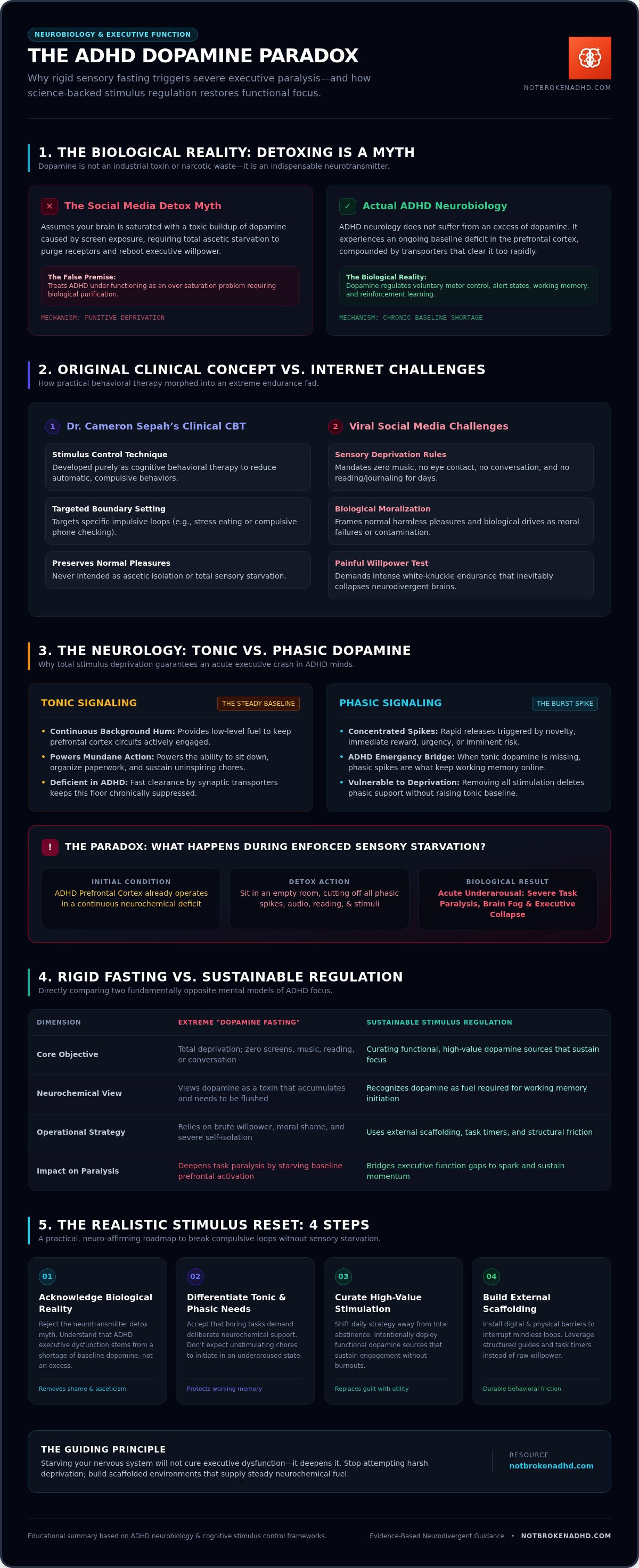
A Realistic Stimulus Reset: 4 Steps to Reduce Friction and Reclaim Focus
Replacing an extreme fast with realistic boundaries protects your energy. Instead of attempting an all-or-nothing dopamine detox for ADHD, you can deliberately design your environment to manage input levels. When you reduce involuntary distraction, your executive system gains room to breathe. This practical four-step sequence helps quiet the digital noise without causing sensory starvation.
Step 1 & 2: Auditing Traps and Inserting Environmental Friction
Start by observing where your attention vanishes. Don't judge yourself or delete every account in a panic. Simply identify your personal black-hole apps; the platforms that offer immediate, rapid stimulation while leaving you completely drained afterward.
Once you locate these loops, insert physical and digital speed bumps:
- Turn screens to grayscale: Stripping vibrant reds and bright notification badges removes the artificial visual novelty that keeps your eyes locked on the display.
- Add physical distance: Keep your phone charger in another room or across the hallway during work blocks.
- Introduce a delay: Set screen-time limits or require a password input before opening high-distraction apps.
Adding twenty seconds of physical friction shatters automatic reaching habits. It creates a brief pause, giving your prefrontal cortex time to interrupt the loop before task paralysis sets in.
Step 3 & 4: Dopamine Pairing and Active Rest Restoration
Under-stimulated brains stall when facing monotonous chores. The solution isn't pure silence; it's intentional pairing. Build a functional stimulation menu by attaching low-demand sensory inputs to tedious work. Listen to instrumental synth tracks while filing taxes, turn on brown noise while cleaning the kitchen, or hold a smooth tactile stone during long meetings. This gentle background stimulation provides just enough neurochemical traction to keep your focus anchored.
Finally, protect your downtime. Scrolling through short-form video feeds feels passive, but it forces your brain to process hundreds of rapid context switches. That isn't rest; it's sensory saturation. True restoration requires stepping away from algorithmic feeds entirely:
- Take a ten-minute walk in natural daylight without earbuds.
- Lie flat on the floor and do light physical stretches.
- Take a hot shower in low lighting to calm physical tension.
Replacing endless feeds with somatic rest allows your nervous system to genuinely recharge. If you want structured frameworks to help manage daily overwhelm, browse our practical Downloadable ADHD Guides for step-by-step stimulus management strategies.
Building Sustainable Executive Function: Tools and Frameworks That Last
Emergency resets only offer short-term relief. After a digital break, the real challenge begins: managing daily life without slipping back into avoidance. Relying on an extreme dopamine detox for ADHD attempts to fix an environmental issue with acute deprivation. But long-term executive stability does not come from isolating yourself. It comes from building reliable external structures that carry the mental load for you.
Externalizing Memory and Task Initiation
Working memory deficits make it hard to hold multiple steps in your mind at once. When an ambiguous project sits on your desk, the lack of immediate structure triggers executive paralysis. Expecting your brain to manufacture intrinsic urgency on command usually leads to frustration. Instead of forcing motivation, externalize your working memory into the physical environment.
Practical external supports bridge the gap between intention and action:
- Visual task breakdowns: Translate vague goals into single, concrete micro-steps on a physical whiteboard or notepad.
- Interval timers: Use a simple visual timer or a dedicated pomodoro timer to anchor your attention in short, manageable working sprints.
- Visual cues: Place essential supplies directly in your physical line of sight so tasks don't disappear the moment you look away.
Externalizing tasks removes the friction of deciding what to do next. It preserves your finite cognitive energy for actually doing the work.
Creating a Personalized Support Architecture
Rigid productivity systems designed for neurotypical brains rarely survive contact with ADHD. Copying someone else's strict morning routine or attempting a radical dopamine detox for ADHD usually ends in shame when natural fluctuations in focus derail the plan. Lasting success comes from understanding your unique sensory tolerances and executive baseline.
Treat your daily habits as an ongoing design experiment. If a digital calendar stops working after three weeks, you haven't failed; that specific tool simply lost the novelty required to capture your attention. Exploring targeted executive function educational content can help you identify self-directed strategies tailored to your cognitive patterns. When you view productivity through the lens of stimulus modulation rather than moral discipline, you can build a sustainable daily rhythm that works with your neurology, not against it.
Reclaiming Your Agency Through Sustainable Regulation
Attempting a rigid dopamine detox for ADHD will never supply your prefrontal cortex with what it genuinely needs to thrive. Lasting progress doesn't come from sensory starvation, digital isolation, or self-punishing fasts. True stability comes from honoring your brain's unique neurochemistry. By adding gentle friction to mindless digital loops and curating intentional background stimulation, you create an environment where focus feels manageable rather than forced.
You don't need harsher discipline to navigate executive dysfunction; you need practical systems that accommodate your lived reality. Grounding educational content created specifically for neurodivergent minds helps dismantle lingering shame while establishing clear, functional routines. With accessible, self-directed tools designed to bridge daily working memory gaps, you can approach your tasks with confidence. When you are ready to replace burnout with sustainable support, explore our practical ADHD guides and self-help tools. Your nervous system isn't broken, and with the right scaffolding in place, steady momentum is entirely within reach.
Frequently Asked Questions
Can a dopamine detox cure ADHD symptoms or executive dysfunction?
No, a dopamine detox cannot cure ADHD symptoms or resolve executive dysfunction. ADHD is a chronic neurodevelopmental condition involving structural and chemical differences in brain signaling, not a temporary toxicity. While moderating screen time can lower sensory overload, it doesn't change your baseline neurobiology. Real management relies on functional scaffolding, behavioral strategies, and professional healthcare approaches rather than extreme wellness trends.
How long should an ADHD dopamine reset or stimulus break last?
A stimulus reset works best as brief, repeated intervals throughout the day rather than multi-day fasts. Stepping away from digital screens for thirty to ninety minutes provides genuine nervous system recovery without triggering panic or intense underarousal. You can pair these short breaks with somatic rest, gentle stretching, or sensory quiet. Consistency matters far more than duration; short, manageable pauses protect your energy without forcing executive burnout.
Why do traditional 24-hour dopamine fasts feel impossible with ADHD?
Traditional fasts feel impossible because ADHD minds already operate with lower baseline tonic dopamine availability. When you completely cut off sensory input, your prefrontal cortex interprets the void as an emergency. Instead of feeling calm, you experience intense restlessness, physical discomfort, and frozen paralysis. Attempting an aggressive dopamine detox for ADHD starves an already under-supplied system, quickly provoking a survival rebound straight into high-stimulation bingeing.
What is the difference between dopamine fasting and dopamine regulation?
Dopamine fasting attempts to eliminate all enjoyable stimulation through total abstinence, while dopamine regulation focuses on managing stimulation quality. Fasting treats sensory input as a toxin to avoid. Regulation acknowledges that ADHD brains require reliable stimulation to initiate action. Instead of sitting in an empty room, you replace erratic algorithmic loops with steady, predictable inputs like instrumental audio, visual checklists, and structured work sprints that support daily task completion.
What should I do when I experience an ADHD underarousal paralysis episode?
Lower the activation threshold by changing your immediate sensory environment instead of fighting for mental focus. Stand up, drink a cold glass of water, or step into natural light for five minutes. Physical movement jumpstarts arousal without demanding heavy executive planning. Once your body shifts out of freeze mode, pick one tiny physical step, like opening a document or setting a five-minute visual timer, to gently restart your momentum.
Does scrolling on social media deplete all the dopamine in an ADHD brain?
No, scrolling does not completely drain your brain's chemical reserves. Your neurons constantly synthesize neurotransmitters to maintain vital bodily functions. However, rapid-fire feeds trigger sharp phasic spikes followed by quick drops, raising your immediate stimulation threshold. This makes ordinary, lower-stimulation tasks feel painfully dull by comparison. Engaging in a thoughtful dopamine detox for ADHD means tapering off high-frequency digital loops, not purifying a depleted organ.
How can I make boring, low-dopamine tasks easier to initiate?
Pair tedious obligations with intentional, low-distraction stimulation to boost your baseline arousal. Listen to upbeat instrumental music, put on brown noise, or use a tactile focus tool while reading documents. Externalize the task structure by breaking steps into small visual checklists and running a dedicated pomodoro timer. By adding sensory novelty directly into mundane routines, you supply your nervous system with the traction needed to cross the starting line.


