

A symptom checklist is not a test to pass or fail; it is a map of your internal friction points. Most people approach an adult adhd symptom checklist with a sense of dread, fearing it will only confirm their deepest insecurities about productivity and focus. You might feel a heavy weight of shame after years of trying to mask your struggles. It is important to realize that you aren't failing at adulthood. You are likely one of the millions navigating a brain that works differently. In fact, research suggests that up to 80 percent of adults with ADHD remain undiagnosed, often because their symptoms don't fit childhood stereotypes.
We understand the cognitive fatigue that comes from constantly trying to "act normal." You deserve to be heard by medical professionals without the fear of being dismissed. This guide will help you transform a simple list of symptoms into a powerful tool for self-understanding and professional advocacy. We will explore how to map your specific executive function struggles and prepare you for a clear, evidence-based conversation with a clinician. By the end, you will have a practical path toward clarity and a significant reduction in the self-blame you've carried for too long.
Key Takeaways
- Recognize that an adult adhd symptom checklist serves as a roadmap for your internal friction points rather than a final clinical diagnosis.
- Learn how to spot hidden executive function struggles like time blindness that often go unnoticed during a standard self-check.
- Discover a 4-step method to navigate your checklist without feeling overwhelmed or experiencing "checklist paralysis."
- Find out how to use your results as a powerful advocacy tool to ensure you're heard and understood during clinical visits.
- Learn to bridge the gap between a list of symptoms and a customized plan for managing your daily life with confidence.
What is an Adult ADHD Symptom Checklist?
An adult adhd symptom checklist is more than a simple inventory of daily struggles. It is a structured mirror designed to capture the specific ways neurodivergence shows up in grown-up lives. Unlike childhood assessments that often focus on classroom disruption, these tools look at internal states like mental fog, chronic procrastination, and the immense effort required to stay organized. It is a way to organize the chaos of your internal experience into something observable and named.
It's vital to remember that these checklists are screening tools, not a final verdict. They serve as the front door to a larger journey of self-discovery. A checklist doesn't provide a clinical diagnosis. Instead, it acts as a bridge. It helps you translate vague feelings of being "lazy" or "scattered" into concrete data points. This data is the foundation of modern ADHD advocacy. It gives you the language to speak with doctors with confidence. You aren't just complaining about being tired; you are presenting a pattern of neurological friction.
The ASRS and Standardized Screening
Clinicians often begin the conversation with the Adult ADHD Self-Report Scale (ASRS). This standardized tool was developed to help identify adults who might need a deeper clinical evaluation. It doesn't just ask if you forget things. It asks how often these events occur. Frequency is the pulse of the assessment. Everyone forgets their keys occasionally. For a neurodivergent adult, these moments are persistent, predictable, and disruptive. Clinicians use these scores to establish a baseline of how much your symptoms interfere with your work, relationships, and peace of mind. It turns subjective frustration into a measurable scale.
Moving Beyond the Stereotypes
For many adults, the hyperactivity in ADHD doesn't look like running around a room. It feels like a motor in the mind that won't shut off. This internal restlessness is often hidden behind a wall of "masking." You might work twice as hard as your peers to appear organized, only to collapse from exhaustion at the end of the day. An adult adhd symptom checklist validates this quiet struggle. It acknowledges that inattentive symptoms, like losing the thread of a conversation or struggling with complex instructions, are just as significant as physical impulsivity. By checking these boxes, you aren't admitting to a flaw. You are identifying a functional difference that deserves the right tools and support.
Identifying Executive Function Friction Points
ADHD is often misunderstood as a simple lack of willpower. In reality, it is a complex challenge involving the brain’s executive functions. These are the mental skills we use every day to manage time, pay attention, and transition between tasks. When you use an adult adhd symptom checklist, you are identifying the specific points of friction where these internal management skills break down. It's about seeing the "why" behind the struggle.
One of the most common friction points is time blindness. This isn't just being late. It is a biological inability to "feel" the passage of time. On an adult adhd symptom checklist, this might appear as a pattern of underestimating how long a commute takes or losing hours to a hyperfocus rabbit hole. When your brain doesn't track time accurately, the world feels like it's moving at a different speed than you are.
Emotional dysregulation also plays a massive role in daily life. It can make a small setback feel like a total catastrophe, leading to a shutdown of productivity. Similarly, working memory issues act as a biological hurdle. You don't forget your grocery list because you don't care. You forget because your brain’s temporary storage is full. It's a hardware limitation, not a character flaw.
The Hidden Symptoms of Adulthood
Many adults experience intense decision fatigue. This is the mental exhaustion that comes from making too many choices. By the end of the day, deciding what to eat can feel as taxing as a high-stakes project. This often leads to task initiation struggles. You know exactly what you need to do, yet you find yourself stuck on the couch, unable to make your body start the first step. Sensory overload adds another layer of difficulty. A loud office or a scratchy clothing tag can drain your focus, leaving you irritable and depleted by noon.
Relating Symptoms to Real Life
It helps to translate clinical terms into lived experiences. For example, distractibility often looks like finding a load of laundry in the washer that has been there since Tuesday. Executive dysfunction is like trying to bake a cake when the recipe is missing three pages and the oven timer is broken. If you find yourself in a constant cycle of overworking to catch up and then crashing for days, you are likely experiencing ADHD burnout. Recognizing these patterns is the first step toward finding a sustainable rhythm. You can explore these patterns further using an ADHD Self-Check Tool to see where your specific friction points lie.
Self-Check vs. Clinical Assessment: Bridging the Gap
Moving from internal awareness to external validation is often the scariest part of the journey. Many adults sit with a completed adult adhd symptom checklist for months, worried that a doctor will simply tell them they need to try harder. This fear of being dismissed is a heavy burden, but your data is your shield. A clinical assessment is a partnership, and you are the expert on your own life. By using a structured tool, you move the conversation away from vague feelings and toward observable patterns.
While online tools are excellent for screening, they have limitations. They cannot account for physical health issues or other neurological conditions that might mimic ADHD. A professional evaluation is necessary to confirm a diagnosis and discuss treatment options. However, your self-check is the perfect "prep work." It ensures that when you finally sit down for an intake, you aren't starting from zero. You are arriving with a clear map of your struggles, ready to advocate for the support you deserve.
Preparing for Your First Appointment
When you walk into a clinical setting, your memory might fail you. The pressure of being observed can trigger "masking," making you appear more put-together than you actually feel. Bringing a filled-out adult adhd symptom checklist ensures you don't forget the small, daily friction points that define your experience. It helps you provide concrete examples, like the three times this month you missed a deadline because of a "rabbit hole" or the constant struggle to manage a household budget.
Clinicians also need to see that these patterns began in childhood, typically before age 12. Your checklist can act as a prompt to help you recall early memories of being "daydreamy" or "disorganized" in school. This historical context is a key requirement for a formal diagnosis. To begin organizing your thoughts and gathering this evidence, you can use the ADHD Self-Check Tool Online: Finding Clarity and Your Next Steps. It is a low-pressure way to start building your case for clarity.
Differentiating ADHD from Overlap Conditions
It's common for ADHD to coexist with conditions like anxiety or depression. Many adults seek help for chronic stress only to discover the root cause is undiagnosed neurodivergence. A checklist helps you untangle these overlapping threads. Generalized anxiety often involves worrying about the future, while ADHD anxiety is often a response to the "executive function failures" of the past, such as fearing you forgot to pay a bill or lock the door.
Executive dysfunction is a persistent baseline, not a temporary reaction to a busy week. It's the difference between being too worried to do the dishes and literally forgetting the dishes exist the moment you leave the kitchen. By using your checklist to narrow down your specific areas of struggle, you help your provider differentiate between emotional distress and neurological friction. This clarity leads to a more accurate management plan that addresses the actual source of your fatigue.
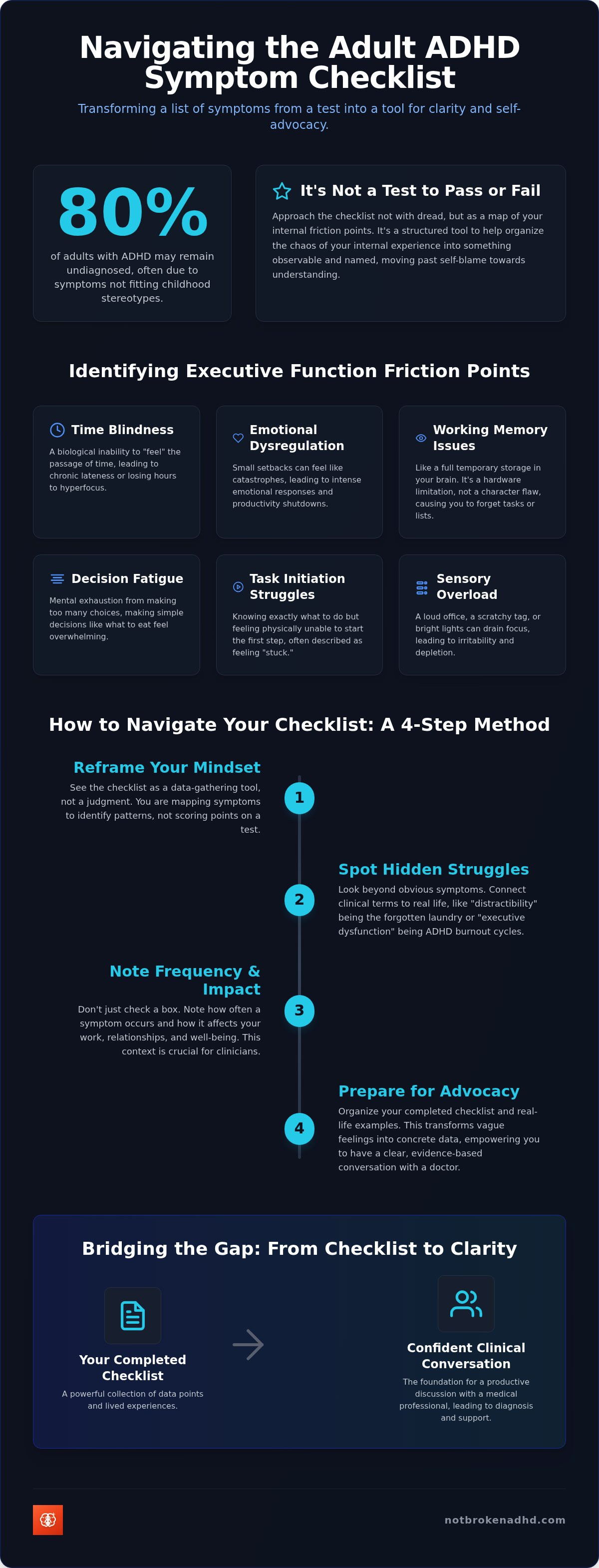
How to Fill Out Your Checklist: A 4-Step Method
Approaching an adult adhd symptom checklist often feels like taking a high-stakes final exam. It isn't. This process is an exploration of your internal landscape, not a test you can fail. Many people get stuck on the "maybe" answers, wondering if their experience is "bad enough" to count. To move past this uncertainty, you need a structured way to reflect on your daily reality. This method helps you turn vague suspicions into a clear, evidence-based map of your executive function.
Step 1: Create a Shame-Free Space
You might feel a spike of anxiety or shame before you even begin. That's normal. Remind yourself that these are functional differences in how your brain processes information, not moral flaws or character deficits. To keep your focus steady and prevent the "checklist paralysis" that comes with big tasks, try using a pomodoro timer for ADHD focus. Work in short, ten or fifteen-minute bursts. Breaking the checklist into small, manageable sections stops your brain from seeing it as one giant, impossible mountain. It allows you to be honest with yourself in a quiet, low-pressure environment.
Step 2: Quantify the Friction
When you work through an adult adhd symptom checklist, frequency is the pulse of the assessment. Frequency is the key differentiator for an ADHD diagnosis because it separates occasional human error from a persistent neurological pattern that impacts almost every day. Don't look for that one time you forgot your wallet three years ago. Instead, look for patterns in your current week. Distinguish between a simple "I forget things" and "My forgetfulness regularly costs me money in late fees or causes recurring arguments in my relationships." This distinction helps you move from general frustration to identifying specific points of friction.
The third step is identifying the specific impact. How much energy are you spending just to "mask" these symptoms and appear productive? Finally, gather concrete evidence from your past seven days to support your answers. Did you lose your train of thought during three different meetings yesterday? Did you leave the laundry in the washer for the second time this week? These recent examples are far more useful than general statements when you eventually speak to a professional. If you are ready to move from "maybe" to clarity, start with our ADHD Self-Check Tool to begin mapping your journey with confidence.
From Checklist to Clarity: Your Next Steps
Once you have finished your adult adhd symptom checklist, you hold a personalized map of your internal friction points. This isn't just a list of problems. It is the raw data you need to build a customized "Field Guide" for your life. Instead of fighting against your nature, you can start designing environments that support your specific brain. This transition is powerful. It moves you from the exhausting question of "What is wrong with me?" to the practical strategy of "How do I work with my brain?"
Education is the most effective tool for dismantling the myth of laziness. When you understand that task initiation is a neurological hurdle, the shame starts to lift. You aren't lazy. You are navigating a brain with a different dopaminergic reward system. This clarity allows you to stop punishing yourself and start providing yourself with the right scaffolding. It's about finding the path of least resistance for your unique executive function style.
Building Your Support System
Support takes many forms. For some, it involves exploring pharmaceutical options to help regulate focus and impulsivity. You can use ADHD Medication Guides to understand these options and prepare for a productive clinical conversation. Beyond medical support, help your loved ones understand your reality. Simulations of the neurodivergent brain can bridge the gap in understanding, showing family and friends that your struggles aren't a choice. Finally, find a neuro-affirming community. Being around others who share your frequency reduces the isolation that often follows a late diagnosis.
Actionable Tools for Daily Success
You don't have to wait for a formal clinical journey to find relief. Digital guides and executive function hacks can provide immediate support for your daily routine. Try implementing simple changes like body doubling for difficult tasks or using visual timers to manage time blindness. These small adjustments reduce the mental load you carry every day. They turn overwhelming mountains into manageable hills.
As you move forward, keep your adult adhd symptom checklist as a reference point for your growth. It's a reminder of how far you've come in understanding your internal world. You are not broken. You are simply navigating a different terrain than the one society was built for. With the right tools and a bit of self-compassion, you can move through that terrain with confidence and ease. Your clarity is the first step toward a life built on your own terms.
Mapping Your Path to Clarity
You now have the framework to view your internal struggles through a lens of biology rather than character. By identifying your specific friction points, you can move from a state of chronic shame toward practical, neuro-affirming strategies. Remember that an adult adhd symptom checklist is your opening act. It is the data you need to bridge the gap between feeling "broken" and understanding your unique executive function. This clarity is what allows you to speak with medical professionals with confidence and authority.
You don't have to navigate this journey alone or with confusing, clinical jargon. Join the thousands of neurodivergent adults using our evidence-based executive function guides and compassionate resources to reclaim their focus. Start your journey to clarity with our interactive ADHD Self-Check Tool. You are simply navigating a different terrain, and with the right tools, you can find a rhythm that finally feels like home. Your journey toward self-understanding is just beginning, and you deserve a path that respects your dignity.
Frequently Asked Questions
Is an adult ADHD symptom checklist the same as a diagnosis?
No, an adult adhd symptom checklist is a screening tool rather than a formal diagnosis. It helps you identify patterns and "friction points" in your daily life. A clinical diagnosis requires a thorough evaluation by a medical professional who reviews your history and rules out other conditions. Think of the checklist as the foundational data you need to start a productive conversation with your doctor about your executive function.
What if I check all the boxes but my doctor says I don’t have ADHD?
Clinical assessments require evidence that symptoms were present before age 12 and significantly impact multiple areas of your life. If you feel dismissed, you can use your adult adhd symptom checklist results to provide more concrete examples. Bringing a filled-out Medication Guide or a log of specific "failures" can help bridge the communication gap. It's about presenting your experience as a pattern of neurological friction rather than isolated incidents.
Can I use this checklist for my boss to get work accommodations?
A checklist alone is rarely enough for formal legal accommodations in most workplaces. Most HR departments require a signed letter from a medical professional. However, your self-check is excellent for identifying personal "hacks." You might discover that you need a pomodoro timer to manage task initiation or simulations to explain your workflow to your team. Use the data to request specific, informal support that helps you work with your brain.
How is adult ADHD different from being "just a little bit distracted"?
The difference lies in frequency and the level of disruption to your life. Everyone experiences occasional distraction or forgetfulness when they are tired or stressed. For neurodivergent adults, these struggles are a constant, baseline experience that interferes with work, relationships, and self-esteem. It isn't a lack of effort; it's a functional difference in how your brain manages focus and information. It's the difference between a one-off error and a persistent hurdle.
Should I fill out the checklist based on how I am on medication or off?
You should generally reflect on your baseline state without the influence of medication. This approach helps you see the full scope of your executive function challenges. If you are already taking medication, try to remember how you functioned before starting treatment or how you feel on "off" days. Understanding your unmasked symptoms allows you to choose the most effective management tools and educational guides for your specific neurological terrain.
Why do I feel like I am "faking it" even when I have all the symptoms?
This feeling is often called imposter syndrome. It's common among adults who have spent years "masking" their symptoms to appear productive or organized. You might feel like you are just lazy or making excuses because you've internalized those labels for so long. Validating your experience through a structured checklist helps dismantle this shame. It proves that your struggles are observable, documented patterns shared by millions of other neurodivergent individuals.
Can a checklist help me understand executive dysfunction?
Yes, a checklist translates vague frustrations into specific executive function categories. Instead of feeling generally "scattered," you might realize you specifically struggle with task initiation or working memory. This shift in perspective is vital for self-advocacy. When you name the friction point, you can find the right tool to fix it. Our executive function educational content is designed to help you move from confusion to a practical management strategy.
Where can I find a reliable ADHD self-check tool online?
You can find a reliable, interactive ADHD Self-Check Tool at The ADHD Field Guide. We provide jargon-free resources designed specifically for the adult experience. Our platform focuses on practical utility, offering downloadable guides and simulations that help you understand your brain's unique wiring. While we don't offer clinical diagnosis, our tools are the perfect first step for anyone looking to transform their internal chaos into a clear map for growth.


