

ADHD does not suddenly appear out of nowhere in adulthood; your coping mechanisms simply ran out of runway. If you find yourself wondering, can you develop ADHD later in life, you are likely wrestling with a disorienting shift. Everyday responsibilities that once felt manageable are now slipping through the cracks, leaving behind missed deadlines, mental exhaustion, and an uncharacteristic layer of shame.
It makes complete sense why you feel blindsided. You didn't suddenly become careless or broken. When life's complexity multiplies, masked neurodivergence often surfaces for the first time, making lifelong internal friction look like an overnight decline. You deserve clear, science-backed answers without confusing medical jargon or contradictory internet theories.
In this guide, you will discover what clinical research actually says about adult-onset struggles, why symptoms frequently remain invisible for decades, and how to tell the difference between late-recognized ADHD and look-alike conditions. Along the way, we'll provide a grounded, shame-free roadmap to help you make sense of your cognitive patterns and confidently prepare for a professional evaluation.
Key Takeaways
- While you may wonder if you can develop ADHD later in life, clinical research confirms it is a lifelong neurodevelopmental difference that surfaces when adult demands outpace your existing coping systems.
- Discover how childhood structures, external support, and internal masking tactics like perfectionism kept executive function struggles hidden for decades.
- Learn to differentiate between late-recognized neurodivergence and cognitive look-alikes, such as nervous system dysregulation, chronic stress, and burnout.
- Identify the core executive function challenges beyond simple focus issues, including time blindness, working memory lapses, and task paralysis.
- Gain a practical, shame-free roadmap to document your daily functional struggles and prepare effectively for a licensed professional evaluation.
Can You Develop ADHD Later in Life? The Medical Reality Explained
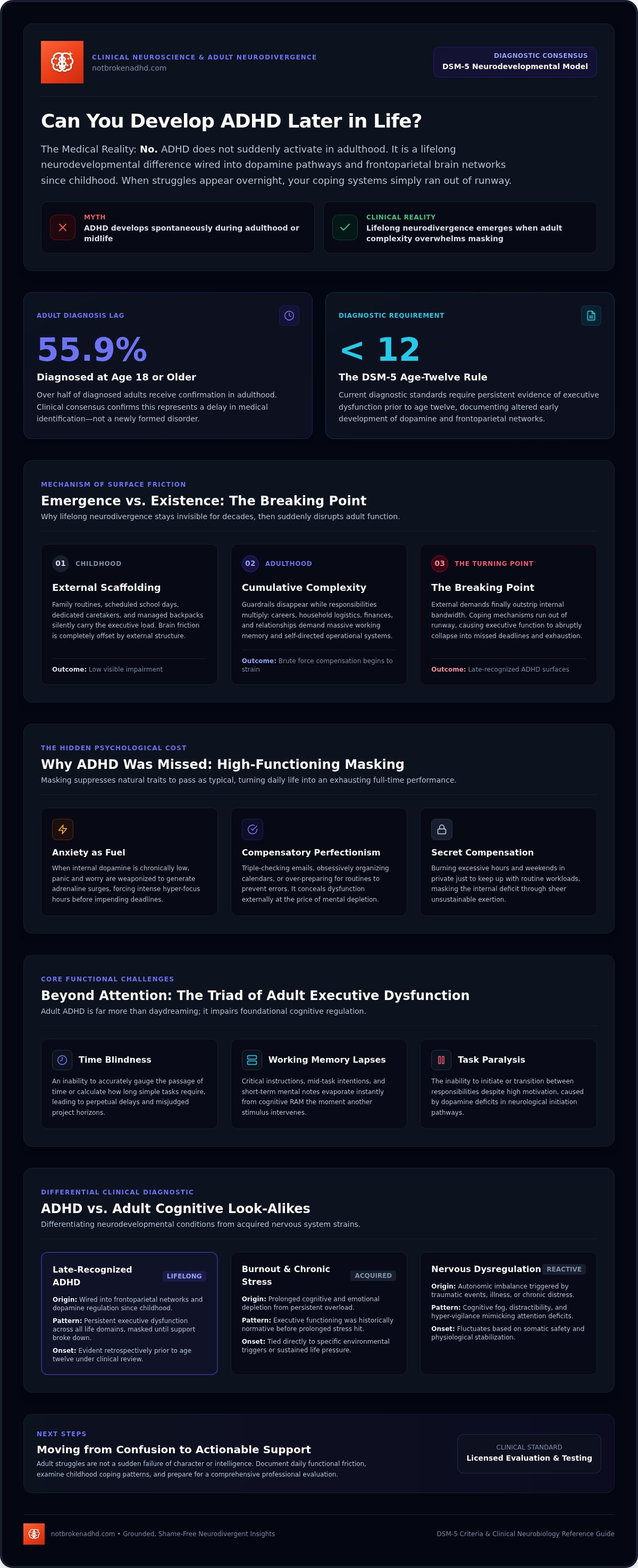
No, you cannot spontaneously develop ADHD later in life. ADHD is a lifelong neurodevelopmental condition wired into the brain from childhood. When symptoms appear to emerge suddenly in adulthood, it is almost always late-recognized ADHD surfacing after adult responsibilities overwhelm your lifelong coping strategies.
The medical consensus remains clear: attention deficit hyperactivity disorder does not activate out of nowhere during midlife. Over 55.9% of diagnosed adults receive their diagnosis at age 18 or older, but that delay represents a lag in identification, not a newly formed disorder. Distinguishing between late-onset symptoms and late-diagnosed neurodivergence is essential. Your underlying neurobiology was always distinct. What changed is the degree of environmental friction pushing against your cognitive bandwidth.
The DSM-5 Diagnostic Criteria and the Age-Twelve Rule
Current diagnostic standards for Adult attention deficit hyperactivity disorder require persistent evidence of executive dysfunction before age twelve. Clinicians look for this childhood footprint because ADHD alters foundational dopamine pathways and frontoparietal networks during early brain development.
Confirming those early traits can be challenging. Adults rarely have crisp memories of elementary school organization, and decades-old report cards are seldom available. Quiet, inattentive struggles often went unnoticed by teachers, leaving adults to rely on hazy retrospective self-reporting. While a few psychiatric studies explore whether a rare, true late-onset phenotype exists, most researchers find that apparent adult-onset cases trace back to childhood signs that were simply overlooked or dismissed as daydreaming.
Emergence vs. Existence: Why Symptoms Surface in Adulthood
There is a massive divide between when a neurological trait begins and when it causes visible impairment. You didn't suddenly acquire a deficit; you simply ran into the limits of brute force.
- Childhood scaffolding: External structures like family routines, scheduled school days, and dedicated caretakers quietly carry much of the executive load for young brains.
- Cumulative complexity: Adulthood strips away that structure while multiplying responsibilities. Managing careers, finances, domestic labor, and emotional relationships requires massive working memory.
- The breaking point: When external demands finally outstrip internal coping capacity, executive function collapses.
If you find yourself asking, can you develop ADHD later in life, understand that your struggles aren't a sudden decline in intellect or character. They simply mark the point where increased life complexity shatters your lifelong compensatory strategies.
Why Adult ADHD Was Missed in Childhood: Masking and Scaffolding
Many people who wonder if you can develop ADHD later in life look back at childhood and see good grades, tidy bedrooms, or an absence of detention slips. That picture often creates self-doubt. In reality, external structure and personal overcompensation frequently hide early executive dysfunction in plain sight.
Parents often provide invisible scaffolding. They manage morning wake-ups, pack backpacks, organize study schedules, and smooth over forgotten assignments. Combine that structured environment with high intellect, and early struggles remain completely concealed. The cracks only begin to show during major transitions. Moving out, navigating college without guardrails, stepping into parenthood, or managing a high-stakes career suddenly demands an independent operational system that was never built.
The Hidden Cost of High-Functioning Masking
Masking is an effortful, unconscious strategy where someone suppresses their natural traits to pass as typical. It turns everyday living into a full-time performance. Rather than functioning smoothly, masked individuals burn incredible amounts of energy compensating behind closed doors.
- Anxiety as fuel: When internal dopamine is low, chronic worry often steps in to trigger adrenaline, forcing focus just hours before a deadline.
- Perfectionism: Triple-checking emails, obsessing over schedules, or over-preparing for meetings prevents mistakes, but produces profound mental exhaustion.
- Secret compensation: Spending five hours on a task that takes peers one hour, hiding the extra labor out of shame.
Relying on panic to get things done is unsustainable. Eventually, that adrenaline-driven system collapses into severe executive burnout, creating a sudden inability to keep up that feels like an overnight cognitive decline.
The Inattentive Presentation and Gender Gaps
Traditional diagnostic models were built around hyperactive young boys who disrupted classrooms. Children with predominantly inattentive presentations, particularly girls, manifest restlessness internally rather than through physical disruption. As detailed in clinical reviews of Adult ADHD symptoms, these struggles show up as mind wandering, sensory overwhelm, and internal rumination.
Because these children don't cause trouble, teachers often label them as quiet, sensitive, or daydreams. Later in life, significant hormonal shifts during puberty, pregnancy, and perimenopause reduce estrogen, which directly influences dopamine availability. This drop strips away remaining cognitive reserves, bringing dormant neurodivergent traits to the surface.
If you are re-examining your past through this lens, using an interactive self-check tool can help you organize childhood patterns and clarify whether your current friction traces back to unmasked traits.
ADHD Look-Alikes: Conditions That Mimic Late-Onset Attention Issues
When focus unravels in adulthood, it is easy to assume your neurobiology changed overnight. If you are asking whether you can develop ADHD later in life, ruling out physical and psychological mimics is an essential first step. Several medical conditions disrupt the prefrontal cortex in ways that look identical to executive dysfunction.
| Condition | Onset Pattern | Key Distinguishing Indicator |
|---|---|---|
| ADHD | Lifelong, pervasive | Persistent history of executive friction; does not resolve with rest. |
| Burnout | Gradual, situational | Tied to prolonged chronic stress; improves after extended recovery. |
| Perimenopause | Midlife transition | Triggered by shifting estrogen; often accompanied by vasomotor symptoms. |
| Sleep Apnea | Any adult age | Severe morning brain fog and oxygen deprivation regardless of hours slept. |
Chronic Burnout vs. Lifelong Executive Dysfunction
Chronic career burnout mimics inattention, task paralysis, and working memory failure. Under continuous survival stress, your brain deprioritizes higher-order planning to manage immediate threats. The crucial difference lies in reversibility. Burnout symptoms lift when demands decrease and the nervous system recalibrates. ADHD symptoms persist across environments, regardless of how restful your vacation was. Insights from the Mayo Clinic on adult ADHD highlight how persistent, pervasive traits differentiate lifelong neurodivergence from temporary cognitive fatigue.
Endocrine Shifts and Systemic Physical Causes
Physical health deeply influences cognitive processing. Estrogen directly supports dopamine synthesis; when levels plunge during perimenopause, many women experience a sudden onset of mental friction. Similarly, low testosterone can sap executive drive. Physical ailments create identical hurdles:
- Sleep disruptions: Obstructive sleep apnea deprives the brain of restorative slow-wave sleep, causing severe daytime inattention.
- Post-viral effects: Long COVID and chronic fatigue disrupt neural connectivity, generating profound mental fog.
- Nutrient deficiencies: Low ferritin, vitamin B12 deficiencies, and thyroid dysfunction directly impair focus and stamina.
Before concluding that you can develop ADHD later in life, schedule a full checkup with your primary care provider. Comprehensive blood panels and sleep screenings ensure you address physical drivers before pursuing an assessment for neurodivergence.
How to Tell if Your Adult Struggles Point to ADHD
Figuring out whether your cognitive friction points to underlying neurodivergence requires looking beyond simple restlessness. While you cannot develop ADHD later in life as a brand-new medical condition, lifelong traits often stay concealed until adult systems fail. Determining whether your daily challenges stem from an atypical nervous system means assessing several core domains of executive function.
The Core Markers of Adult Executive Dysfunction
Adult ADHD rarely looks like bouncing off walls. Instead, it shows up as internal turbulence and dysregulation across everyday routines.
- Working memory lapses: Walking into a kitchen and completely forgetting why you are there, misplacing essentials like keys and phones daily, or losing track of your thoughts mid-sentence during crucial meetings.
- Task initiation friction: Staring directly at an urgent, five-minute task while feeling completely paralyzed and unable to force your body to begin.
- Time blindness: Treating time as either "now" or "not now," underestimating project lengths, and struggling to gauge the passing hours.
- Emotional dysregulation: Experiencing intense, physical waves of rejection sensitivity when receiving constructive workplace criticism, often needing hours to recover your equilibrium.
These disruptions aren't personality flaws. They are observable differences in how your brain processes dopamine and coordinates self-regulation.
Uncovering Your Childhood Footprints
Because diagnosis hinges on childhood presence, digging into your early history is essential. Old school records often hold significant clues. Look for repeated teacher remarks such as "bright but disorganized," "talks excessively," "fails to work up to potential," or "constantly daydreams."
Adolescent patterns provide equally strong evidence. Think back to whether you had chronically messy lockers, erratic homework completion, impulsive spending sprees, or deep hyperfixations that crowded out sleep. You can also ask family members targeted, neutral questions: Did you struggle to get ready on time? Did you need repeated reminders to brush your teeth or finish chores? Did your bedroom consistently look like a disaster zone?
Sorting through decades of memories can feel overwhelming. Interactive resources like this ADHD Self-Check Tool Online: Finding Clarity and Your Next Steps give you an organized framework to record these functional patterns. When you are ready to explore your history and catalog your daily friction points, try the free self-check tool to organize your personal experiences before speaking with a clinician.
Next Steps: Moving from Confusion to Actionable Support
Realizing that you didn't suddenly develop ADHD later in life, but may have carried it for decades, can bring a profound mix of relief and grief. Moving forward requires practical action rather than self-blame. A formal medical assessment provides diagnostic clarity, but you do not need to pause your life while waiting for an evaluation.
You can regain agency today by approaching the diagnostic process with clear data and setting up low-friction organizational habits immediately.
Preparing for a Comprehensive Clinical Evaluation
Clinical evaluations for adult ADHD typically involve structured clinical interviews, standardized symptom rating scales, and a review of personal history. Navigating this process effectively requires preparation. Here is a four-step roadmap to guide you:
- Document functional friction: Keep a two-week log of real-life incidents rather than abstract feelings. Write down specific occurrences, such as "forgot to pay electric bill despite three reminders" or "froze for two hours before starting a simple spreadsheet."
- Gather multi-setting evidence: Diagnostic criteria require impairment across multiple domains. Note how challenges appear at work, in domestic routines, and within personal relationships.
- Screen prospective providers: Adult presentations are often misunderstood. Ask clinicians directly: "What proportion of your practice involves diagnosing adult ADHD?" and "How do you evaluate masked or inattentive presentations?"
- Prepare for emotional waves: Healthcare waitlists can be long, and imposter feelings are common. Remind yourself that seeking an assessment is an act of self-advocacy, not an attempt to make excuses.
Building an ADHD-Friendly Life Before a Formal Diagnosis
Support does not have to wait for an official medical rubber stamp. Non-clinical scaffolding can immediately reduce the daily friction eroding your energy.
- Externalize time: Swap invisible digital countdowns for visual timers or an analog pomodoro timer. Seeing time physically disappear breaks the trance of time blindness.
- Use focus sprints: Lower the barrier to starting hard projects by committing to just ten minutes of low-stakes effort without demanding completion.
- Structure your workspace: Keep essential tools visible on open shelving. If daily items are hidden behind closed closet doors, working memory often forgets they exist.
Transforming your daily habits takes structured, practical guidance. Explore our structured educational guides to support your brain with The ADHD Field Guide, designed to help you dismantle daily overwhelm and build an operating system tailored to your wiring.
Finding Clarity and Reclaiming Your Momentum
Answering whether you can develop ADHD later in life is rarely about uncovering a sudden medical shift; it's about connecting the dots across your entire story. Recognizing that childhood scaffolding and intense masking kept your early friction hidden dismantles the shame of feeling like your cognitive capacity abruptly vanished. Adult demands didn't break your mind. They simply revealed that your old coping strategies reached their natural limit.
Self-understanding is the first step toward building sustainable routines that actually fit your neurology. By grounding educational content in clinical research and lived experience, we create practical downloadable guides focused on real-world executive functioning alongside accessible digital tools built specifically for neurodivergent minds. When you want structured support before or alongside clinical care, explore our ADHD educational resources and self-check tools to begin turning insight into daily momentum. You aren't broken, and you don't have to figure this out alone.
Frequently Asked Questions
Can you suddenly develop ADHD in your 30s, 40s, or 50s?
No, you cannot suddenly develop ADHD later in life. ADHD is a lifelong neurodevelopmental condition present since childhood. What typically happens in your 30s, 40s, or 50s is a sudden shift in demands. Career advancements, family responsibilities, or hormonal transitions overwhelm the masking mechanisms you used for decades. The traits were always there; the environment simply made them impossible to hide.
Can severe trauma, chronic stress, or burnout cause ADHD?
Trauma, stress, and burnout cannot cause ADHD, though they frequently produce look-alike cognitive deficits. Severe chronic stress floods the brain with cortisol, temporarily impairing the prefrontal cortex and reducing working memory. While acute trauma or workplace burnout mimics executive dysfunction, true ADHD requires a lifelong pattern of neurodivergence. A doctor can help determine whether your focus issues stem from situational nervous system overload or masked neurological traits.
Why is ADHD diagnosed so much more frequently in adults today?
Adult diagnoses are rising primarily because clinical criteria now recognize inattentive and masked presentations, especially in women. For decades, clinicians looked exclusively for hyperactive boys disrupting classrooms. Today, greater public awareness, telehealth accessibility, and reduced stigma encourage adults to seek evaluations. Over half of all diagnosed adults received their official diagnosis at age 18 or older after years of compensating silently.
What should I do if my childhood was too chaotic to remember symptoms?
Tell your evaluator honestly that early memories are sparse or clouded by chaos. Skilled clinicians who evaluate adults do not expect spotless childhood records or perfect recollections. Instead, they look for broad themes, such as chronic academic struggles, difficulty maintaining friendships, or sensory overwhelm. You can also review old letters, creative projects, or ask extended family members about early behavioral patterns to help bridge memory gaps.
Is an adult ADHD assessment still worth getting later in life?
Yes, pursuing an evaluation later in life provides immense value regardless of your age. A formal diagnosis replaces decades of internalized shame and self-criticism with neurological clarity. It validates your lived experience, grants access to targeted medical therapies, and helps you seek legal workplace accommodations. Most importantly, it allows you to build sustainable daily routines that work with your brain rather than fighting against it.
How do hormonal changes like menopause affect adult ADHD symptoms?
Hormonal fluctuations significantly amplify ADHD traits because estrogen directly modulates dopamine synthesis in the brain. During perimenopause and menopause, plunging estrogen levels cause a sharp decline in cognitive regulation. Many women who ask whether you can develop ADHD later in life are experiencing this exact hormonal drop, which abruptly unmasks mild, lifelong traits that were previously manageable through strict self-discipline.
What is the difference between adult ADHD and early-onset dementia?
The key difference lies in lifelong history and the nature of memory lapses. ADHD involves retrieval and attention failures; information was never properly encoded due to distraction, but recognition prompts usually bring it back. Early-onset dementia causes progressive, irreversible loss of previously stored information, language skills, and spatial orientation. If cognitive decline appears rapidly without any history of childhood friction, a thorough neurological screening is crucial.


