

What if your chronic career burnout isn't a personal failure, but a biological mismatch? If you spend your workdays masking executive dysfunction, swinging between crushing boredom and sudden hyperfocus, you aren't broken. Searching for the best careers for adhd adults isn't about escaping hard work; it's about finding environments that don't constantly drain your cognitive battery.
You already know the familiar sting of corporate guilt. Repetitive daily tasks feel physically painful, working memory slips trigger quiet panic, and trying to force linear productivity into a non-linear brain leads straight to exhaustion. You need work that offers urgency, autonomy, and novelty without demanding constant, unsustainable self-restraint.
In this guide, you'll discover how to align your daily stimulation needs with sustainable roles that leverage your natural strengths. We'll break down why certain positions trigger debilitating task paralysis while others unlock effortless flow, share a curated list of high-engagement career options, and provide a clear framework to evaluate your executive function capacity before you switch jobs.
Key Takeaways
- Understand how an interest-based nervous system governs sustained workplace focus, explaining why repetitive administration causes paralyzing burnout.
- Discover the best careers for adhd adults mapped to specific cognitive reward profiles and fast-paced environments rather than traditional industry paths.
- Identify the core differences between high-thriving and high-burnout workplaces, including how constant digital pings derail working memory.
- Follow a step-by-step audit process to track your personal hyperfocus triggers and measure executive functioning thresholds before making a job change.
- Set up low-friction workplace scaffolding, from interval focus pacing to visual time-boxing, to manage time blindness without relying on sheer willpower.
Why Traditional Workplaces Drain the Adult ADHD Brain
Most corporate environments are engineered around linear attention, predictable stamina, and low sensory interference. For a neurodivergent nervous system, that architecture is exhausting. If you find yourself hitting a wall by mid-afternoon, the issue isn't a deficit of discipline. It's a severe mismatch between how open offices operate and how your brain handles cognitive fuel. Understanding this friction is the first step toward uncovering the best careers for adhd adults that protect your energy instead of depleting it.
Traditional jobs prioritize steady, administrative compliance over organic bursts of creativity. Open-plan layouts force your sensory filters to work overtime, while repetitive filing and status reports trigger task paralysis. You enter an unsustainable pattern: you hyperfocus to save a project at the eleventh hour, overcommit to prove your value, and crash into heavy fatigue. When you recognize that your struggle stems from structural friction rather than personal laziness, the shame disappears. Aligning your daily work with your neurological wiring isn't a luxury; it preserves your mental health and baseline self-esteem.
The Interest-Based Nervous System at Work
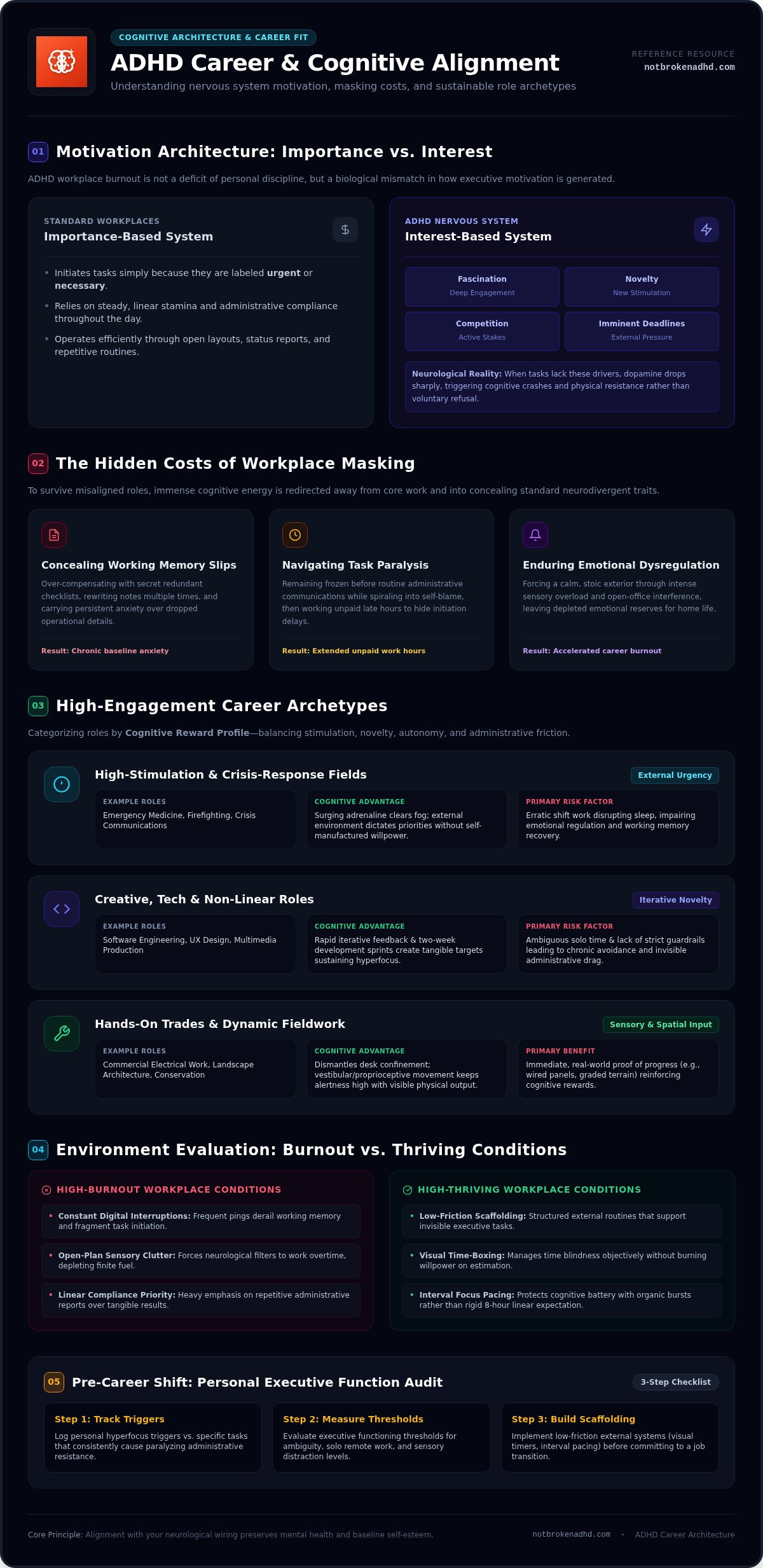
Standard workplace performance relies on an importance-based motivation system. Neurotypical brains can initiate tasks simply because a manager labeled them urgent or necessary. An ADHD brain relies instead on an interest-based nervous system driven by fascination, competition, novel stimulation, and imminent deadlines. When a task lacks these elements, dopamine levels drop sharply. Routine compliance feels physically uncomfortable, causing sudden cognitive crashes where your mental battery simply unplugs.
The Hidden Cost of Workplace Masking
To survive roles that clash with their wiring, many professionals resort to masking, spending enormous energy hiding normal neurodivergent challenges:
- Concealing working memory slips: Over-compensating with secret checklists, rewriting basic notes multiple times, and constantly fearing someone will notice a dropped detail.
- Navigating task paralysis: Sitting frozen before a simple email while spiraling into self-blame, then working unpaid late hours to disguise the delay.
- Enduring emotional dysregulation: Forcing a calm exterior through intense sensory overload, which accelerates full-scale burnout and leaves nothing left for home life.
Identifying the best careers for adhd adults isn't about finding an easy route. It's about securing a work environment where your natural energy patterns are assets rather than liabilities you must hide every day.
The Best Careers for ADHD Adults Across Core Strengths
Conventional career guides sort jobs by industry or salary bands. For a neurodivergent brain, that taxonomy falls short. What matters is the cognitive reward profile: the specific balance of stimulation, novelty, autonomy, and administrative drag. The best careers for adhd adults align daily duties with your innate cognitive strengths, ensuring you aren't wasting finite willpower fighting executive paralysis.
High-Stimulation and Crisis-Response Fields
Emergency medicine, firefighting, and crisis communications provide instant, external stakes. When chaos hits, your adrenaline surges, naturally clearing the cognitive fog that monotonous office meetings induce. Because the external environment dictates priority, you don't have to manufacture motivation from scratch. The primary risk is physiological recovery. Erratic shift work can disrupt sleep, which quickly impairs emotional regulation and working memory.
Creative, Tech, and Non-Linear Roles
Software engineering, UX design, and multimedia production offer rapid, iterative feedback. Two-week development sprints break long projects into tangible targets, creating regular novelty that sustains natural hyperfocus. Yet creative freedom brings hidden operational hazards. Without strict guardrails, ambiguous remote expectations and endless solo time can lead to chronic avoidance. Many professionals lean on structured executive function educational content to create external routines that keep invisible administrative tasks from stalling deep work.
Hands-On Trades and Dynamic Fieldwork
Careers in commercial electrical work, landscape architecture, and conservation dismantle sedentary desk confinement entirely. Physical movement provides constant vestibular and proprioceptive input, keeping your nervous system alert. Every assignment generates visible, real-world results: a wired panel, a graded hillside, or a restored trail. Furthermore, structured apprenticeships offer established, sequential learning that bypasses corporate ambiguity. Reviewing verified occupational profiles via The ADHD Field Guide shows how hands-on trades minimize the unwritten social norms that drain neurodivergent energy.
Choosing among the best careers for adhd adults isn't about eliminating all stress. It's about trading draining administrative friction for dynamic, engaging challenges that your brain is naturally equipped to solve.
Workplace Environments: Comparing Thriving vs. Burnout Conditions
Job titles tell only half the story. The operational culture of a workplace dictates whether an individual excels or collapses. Even within the best careers for adhd adults, a chaotic communication structure or a micromanaging supervisor can trigger severe executive fatigue. Real-time chat apps like Slack or Microsoft Teams constantly derail working memory. Every notification bell shatters focus, forcing you to spend 15 minutes rebuilding your train of thought.
| Workplace Factor | Thriving ADHD Environment | Burnout-Inducing Workplace |
|---|---|---|
| Performance Tracking | Clear outcome-based milestones | Rigid surveillance and performative face-time |
| Communication | Documented, asynchronous workflows | Constant unscheduled interruptions and chat storms |
| Task Pacing | Autonomy over task sequencing | Repetitive, locked schedules with little variation |
| Sensory Load | Quiet zones, hybrid options, low sensory noise | Open-plan layouts and relentless auditory chaos |
Key Elements of an ADHD-Friendly Work Culture
A sustainable workplace provides psychological safety around neurodivergent working styles. When organizations prioritize asynchronous communication, you don't have to keep complex project details juggling in your working memory during impromptu discussions. Transparent metrics evaluate actual output rather than seated hours. In addition, explicit project handoffs eliminate the ambiguity that routinely sparks task initiation paralysis.
High-Risk Workplaces and Roles to Reconsider
Certain professions carry structural barriers that make self-regulation punishingly difficult:
- Audit accounting and billing: High regulatory compliance paired with meticulous, zero-error data verification depletes mental stamina rapidly.
- Assembly-line processing or routine administration: Low-autonomy roles with high repetition starve the interest-based nervous system, frequently causing intense brain fog and low mood.
- Unstructured solo ventures without accountability: Complete isolation without external check-ins leaves individuals vulnerable to chronic task avoidance.
Finding the best careers for adhd adults requires vetting company culture just as heavily as the job description. If you currently feel trapped in a high-friction administrative job, standardizing repetitive tasks with automated templates can help preserve your executive capacity while you map your next move.
How to Assess Your ADHD Career Fit: A Step-by-Step Guide
General personality tests fail neurodivergent professionals because they evaluate interests while ignoring executive functioning capacity. Before jumping into a new field, you need a realistic map of how your attention behaves under pressure. Identifying the best careers for adhd adults requires auditing past performance patterns rather than relying on abstract job descriptions.
- Audit past projects: Make a two-column list of previous work assignments. Note which tasks triggered deep hyperfocus and which caused complete task paralysis.
- Map your sensory tolerances: Record how open spaces, background chatter, fluorescent lights, or prolonged physical stillness impact your afternoon energy.
- Calculate administrative overhead: Estimate the actual percentage of unbillable paperwork, timesheets, and emails required in your target role. If that number exceeds 20%, proceed with caution.
- Run informational interviews: Ask professionals in target positions about their unwritten daily duties. Focus specifically on how they handle interruptions and sudden priority shifts.
Auditing Your Focus and Energy Curves
Spend two working weeks logging your daily focus patterns. Pay close attention to when mental fatigue sets in versus when you enter a state of natural flow. Physical cues are telling indicators. Restless foot tapping, sudden drowsiness at your desk, or compulsive browser tab switching usually signal under-stimulation rather than true biological tiredness. Recognizing these subtle bodily signs helps you pinpoint tasks that starve your interest-based nervous system.
Evaluating Your Executive Function Profile
Every neurodivergent profile carries unique balance points across working memory, task initiation, and impulse control. You might excel at rapid conceptual problem-solving but struggle severely with multi-step administrative follow-through. Exploring an ADHD self-check tool online can provide concrete language to clarify where your functional friction actually lives.
Using structured self-assessments allows you to separate internal cognitive traits from toxic operational environments. When you know your specific baseline, you can pinpoint the best careers for adhd adults that match your daily cognitive bandwidth. If you're ready to evaluate your work profile systematically, explore our downloadable ADHD guides to begin mapping your ideal career shift today.
Sustainable Workplace Scaffolding for ADHD Adults
Standard time management advice often fails neurodivergent professionals because it relies on willpower and working memory. Bound paper planners and complex tracking apps create guilt the moment an entry is missed. Sustainable scaffolding takes the opposite approach. By replacing rigid expectations with adaptive, low-friction tools, you externalize your attention and keep tasks tangible. Visual boards, for example, rescue urgent deliverables from the mental void, ensuring ongoing projects stay in plain sight on your screen or desk.
Tackling Time Blindness and Task Initiation
Time blindness makes work hours feel either endless or entirely gone. Using visual countdowns or a physical Pomodoro timer breaks long afternoons into bite-sized, predictable intervals, significantly lowering the mental resistance needed to start. Rather than facing an intimidating four-hour block, you commit to a single, focused sprint. When projects feel overwhelming, reduce the initial step to an immediate sensory action, such as opening a single document. If an unexpected call derails your morning, lean on a non-punitive reset: step away for five minutes, clear your physical desk, and restart your focus timer without self-blame.
Advocacy and Accommodations Without Stigma
Even in the best careers for adhd adults, sustaining your energy requires protecting your attention through practical workplace boundaries. Under the Americans with Disabilities Act, employers with 15 or more employees must provide reasonable accommodations, but you don't always need to disclose a clinical condition to obtain functional support. Frame your requests around operational clarity and output:
- Written task recaps: Ask for brief recap emails after fast-paced verbal meetings to protect working memory.
- Calendar defense: Block daily two-hour focus windows to silence instant messaging alerts and complete deep work.
- Flexible scheduling: Negotiate core working hours that align with your natural alertness patterns rather than an arbitrary clock.
When you present adjustments as performance enhancements that improve your deliverables, managers welcome them. Pairing the right job match with reliable external scaffolding allows you to build a career that honors your neurological strengths without burning you out.
Aligning Your Next Career Move With Your Brain
Career success with ADHD isn't about white-knuckling through repetitive corporate expectations or forcing yourself into neurotypical molds. Sustainable progress starts by respecting your interest-based nervous system, vetting work cultures for actual psychological safety, and leaning on reliable external scaffolding. Finding the best careers for adhd adults isn't about chasing a magic job title; it's about choosing environments that value your rapid problem-solving while minimizing administrative drag.
When you stop viewing executive function friction as a personal flaw, your path forward becomes clear. You don't have to rely on guesswork or sheer willpower to protect your energy. Explore our ADHD Self-Check Tool and educational guides to gain objective, evidence-based clarity on your unique focus patterns. With practical strategies and work that genuinely fits your cognitive wiring, building an engaging, burnout-free career is completely within your reach.
Frequently Asked Questions
Can people with adult ADHD be successful in high-stress corporate careers?
Yes, adults with ADHD often excel in high-stress corporate roles if the pressure translates into rapid problem-solving rather than administrative micromanagement. Positions in investment banking, crisis public relations, or tech leadership offer intense urgency that stimulates dopamine production. However, long-term success requires offloading linear administrative tasks, delegating scheduling, and establishing firm recovery windows to prevent physical exhaustion from masking.
What are the worst jobs for adults with ADHD?
The worst roles combine low autonomy, repetitive tasks, and strict compliance monitoring. Positions like claims auditing, data entry, assembly manufacturing, and routine bookkeeping starve an interest-based nervous system. The lack of novelty creates chronic cognitive fatigue and paralyzing boredom. Even well-paying corporate positions become unbearable if daily success hinges on meticulous filing rather than strategic, high-leverage execution.
Should I disclose my ADHD diagnosis to my employer or during an interview?
You aren't legally required to disclose a diagnosis during an interview or on the job. In most cases, it's safer to request functional accommodations rather than sharing a medical label. Asking for written project summaries, visual sprint boards, or quiet desk arrangements frames your needs as operational optimizations. Disclose only when formally seeking statutory protections under the Americans with Disabilities Act.
What workplace accommodations can I ask for if I have ADHD?
Under the Americans with Disabilities Act, eligible employees can request reasonable accommodations that support executive functioning. Practical options include noise-canceling headphones, designated quiet focus spaces, written task instructions, and permission to record meetings. You can also negotiate flexible start times or asynchronous project updates. These practical adjustments remove daily sensory friction, making even demanding positions viable among the best careers for adhd adults.
Why do adults with ADHD often switch careers frequently?
Adults with ADHD frequently change paths because an under-stimulated brain runs on novelty and fast learning curves. Once a new job becomes predictable, the initial dopamine surge fades, making routine tasks feel exhausting. What looks like restlessness or lack of commitment is often an involuntary nervous system response to chronic under-stimulation. Moving toward project-based or iterative roles provides continuous novelty without disrupting career stability.
How do I know if career struggles are caused by ADHD or burnout?
ADHD symptoms are lifelong executive functioning differences, whereas burnout is an acute state of physical and emotional depletion. If resting over a long weekend doesn't restore your energy, you're likely facing burnout caused by chronic workplace masking. Distinguishing between the two requires assessing your daily friction points. Objective screening resources and educational frameworks help clarify whether the root problem is neurological fatigue or toxic workplace culture.
Are remote or work-from-home jobs good for ADHD adults?
Remote work offers a mixed environment for neurodivergent professionals. Working from home removes distracting office chatter, long commutes, and fluorescent lights, allowing you to tailor your sensory setup. However, the lack of external accountability can trigger severe isolation and time blindness. Finding the best careers for adhd adults in remote settings requires building structured daily anchors, using visual focus timers, and keeping clear communication boundaries.


